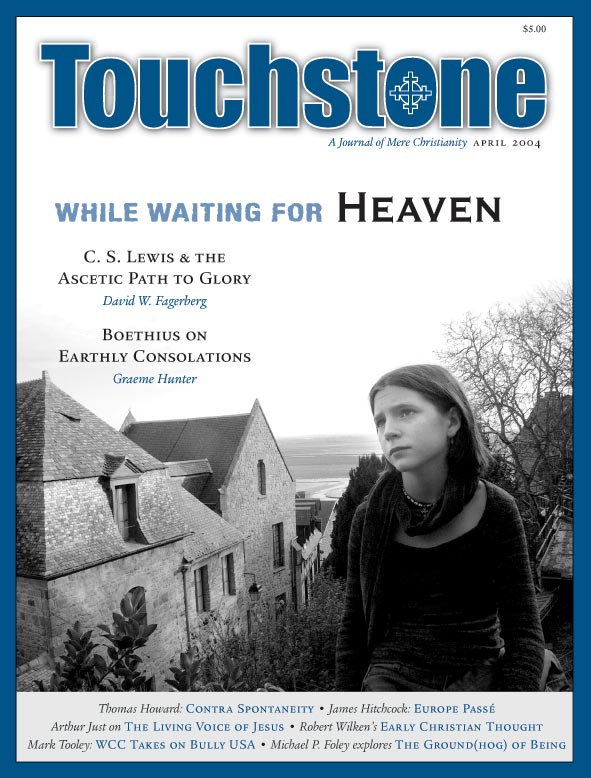
Between Heaven & Earth by David W. Fagerberg
Between Heaven & Earth
C. S. Lewis on Asceticism & Holiness
by David W. Fagerberg
Few words have suffered a worse fate than the word asceticism. It
makes us think of someone who is strict, stern, and so excessively and pointlessly
austere that he is unable to appreciate the delights of creation. But asceticism
did once have a positive meaning in the Christian tradition, and I should like
to contribute to the word’s rehabilitation by considering the place of
asceticism in what C. S. Lewis called mere Christianity, for it is my thesis
that the merest of Christians must be ascetic. The ascetical life may have been
perfected in the sands of the monastic desert, but it is born in the waters
of the baptismal font, and a Christian without asceticism is like a pancake
without flour.
Lewis rarely wrote about asceticism explicitly, but his acute observations
of human nature and the patristic and medieval theology he studied were expressed
in themes and insights I would categorize as ascetical.1 I might, then,
contribute to redeeming the concept of asceticism by uncovering these themes
in his fiction and nonfiction, with the aid of quotes from other writers, ancient
and modern. I will begin with a definition of asceticism, then consider the
role of time in the process, and conclude with Lewis’s images of creation’s
transfiguration. (This will assume some familiarity by the reader with Lewis’s
work, especially The Chronicles of Narnia and The Great Divorce.)
Hwin the Ascetic
The word asceticism derives from the Greek words askesis, which means
“practice” or “exercise” (it was particularly applied
to athletes), and askein, which means “to work.” Asceticism
is the exercise, the effort, the labor expended to attain a goal. The goal of
Christian asceticism is what Eastern Christian theology calls “deification”
and Western Christian theology calls “sanctifying grace.” It is
union with God by conformity to God.
The Fathers of the Church repeatedly affirmed that God became man so that man
might be made divine. Of course, this does not mean that man turns into a deity.
Our human nature is not changed into a divine nature, but rather, the life of
Christ is shared so abundantly that through his gifts we “share in the
divine nature” (2 Peter 1:3–4), are taken up into the Trinitarian
relationship of love. Our being conformed to such love is called asceticism.
This conformity is effected by both his grace and our response. Asceticism is
not our half of the work, but God’s grace conforming us and our participation
in that process which itself is caused by grace.
What might this mean? The source of Christian asceticism—the motive
and reason and goal of Christian asceticism—is told by Hwin in The
Horse and His Boy, when the good and humble mare meets Aslan for the first
time. She shakes all over as she trots up to the Lion and says, “Please,
you’re so beautiful. You may eat me if you like. I’d sooner be eaten
by you than fed by anyone else.” Eating is a metaphor we use when we want
to describe a love of a particular sort of intensity. What parent has not tucked
a child into bed, with hugs and kisses, and said, “I love you so much
I could just eat you up”?
The metaphor means that all boundaries between lover and beloved will be overcome.
I propose that in the Christian tradition, whatever prepares us to be loved
by God with this intensity is called asceticism.
Because it is an act of love, Christian asceticism does not originate from
any sort of disgust with this world. Lewis noted that because Nature, and especially
human nature, is fallen, it must be corrected, “but its essence is good;
correction is something quite different from Manichean repudiation or Stoic
superiority.”2 Christian asceticism comes from the willingness
to surrender our appetites that we might be taken up into mystical communion
with the Trinity. We must choose between two alternatives, Augustine declared
in The City of God: “Love of self till God is forgotten, or love
of God till self is forgotten.”3
“Imagine a man in whom the tumult of the flesh goes silent,” Augustine
rhapsodized in The Confessions. “His soul turns quiet and, self-reflecting
no longer, it transcends itself. . . . And imagine [God] speaking.
Himself, and not through the medium of all things. Speaking Himself. So that
we could hear His word, not in the language of the flesh, not through the speech
of an angel, not by way of a rattling cloud or a mysterious parable. But Himself.
The One Whom we love in everything.”4
This desire for the silence in which we hear God is the genesis of asceticism.
Asceticism is the silencing of the tumult of the flesh. It quiets the noise
of worldliness so that we can hear God’s voice.
Misdirected Appetites
Why are we not naturally conformed to God’s love? Our appetites have
been misdirected, leading us to believe that there is a contradiction between
God’s glory and our own happiness, that we cannot submit our lives to
God and still have what we really want. “The ‘original’ sin
is not primarily that man has ‘disobeyed’ God; the sin is that he
ceased to be hungry for God and God alone,” wrote the Orthodox theologian
Alexander Schmemann. “The only real fall of man is his non-eucharistic
life in a non-eucharistic world.”5
In The Silver Chair a young girl named Jill Pole meets Aslan, but
she is as afraid of being eaten as Hwin is eager to be eaten. Aslan stands between
Jill and a stream when she is desperately thirsty, and she tries to exact a
promise from the great Lion who has invited her to drink. “Will you promise
not to—do anything to me, if I do come?” said Jill. (We each of
us hope that we can receive God on our own terms, and that he will not do anything
too radical to us.) “I make no promise,” replies the Lion. Jill
is (unlike Hwin) afraid she will lose her autonomy.
Lewis confesses to understanding this fear. He remarked in The Problem
of Pain that “the joys of Heaven are, for most of us in our present
condition, ‘an acquired taste.’”6 And in “A
Slip of the Tongue,” he admitted that his “endlessly recurrent temptation”
is “to go down to that Sea . . . and there neither dive
nor swim nor float, but only dabble and splash, careful not to get out of my
depth and holding onto the lifeline which connects me with my things temporal.”7
We must risk what Aslan will do to us. Humility is thus the animating power
of asceticism. Asceticism, in the words of the Orthodox writer Paul Evdokimov,
“undoes the act by which Adam ceased to be fully himself, in wishing to
belong only to himself and in refusing to go beyond himself in God.”8
Just as our appetites have been misdirected, so they have been enchanted,
and the ascetical task consists of breaking this enchantment to heal our appetites.
When, in The Lion, the Witch and the Wardrobe, the White Witch wishes
to seduce Edmund into betraying his siblings, she gives him enchanted Turkish
Delight, and only later does he learn two facts about enchanted food. First,
“anyone who had once tasted it would want more and more of it, and would
even, if they were allowed, go on eating it till they had killed themselves.”
(That is why, in a headstrong impulse of grace, God expelled our father and
mother from the Garden of Eden. He wanted to save their lives.) Second, nothing
“spoils the taste of good ordinary food half so much as the memory of
bad magic food.”
Because our appetites are corrupted (misdirected and enchanted both), we are
not hungry for that which is good, or good for us. So we never get filled and,
like Edmund, we go on desiring that which will not fill us. “Control your
appetites before they control you,” advised John Climacus in step 14 of
the Ladder of Divine Ascent.9
The restoration of our sensibilities must begin with the dissolution of our
enchantment. We see this in The Silver Chair. The Lady of the Green
Kirtle nearly succeeds in entrancing her victims by means of a green powder
cast into the fire, whose fumes confuse and bewitch them. Her scheme is foiled
by Puddleglum when he bravely stamped out the fire with his bare foot (filling
the air with the very unenchanting smell of burnt Marshwiggle).
“The pain itself made Puddleglum’s head for a moment perfectly
clear and he knew exactly what he really thought. There is nothing like a good
shock of pain for dissolving certain kinds of magic.” Even if the ascetic
overcoming of our enchantment shocks us, the Russian philosopher Vladimir Solovyof
said, we should clearly understand that “the purpose of Christian asceticism
is not to weaken the flesh, but to strengthen the spirit for the transfiguration
of the flesh.”10
Time for Asceticism
We have been given time for this ascetic strengthening and transfiguration.
The parousia is delayed to allow time for this very task to be completed,
which completion was the purpose of creation. Lewis was firm that ascetic practices
are a means, not an end. In themselves they strengthen the will, and “are
only useful in so far as they enable the will to put its own house (the passions)
in order, as a preparation for offering the whole man to God.”11
“The duty exists for the delight,” Lewis wrote in Reflections
on the Psalms. “When we carry out our ‘religious duties’
we are like people digging channels in a waterless land, in order that when
at last the water comes, it may find them ready. I mean, for the most part.
There are happy moments, even now, when a trickle creeps along the dry beds;
and happy souls to whom this happens often.”12
The abbot of a monastery once told me that “religion is building a road
for God to come to you by.” That God travels that road at all is completely
gratuitous (in the proper sense of given freely, regardless of merit), but we
must prepare for his coming.
God has given us time and space so that we might acquire our taste for eternity
and become what God intends us to be. Now is the time of repentance. Human beings
are homo viator: We are beings left incomplete by the Creator so that
we can cooperate in our own becoming. Anthropos is a verb (a human
being) until he becomes a noun (saint).
Maximus the Confessor counseled, “Seek the reason why God created, for
this is true knowledge.”13 Theologian Dumitru Staniloae explained
why. “If God created all things in order that they might share in his
love, their purpose is to reach full participation in this love. . . .
In the tendency toward complete union with God and toward rest in his fullness,
Maximus saw the meaning of movement and hence of time.”14
Becoming a saint takes time. God has given us time. Indeed, marveled Ephrem
the Syrian, he wearied himself so as to gain us.
For this is the Good One, who could have forced us to please Him,
without any trouble to Himself; but instead He toiled by every means
so that we might act pleasingly to Him of our free will,
that we might depict our beauty
with the colors that our own free will had gathered;
whereas, if He had adorned us, then we would have resembled
a portrait that someone else had painted, adorning it with his own colors.15
We participate in the portrait we will become. We are sketched in the image
of God in charcoal silhouette, but we have been given a hand in selecting the
colors of our likeness to God.
Becoming More Real
Lewis wondered in Mere Christianity, “Is there perhaps no other
way of getting many eternal spirits except by first making natural creatures,
in a universe, and then spiritualizing them?”16 But being spiritualized
does not mean being less real; quite the contrary (as Lewis knew).
In The Last Battle, the last of The Narnia Chronicles, when
Narnia ended as every creature went through the Door of Judgment, it was not
destroyed; rather, it was made new. The whole concept of the New Creation involves
the belief that whatever estrangement there is between spirit and nature will
be healed. We await the day “when Nature and Spirit are fully harmonized—when
Spirit rides Nature so perfectly that the two together make rather a Centaur
than a mounted knight,” as Lewis wrote in Miracles.17
Lewis described the difference between old Narnia and the new, sunlit land by
recalling a childhood experience. Imagine a room, he suggested, with a window
in one wall opening to a sea or green valley and a mirror facing the window
on the opposite wall. After looking at the real thing through the window, you
might turn and catch a glimpse of it in the mirror.
And the sea in the mirror, or the valley in the mirror, were in one sense
just the same as the real ones: yet at the same time they were somehow different—deeper,
more wonderful, more like places in a story: in a story you have never heard
but very much want to know. The difference between the old Narnia and the
new Narnia was like that. The new one was a deeper country: every rock and
flower and blade of grass looked as if it meant more.
Jewel the Unicorn is the first to understand. He declares, “I
have come home at last! This is my real country! . . . The reason
why we loved the old Narnia is that it sometimes looked a little like this.”
In moving from earth to Heaven, and from time to eternity, we move from shadow
to substance. That is why, in The Great Divorce, Lewis described the
ghostly tourists from hell as having a difficult time negotiating the landscape
of heaven. They are warned, “It will hurt at first, until your feet are
hardened. Reality is harsh to the feet of shadows.”18 Temporal
creation is but the shadowland of Eternity.
Human Shadows
Lewis presents asceticism as making us stronger, sturdier, more robust. “Behind
all asceticism,” he wrote in Miracles, “the thought should
be, ‘Who will trust us with the true wealth if we cannot be trusted even
with the wealth that perishes?’ Who will trust me with a spiritual body
if I cannot control even an earthly body?’” Our present bodies,
small and perishable, are as ponies given to schoolboys, and we must learn to
manage them “not that we may some day be free of horses altogether but
that some day we may ride bare-back, confident and rejoicing, those greater
mounts, those winged, shining and world-shaking horses which perhaps even now
expect us with impatience, pawing and snorting in the King’s stables.”19
The ascetical discipline means training our desires for something more potent
than anything we are accustomed to—and better than anything we now like
or even imagine. In his famous sermon “The Weight of Glory,” Lewis
said, “It would seem that our Lord finds our desires, not too strong,
but too weak. We are half-hearted creatures, fooling about with drink and sex
and ambition when infinite joy is offered us, like an ignorant child who wants
to go on making mud pies in a slum because he cannot imagine what is meant by
the offer of a holiday at the sea. We are far too easily pleased.”20
The demon Screwtape knows that it is a lie (no doubt first told by his side)
that asceticism means diluted or minimized pleasure, as though sin affords a
more robust variety of pleasure than virtue. Thus, he cautions Wormwood never
to forget “that when we are dealing with any pleasure in its healthy and
normal and satisfying form, we are, in a sense, on the Enemy’s ground.”
Though the demons have used pleasure as a lure to damn many souls, still
it is His invention, not ours. He made the pleasures: all our research so
far has not enabled us to produce one. All we can do is to encourage the humans
to take the pleasures which our Enemy has produced, at times, or in ways,
or in degrees, which He has forbidden. . . . He is a hedonist
at heart. All those fasts and vigils and stakes and crosses are only a façade.
Or only like foam on the seashore. Out at sea, out in His seas, there is pleasure,
and more pleasure.
God is “vulgar,” Screwtape tells Wormwood with disgust. “He
has a bourgeois mind. He has filled His world full of pleasures. . . .
Everything has to be twisted before it’s any use to us. We fight under
cruel disadvantages.”21
Asceticism is the untwisting of things and our relation to them. It is the
ordo amoris: the right ordering of love.
The Truer Narnia
It is also, and therefore, the discovery of reality—of what we might
call the real reality. In The Last Battle, Prince Tirian has been thrown
through a stable door to die, as enemy soldiers await him inside. He is surprised
to find himself standing in a green meadow with the High King Peter and Queen
Lucy.
“It seems, then,” said Tirian, smiling too, “that the
Stable seen from within and the Stable seen from without are two different
places.”
“Yes,” said the High King Peter. “Its inside is bigger than
its outside.”
“Yes,” said Queen Lucy, “In our world too, a stable once
had something inside it that was bigger than our whole world.”
A little later, Lucy realizes that the garden they are in “is like the
Stable. It is far bigger inside than it was outside.” Of course, replies
Mr. Tumnus, the Faun. “The further up and the further in you go, the bigger
everything gets. The inside is larger than the outside.” She then realizes
that this transfigured creation “is still Narnia, and more real and more
beautiful than the Narnia down below, just as it was more real and
more beautiful than the Narnia outside the Stable door!”
Lewis used the same spatial image in The Great Divorce. George MacDonald
tells the bewildered traveler that though he (the traveler) thought he had approached
heaven by traveling over an infinite abyss, with towering cliffs, he actually
came up through a tiny crack in the ground. “The voyage was not mere locomotion.
That bus, and all you inside it, were increasing in size.” The
traveler wonders whether anyone can make himself small enough to reach the diminished
people inside the crack of hell.
“Only the Greatest of all can make Himself small enough to enter Hell.
For the higher a thing is, the lower it can descend. . . .
Only One has descended into Hell.”
“And will He ever do so again?”
“It was not once long ago that He did it. Time does not work that
way when once ye have left the Earth. All moments that have been or shall
be were, or are, present in the moment of His descending. There is no spirit
in prison to Whom He did not preach.”22
As a thing can be bigger inside than it is outside, so a moment of time can
hold eternity, like the stable held the Eternal One. The inside of time is bigger
than its outside; the kairos of time is bigger than the chronos in which it
is contained. We discover the Kingdom by going further in to find a pathway
further up. Isaac the Syrian said, “The ladder of the Kingdom is within
you, hidden in your soul. Plunge deeply within yourself, away from sin, and
there you will find steps by which you will be able to ascend.”23
Augustine exclaimed, “And look, you were within me and I was outside . . .
You were with me, and I was not with you.”24
It is the human mystery to celebrate the eternal in time. Our soul is a receptacle
that can be capacitated to contain the Eternal One. “Do you realize,”
Gregory of Nyssa asked, “how much your Creator has honored you above all
creatures? . . . All the heavens fit into the palm of God’s
hand. And though He is so great that He can grasp all creation in His palm,
you can wholly embrace Him; He dwells within you, nor is He cramped as he pervades
your entire being.”25 Our inside is bigger than the universe,
and one of our spiritual moments is bigger than all the time that has ever washed
over the inanimate matter in it.
Movement in Time
Just before the traveler in The Great Divorce awakes at the end of
the book, he sees the relationship between the eternal soul and the temporal
person. He sees gigantic, motionless forms looking upon a table with little
figures like chessmen.
And [he] knew that each chessman was the idolum or puppet representative
of some one of the great presences that stood by. And the acts and motions
of each chessman were a moving portrait, a mimicry or pantomime, which delineated
the inmost nature of his giant master. And these chessmen are men and women
as they appear to themselves and to one another in this world. And the silver
table is Time. And those who stand and watch are the immortal souls of those
same men and women.26
Our journey through time is the movement of our souls, either
toward God or away from him. In the tendency toward complete union with God,
Maximus saw the meaning of movement, and hence of time.
We possess a consciousness of this tendency, but we are unclear about what
it is we desire. In our amnesiac state we call it beauty, as if that settled
the matter. But Lewis insists that beauty is not in temporal things,
it only comes through them. As G. K. Chesterton said, “Man
cannot love mortal things. He can only love immortal things for an instant.”27
Each mortal truth, beauty, or goodness is a fleeting instant of an immortal
truth, beauty, or goodness. (“It’s all in Plato, all in Plato,”
exclaims Lord Digory in The Last Battle. “Bless me, what do
they teach them at these schools!”)
Finite beautiful things are only an image of what we truly desire, but they
may do the trick. “They are not the thing itself; they are only the scent
of a flower we have not found, the echo of a tune we have not heard, news from
a country we have never visited,” Lewis said in “The Weight of Glory.”
Do you think I am trying to weave a spell? Perhaps I am; but remember your
fairy tales. Spells are used for breaking enchantments as well as for inducing
them. And you and I have need of the strongest spell that can be found to
wake us from the evil enchantment of worldliness which has been laid upon
us for nearly a hundred years. Almost our whole education has been directed
to silencing this shy, persistent, inner voice; almost all our modern philosophies
have been devised to convince us that the good of man is to be found on this
earth.28
Asceticism is the cost of breaking the enchantment of the immediate. The French
poet Paul Claudel said, “It seems as if the acorn knows its destiny and
carries within itself an active idea of the oak required of it. And in the same
way it seems as if memory and foresight join together in the hearts of Adam’s
sons to deny the immediate the right to prevail.”
Screwtape advises Wormwood to exploit human ambiguity to his advantage. Humans
are amphibians, he explains: half spirit and half animal. “As spirits
they belong to the eternal world, but as animals they inhabit time. This means
that while their spirit can be directed to an eternal object, their bodies,
passions, and imaginations are in continual change, for to be in time means
to change. Their nearest approach to constancy, therefore, is undulation—the
repeated return to a level from which they repeatedly fall back, a series of
troughs and peaks. . . .”29
The devils cannot understand why the Enemy permits this, and even less why the
Enemy relies on the troughs even more than on the peaks. They can only speculate,
incredulously, that
all the talk about His love for men, and His service being perfect freedom,
is not . . . mere propaganda, but an appalling truth. He really
does want to fill the universe with a lot of loathsome little replicas of
Himself—creatures whose life, on its miniature scale, will be qualitatively
like His own, not because He has absorbed them but because their wills freely
conform to His. We want cattle who can finally become food; He wants servants
who can finally become sons. We want to suck in, He wants to give out. We
are empty and would be filled; He is full and flows over.30
The Saints’ Mastery
When God says he loves us so much he could just eat us up, he means something
Screwtape cannot understand and Jill Pole need not have feared. When our hunger
for God meets God’s hunger for us, our being becomes complete.
In Heaven, the traveler of The Great Divorce sees completed people.
“One gets glimpses, even in our country, of that which is ageless—heavy
thought in the face of an infant, and frolic childhood in that of a very old
man. Here it was all like that.”31 This is the face of a saint
who has mastered time. The saint practices the art of iconography on himself.
The icon, in the words of a modern Orthodox writer, “is the Christ, the
God who became a face.” Additionally, the icon is the face of all the
friends of God who are our friends, too, and wish to include us in the circle
of saints.
The Kingdom of God is anticipated, either starting from the beauty of the
world, though this is an ambiguous beauty, or starting from certain faces,
certain old faces, fashioned by a long life, faces which have not been plunged
into resentment or bitterness or the fear of death, faces of those who do
not flinch as they approach death, faces that know precisely where they are,
and have found again the mind of a child.32
The ascetic has patience, which Evdokimov considers a form of “interiorized
monasticism,” because it is the opposite of despondency, which so often
results from a desire for instant gratification. The ascetic trusts time because
he does not live in “merely ordinary time, where death has the last word
and where time erodes . . . but [in] time mingled with eternity,
as it is offered to us by the Resurrection.”33
Lewis thought this transfiguration made the person complete, and that already
these completed people were dotted here and there, all over the earth. “Every
now and then one meets them.” In Mere Christianity, Lewis offered
an intriguing description of these ascetics. “Their very voices and faces
are different from ours; stronger, quieter, happier, more radiant. They begin
where most of us leave off.” The ascetic who is being conformed to holiness
is recognizable, but Lewis thought you must know what to look for, because they
will not be like your general idea of religious people.
They do not draw attention to themselves. You tend to think that you are
being kind to them when they are really being kind to you. They love you more
than other men do but they need you less. They will usually seem to have a
lot of time: you will wonder where it comes from. In that way, to become holy
is rather like joining a secret society. To put it at the very lowest, it
must be great fun.34
Notes:
1. The four references given in Janine Goffar’s The C. S. Lewis Index
(Crossway Books, 1995) are: God in the Dock (Eerdmans, 1970), pp. 149, 195;
Miracles (Macmillan, 1978), p. 163; The Problem of Pain (Macmillan, 1962), p.
112.
2. “Some Thoughts,” God in the Dock, pp. 148–149.
3. XIV.28.
4. IX.10.25; translation from Colm Luibheid’s preface to John Climacus,
The Ladder of Divine Ascent (Paulist Press, 1982), p. xvii.
5. For the Life of the World (St. Vladimir’s Seminary Press, 1963), p.
18.
6. The Problem of Pain (Macmillan, 1962), p. 61.
7. “A Slip of the Tongue,” in Screwtape Proposes a Toast and other
Pieces (New York: Collins Books, 1965), p. 122.
8. The Struggle with God (Paulist Press, 1966), p. 100. Reprinted as Ages of
the Spiritual Life (St. Vladimir’s Press, 1998).
9. The Ladder of Divine Ascent (Paulist Press, 1982) pp. 167–168.
10. A Solovyof Anthology, arranged by S. L. Frank (SCM Press, 1950), pp.
119–120.
11. The Problem of Pain, p. 112.
12. Reflections on the Psalms (Harcourt, Brace & World, 1958), p. 97.
13. Maximus the Confessor, “The Four Hundred Chapters on Love,”
4:5, in Maximus Confessor: Selected Writings (Paulist Press, 1985), p. 76.
14. The Experience of God, vol. II (Holy Cross Orthodox Press, 2000), pp. 17–18.
15. Faith 31:1–7, cited in The Luminous Eye by Sebastian Brock (Cistercian
Publications, 1985), p. 61.
16. Mere Christianity (Macmillan, 1957), p. 144.
17. Miracles, p. 160.
18. The Great Divorce (Macmillan, 1968), p. 42.
19. Miracles, p. 169.
20. “The Weight of Glory” in The Weight of Glory and Other Addresses
(Macmillan, 1949), pp. 3–4.
21. The Screwtape Letters, (Macmillan, 1970), pp. 41, 101–102.
22. The Great Divorce, pp. 123–124.
23. The Ascetical Homilies of Saint Isaac the Syrian (Holy Transfiguration Monastery,
1984), p. 11.
24. The Confessions IX.26 (New American Library, a Mentor Book, 1963), p. 235.
25. From Glory to Glory: Texts from Gregory of Nyssa’s Mystical Writings,
selected by Jean Danielou (St. Vladimir’s Seminary Press, 1979), p. 162.
26. The Great Divorce, pp. 126–127.
27. “Omar and the Sacred Vine,” in Heretics, found in The Collected
Works of Chesterton, vol. I (Ignatius Press, 1986), pp. 92, 95.
28. “The Weight of Glory,” pp. 6–7.
29. The Screwtape Letters, pp. 36–38.
30. Ibid.
31. The Great Divorce, p. 30.
32. Gennadios Limouris, Icons: Windows on Eternity, Theology and Spirituality
in Color (WCC Publications, Faith and Order Paper 147, 1999), p. 119.
33. Olivier Clément, Three Prayers (St Vladimir’s Seminary Press,
2000), p. 79.
34. Mere Christianity, pp. 172–173.
He gave an early version of “Between Heaven & Earth” at the
C. S. Lewis Summer Institute in 2002.
David W. Fagerberg is Associate Professor in the Department of Theology of the University of Notre Dame and the author of The Size of Chesterton?s Catholicism (Notre Dame). |