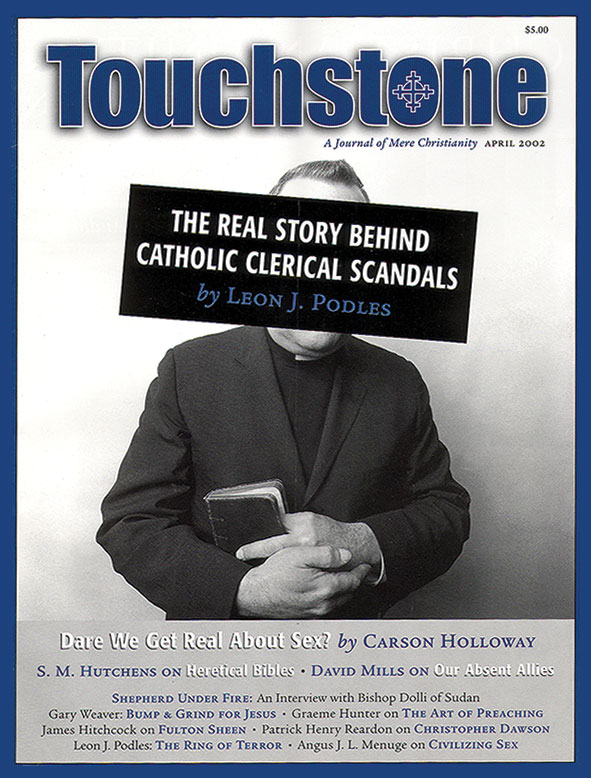
Catholic Scandals by Leon J. Podles
Catholic Scandals: A Crisis for Celibacy?
The Real Story Behind Clerical “Pedophilia” & What It Means
for Clerical Celibacy
by Leon J. Podles
The Catholic Church has been the object of much unwanted attention, some of
which it has brought upon itself. Dozens of cases involving clerical “pedophilia”
have been tried in the courts, several priests have gone to jail, and various
dioceses have had to pay out tens or perhaps even hundreds of millions of dollars
(the exact sums are often in sealed settlements) to the victims.
There have been some high-profile cases: Bishop Symons of Palm Beach resigned
after he admitted his sins with teenage boys. The archbishop of Vienna, Cardinal
Groer, was forced to resign after several seminarians complained that he had
molested them. The diocese of Dallas had to pay out $23.5 million in a case
involving Rudolph Kos. The bishop of Bayeaux is being prosecuted for not reporting
to the police child molestation by one of his priests. And most recently a media
storm has raged around the archdiocese of Boston since it became public that
a pedophile priest, John Geoghan, was transferred from parish to parish in the
1980s, with the knowledge of the archbishop, Cardinal Law.
In view of this, a long-suffering public often wonders whether the Church
would not be better off with a married clergy. Of course, the Latin tradition
of clerical celibacy has been under attack for a long time for various reasons
(celibacy is never exactly what one would call popular), and the latest scandals
have only served to make the question more pressing in the minds of many Catholics.
True Pedophilia Is Rare
Philip Jenkins in his book Pedophiles and Priests: Anatomy of a Contemporary
Crisis (Oxford University Press, 1996) tries to look at the problem objectively
and dispassionately. According to Jenkins (who is not a Catholic), true pedophilia
is extremely rare, is perhaps more common among Protestant clergy than among
Catholic priests, and is even more common among married laymen. There is certainly
a problem in the Catholic Church (and other churches), but it is not exactly
what the media make it out to be.
First, as to the nature of clerical misbehavior: Pedophilia refers
to sexual desire for pre-pubescent children. This is extremely rare,
and only a handful of cases in several decades have involved priests who are
true pedophiles.
Almost all the cases reported in the media as pedophilia actually involve
an attraction (which a priest has acted on) to adolescent boys who are sexually
mature but under the age of consent, which is 18 in civil law and 16 in canon
law. This behavior is a variety of homosexuality. Homosexuals are often
attracted to very young men because they combine the charm of boyishness with
sexual maturity. Such sexual attraction is called ephebophilia, which
the ancient Greeks cultivated to some extent but which rapidly fell out of favor
as Christianity transformed classical culture.
In the 1960s and 1970s the Catholic Church followed secular psychological advice
that sexual involvement with minors should be dealt with quietly and privately,
that the youth involved were more likely to be hurt by a public fuss than by
the sexual involvement, and that sexual interest in minors could be disciplined
and cured.
This opinion changed in the mid-1980s, when many of the cases that had occurred
from the mid-1960s onward came to light. In this period of about 20 years, about
150,000 men had served as Catholic priests and religious in the United States.
There were about 500 reported (not all proved) cases of sexual involvement with
minors, thus involving 0.3 percent of the clergy and religious, and most of
the cases involved fifteen- to seventeen-year-old boys. Since not all allegations
were substantiated, Jenkins says the evidence “suggests an offence rate
of 0.2 percent.” The archdiocese of Chicago did a survey of all its clergy
files from the years 1951–1991, and found allegations against 2.6 percent
of priests, allegations that may have been justified against 1.7 percent of
them. Moreover, it found only one true case of pedophilia, which involved
a priest and his small niece.
True pedophilia occurs most often within families; celibacy removes most Catholic
priests from temptations of that sort. When it comes to pedophilia (not ephebophilia),
clergy in churches that do not require celibacy have the same (if not worse)
problems. The Catholic Church has been a target because it keeps good records,
but the Episcopal Church has a comparable problem, and some of the worst cases
have been in fundamentalist and Pentecostal churches—but these cases rarely
receive public attention.
Jenkins also shows how the “pedophilia” cases in the Catholic Church
(and the bungling way church authorities sometimes handled them) have been used
by would-be church reformers as a tool to further their agenda: the end of clerical
celibacy (and much else) in the Catholic Church.
Ultimately, the chief beneficiaries of this misinformation and the disorder
in the Catholic Church are the secularizers who want to undermine the moral
authority of religion in society. The Nazis also were great exposers of clerical
scandals, and it was not because of the greater National Socialist purity of
heart (both Philip Jenkins in his book and Victor Klemperer in I Will Bear
Witness refer to this anti-clerical campaign).
Homosexuality Is the Problem
Second, and most important, Jenkins’s analysis indicates that the true
nature of the problem in the Catholic Church is not pedophilia, but homosexuality,
which can lead to sexual relations with sexually mature but underage boys.
Neither the media nor the Church have made it clear to the public that most
of the abuse cases involve teenage boys, for this would focus the issue on the
problems of homosexuality, a topic that is not politically correct. By not making
this clear, the media has given the impression that the Catholic Church attracts
sick priests who like little children, as opposed to homosexuals who like teenage
boys (not a good thing, but not as disgusting as pedophilia).
No one knows what percentage of clerics is homosexual, partially because it
is not easy to define a homosexual, a modern category that contains
many hidden, dubious assumptions. Is a homosexual a man who has ever felt the
slightest sexual attraction to another male, or a man whose desires are largely
directed to other men, or a man whose desires are exclusively directed to other
men, or a man who acts on these desires, or a man who structures his personality
around these desires?
Certainly an occasional homosexual desire does not make a man homosexual any
more than an attraction to his secretary makes a heterosexual married man an
adulterer. Temptations are often given to test the soul. What most people mean
by a homosexual is a man who acts on a sexual desire for a man or whose personality
is structured around that desire.
What percentage of clerics are, in fact, homosexuals in any of these senses?
Donald Cozzens, the rector of the Cleveland Roman Catholic seminary, in The
Changing Face of the Priesthood, quotes figures from 23 percent to 80 percent.
He suspects that the priesthood has become or is rapidly becoming a gay profession,
one in which heterosexuals are increasingly uncomfortable.
From my own experiences with clerical homosexuals, I suspect that the figure
is well under 20 percent, although this is still 7 to 8 times the occurrence
in the general population. The Vatican’s request for better screening
has been ignored like everything else the Vatican says. Indeed, the guidelines
put out by the American bishops clearly envision the possibility of accepting
“gay” candidates if they agree to be celibate.
In the 1960s, I thought I might have a vocation, and I applied to a seminary
program. Other applicants and I went through a psychological evaluation that
may have been aimed at weeding out general nut cases and homosexuals. It failed
on both accounts. In retrospect I would guess that a quarter of the people in
the program were homosexuals or effeminate. My roommate was a homosexual, and
when he approached me, I left the seminary within hours.
I reported this incident to the authorities. The first words of the rector
were symptomatic: “Why me? Why me?” He didn’t like the problem
(who would?), but his focus was on avoiding problems for himself. I was astonished
when the offender was allowed to continue. He was only asked to leave years
later when he spent all his free time in gay bars. Perhaps the rector did not
report the offender to other authorities (like Evelyn Waugh’s schoolmaster,
who was handed on from one school to another to get rid of him). The offender
continued to offend, and eventually he died of AIDS. Friends I know who had
been in other seminaries reported similar behavior—and a similar lack
of response by the authorities.
One seminary, known internationally as the Pink Palace, hosted a lecture by
a famous scholar. I attended, but learned much more from the conversation around
me than from the lecture. One cleric inquired of a professor at the seminary
about a Celtic Spirituality course; the professor responded that unfortunately
the course was no longer available. The priest who taught Celtic Spirituality
had been sleeping with the seminary students and flaunting it. The flaunting
was the offense, and the offender was sent to rural Pennsylvania to rusticate.
The seminary was apparently as pink as it was painted. In the same diocese,
a diocesan priest and chancery official was a columnist for the Washington
Gay Blade. He showed up at a city council hearing to offer support to those
testifying for a gay rights bill.
A Bad Effect
Third, apart from the legal troubles and bad publicity, what effect does the
presence of homosexual clergy have on the Church? Cozzens claims that the presence
of homosexuals in the seminary and priesthood tends to discourage heterosexual
candidates. Celibacy is hard enough, but to be put in a situation in which being
celibate is (with some reason) equated with being homosexual makes it even harder.
Homosexual priests also have an interest in distorting church teaching. The
year before Bishop Symons of Palm Beach was deposed after he admitted contact
with teenage boys, his diocese, with his approval, hosted a retreat on homosexuality
by the notorious Robert Nugent and Jeannine Gramick. Symons defended them from
conservative lay critics, no doubt because Nugent and Gramick represented what
the bishop liked to think was “the authentic teaching of the Catholic
Church” on homosexuality. But the Vatican disagreed and has severely disciplined
Nugent and Gramick, and removed Symons from office (he has since been “cured”
and has resurfaced in the Midwest).
Lack of Masculinity
What is the source of the probably disproportionate number of homosexuals
among the Catholic clergy? Does the Latin tradition of ordaining only unmarried
men who promise to remain unmarried contribute to this problem? Obviously, the
percentage of homosexuals is larger among the unmarried than among the married,
but most single men are not homosexuals. Why are there so many homosexuals among
the clergy? Why would homosexuals be especially attracted to the priesthood?
An underlying problem, which I treated at length in my book, The Church
Impotent: The Feminization of Christianity, is that for centuries the churches
of Western Christianity have been seen by both men and women as belonging to
the feminine sphere of life, just like nursing, cooking, and the care of small
children. Consequently, men who are attracted to careers in the Church often
have a weak sense of masculinity, have difficulty dealing with men and therefore
prefer to deal mostly with women, and have personalities that tend to pick up
a feminine savor; they are, in short, more or less effeminate. Now an effeminate
man certainly may be heterosexual, but homosexuals are much more likely than
heterosexuals to be effeminate.
Not only does this effeminacy increase the likelihood of a cleric’s being
a homosexual, but it can also often lead to apathy in the face of clerical sexual
misbehavior. Most men are outraged by a homosexual advance to a youth, not only
because it is wrong, but also because it encourages the youth to deviate from
heterosexuality, a crucial constituent of masculinity. The absence of this normal
male outrage among bishops and other religious leaders has been astonishing
and disquieting, and is a symptom of another and deeper problem, a lack of masculinity.
No Second Chances
How could the Church avoid having such a large number of homosexuals among the
clergy, a problem that is both the consequence of the feminization of religion
and a cause of further feminization? If church leaders wished to address the
problem, they could do many things.
It should be obvious that any cleric who has sexual contact with a minor should
be immediately defrocked. No second chances. Such conduct indicates a weakness
of character that makes him unfit to be a leader in the Christian community.
Clerics who insist on identifying with the gay lifestyle should also be removed,
even if they claim to be continent. Such a distortion of the male personality
makes them unfit for church leadership, which is based on male headship. Men
who are privately struggling with homosexual temptation can be counseled; such
cases demand individual counseling and perhaps treatment.
A more heterosexual celibate clergy would certainly be desirable but in itself
would not end sexual scandals. One scandal, right out of the infamous book Maria
Monk, recently surfaced in Africa: A priest impregnated a nun, arranged
for an abortion in which she died, and then said her funeral mass. Heterosexuals
are quite as capable of sexual misbehavior as homosexuals are, and Archbishop
Marino, Jim Bakker, and Jimmy Swaggart are disgraces to the ministry. Heterosexual
scandals are a big problem in Protestantism, according to Jenkins, but because
they do not fit into a story line that can be used to attack celibacy and the
authority of the Catholic Church, they do not get nearly as much press.
A Married Clergy?
Would a married clergy help the Catholic Church? It has not been a panacea for
Protestant churches. It has not prevented them from having problems with homosexual
clergy. The Episcopal Church has a married clergy and has long had a substantial
contingent of homosexual clergy (the Anglo-Catholic spike is a stereotype in
British fiction). Episcopalians tell me that laymen assume that an unmarried
priest (with rare exceptions) is a homosexual. The rector of the Ecumenical
Institute at St. Mary’s in Baltimore was at one time an unmarried Episcopalian
priest; he was arrested and convicted for molesting a child in his parish. He
was replaced by a good Presbyterian minister with a large family.
And clerical marriage brings its own problems, too little acknowledged in the
discussion of celibacy. First, there is the problem of clerical infidelity and
divorce. The opportunity to marry does not seem to have reduced the occurrence
of clerical sexual sins, even among the conservative churches. These often have
a particularly destructive effect on a local church because of the violation
of the cleric’s marital vows and those of the woman (or women) with whom
he was having an affair. Further, what can be done with a divorced pastor? Even
if he is blameless (and generally fault is shared), he is no longer a model
to his flock of Christian marriage. And finally, there is the problem of clerical
romances for those clergy looking to be married. This includes not only the
temptations of dating but also the inevitable gossip and other disruptions of
the church’s life.
Second, there are problems raised even by good clerical marriages. Many clerical
marriages are exemplary and edifying, but the lot of a married cleric is not
easy. The wife and children are under the strictest scrutiny. The wife finds
that she is not mistress in the rectory, because the vestry wants to run every
detail of her life, down to counting the towels. When the children misbehave
(whose children don’t?), they are a double burden to their father. If
the pastor has a small family, he is not an example of faithful generosity to
Christian congregations that aren’t even reproducing themselves. If he
has a large family, he is condemned to live in poverty or become the object
of resentment by parishioners, who feel that they can’t afford a large
family, so why should the pastor?
Would ending celibacy perhaps at least provide more candidates for a shrinking
Catholic clergy? But the mainline denominations have also all been hit with
a clergy shortage, even though half of their seminary students are now women.
Without the women, large numbers of pulpits would be vacant. In Scotland, for
example, the number of candidates for the Church of Scotland declined by 70
percent between 1992 and 1999. The Greek Orthodox Church in the United States
has a shortage of clergy even though they can be married and have an average
starting salary of $60,000. In modern Western cultures, the ministry is not
a popular profession: high educational requirements, low pay, and little respect.
Further, isn’t celibacy unnatural? It must lead to problems if not scandals.
Couldn’t the energy that is needed to maintain celibacy be directed elsewhere
with more effect? The work that the hierarchy put into the chronic struggle
of the medieval church against concubinage might have been better used in evangelizing
laity or in missionary work. The Reformers gave up the fight, deciding it was
better to have a clergy in Christian marriage than an unmarried clergy in concubinage,
and put their efforts into much needed instruction of the laity. The Reformers
argued that celibacy is almost impossible for men, that it opens the Church
to abuses and scandals. They were certainly correct about the state of discipline
in the late medieval Church, but their arguments prove too much. As historians
have noted, the Reformers who released monks and nuns from their vows because
continence was impossible then had to convince unmarried young men and women
that continence was possible.
The Tradition of Celibacy
Why is the Catholic Church so stubborn about maintaining celibacy? Wouldn’t
it be an ecumenical gesture to the Eastern Orthodox and Protestants to allow
a married clergy in some form? To understand the reluctance of the Church to
change its discipline in the West, we must look at the history of clerical celibacy.
The tradition, despite allegations that it is of medieval origin and was motivated
by a desire to stop the alienation of church property, in fact dates back to
apostolic times.
Christian Cochini’s The Apostolic Origins of Clerical Celibacy
surveys and analyzes the practice of celibacy in the early Church. From the
fourth century we find widespread (although not unanimous) evidence that the
Church indeed ordained married men, but expected them to refrain from relations
after marriage. Early Christians felt great (although perhaps not totally warranted)
confidence in the ability of Christians to remain continent within and outside
marriage.
The Eastern Church in the Council of Trullo (691) cited previous councils (Cochini
claims they misunderstood the earlier decrees) and confirmed what must have
been an existing practice (how ancient, we do not know) of allowing married
priests to have sexual relations with their wives. This became the law in all
Orthodox churches.
Despite this legislation, both East and West felt a strong affinity between
celibacy and the priesthood, but expressed it in different ways. In the East
a priest, if widowed could not remarry; the bishop was chosen from the monks
and was therefore always a celibate; a married priest was expected to refrain
from intercourse before celebrating the Eucharist, which was therefore increasingly
restricted to Sunday. In the West the problems that a married but celibate clergy
created led the Church to ordain only unmarried men. Some Catholics (like Cochini
and Stanley Jaki) allege that the East changed the universal apostolic practice
of clerical celibacy, and Rome’s acceptance of married clergy in the Eastern
Churches in communion with Rome has always been somewhat grudging.
Changes in Discipline
However, there may have been more than one apostolic tradition, and in any case
the change in the East would have been within the authority of the Church to
adapt (without rejecting) apostolic traditions. Similarly, the disciplines surrounding
baptism changed radically in the early Church, as baptism became not the beginning
but the end of a process of conversion. Penance was at first public, and a sinner
after baptism had only one opportunity in his lifetime to confess and do penance.
Now Catholics are encouraged to confess monthly.
The Catholic Church itself has made changes in the law of celibacy. Even the
Western Latin rite has received married Protestant clergymen, ordained them,
and allowed them the use of marriage. It has also ordained married deacons and
allowed them the normal use of marriage (contrary to the ancient canons of the
West), and it may decide to permit widowed deacons to remarry (contrary to the
canons of both East and West). The Roman Catholic Church therefore could, if
it followed Orthodox practice, still maintain some tradition of celibacy.
But, it must be said, those traditions that still connect the clerical state
with celibacy (such as choosing bishops only from monks) are also under attack
in Orthodoxy, and most Orthodox churches will ordain only married men as parish
priests. It would be difficult to maintain any meaningful tradition of celibacy
in the West if any large-scale changes were made. Further, and worse, the mere
fact of change would encourage those in the Catholic Church who also want women
priests and homosexual marriages.
The Good of Celibacy
Apart from an admirable conservatism and general reluctance to change ancient
traditions, what is the Christian value of celibacy? Why did the tradition grow
up in the first place? Paul counseled even the married laity to refrain from
relations for a time so as to make space for prayer (1 Cor. 7:5). Sexual relations,
like eating food, is good, but abstention from food and sex in preparation for
prayer, especially the greatest prayer, the Eucharist, is a sign that entry
into the New Creation to some extent precludes full participation in the old
creation, even the good parts of it.
In the Old Testament, despite the importance of reproduction for the Jewish
people, priests separated from their wives during their time of service in the
temple, and soldiers separated from their wives while engaging in war, which
for Israel was a religious act. The early Church felt that what was true for
the Levites was a fortiori true for the priests of the New Covenant.
The priest’s identity finds its center in his offering of the Eucharist.
All his other duties and powers flow from this. He must be ever ready to offer
the Eucharist, and indeed the custom began early in the West of the daily Eucharist
(“give us this day our daily bread” was thought first of all to
apply to the Eucharist).
It was also felt that the marital relation tied a man too closely to the order
of creation and made it harder to offer the Eucharist with an undivided heart
(simpliciter is the word used in the canons). Continence has a positive
role in preparing for a fruitful administration and reception of the sacraments.
If the laity were willing to abide by the ancient discipline of abstaining from
intercourse for three days before receiving the Eucharist and for the whole
of Lent, perhaps it would not be necessary for the clergy to be celibate (no
one has suggested this reform!). Clerical celibacy was a source of contention
even in the patristic period; clerics were often punished for violating the
canons.
Celibacy is a special thorn in the flesh of our sex-saturated culture and
is therefore perhaps even more important today than it was in previous generations,
which held marriage more in honor. Celibacy proclaims that it is possible to
live without sexual pleasure, a rebuke to those who make sexual pleasure the
center of their lives and justify horrendous actions (such as abortion) by the
impossibility of refraining from sex. The mere existence of a celibate clergy
that is largely faithful is a sign to all those who are not married (and perhaps
cannot marry) that it is not an impossible burden to refrain from sex. While
a lively monasticism might help the laity realize this, a parish clergy keeps
celibacy before the eye of the laity at all times. This involvement with the
life of the laity makes celibacy both more difficult and more valuable.
Sign of Trouble
Perhaps celibacy also serves in the Catholic Church like the canary in the
mines: Problems with celibacy might be the first sign that something else has
gone wrong. Both celibacy and Christian marriage must have a firm foundation
in ordinary Christian asceticism: prayer, fasting, almsgiving, reading of Scripture.
Especially in our sex-saturated culture, anyone who is serious about maintaining
chastity—married or single—has to refrain from many amusements (such
as much that’s on TV and in the movies), and has to be serious about prayer.
Even the sacrament of confession has been neglected today by priests at a
time when there is all the more need for spiritual counsel and direction. The
difficulties with celibacy are simply an egregious manifestation of a general
lack of discipline in the Church, a discipline that must be mostly self-discipline,
and a symptom of a laxity and worldliness that were encouraged by some of the
changes after the Second Vatican Council.
Christians can live out the apostolic faith in different ways. The Roman Catholic
Church can maintain its tradition of celibacy in the Latin rite without regarding
the tradition of other churches as second class. The celibacy of one part of
the clergy would be a valuable gift that the Roman Church could offer to the
rest of Christendom.
A Special Responsibility
Because of the chronic hostility of the world, the Church must maintain the
discipline of celibacy with great strictness. Human nature will not change until
the Parousia, but laxity and immorality are not inescapable. Not every period
of the Church has been as bad as the current one (although some have been worse).
The nineteenth-century French skeptic Ernest Renan was no friend of the Catholic
Church, but he says of the clerical scandals of his time: “The fact is
that what is commonly said about the morality of the clergy is, so far as my
experience goes, absolutely devoid of foundation. I spent thirteen years of
my life under the charge of priests, and I never saw the shadow of a scandal
[je n’ai pas vu l’ombre d’un scandale]; I have known
no priests but good priests.” While sexual desire will continue to give
us trouble until the end of time, ecclesiastical practices and discipline can
be adopted that may produce clergy who lead exemplary lives.
It bears repeating that the vast majority of today’s scandals in the Catholic
Church are due to homosexual priests, who would not marry and raise families
even if they were given the opportunity. The problem is how to eliminate homosexuality
from the priesthood.
The chief remedy for difficulties all clergy experience—Catholic, Protestant,
and Orthodox—is not more therapy and better legal and disciplinary procedures
(although all these are necessary), but prayer, penance, and spiritual discipline,
by the clergy and laity of all denominations. Both clerical (and lay) celibacy
and clerical (and lay) marriage should be exemplary.
While Christian celibacy and Christian marriage can be a witness to our society,
I think celibacy is both more difficult and more needed today. The clergy bear
a special responsibility before God and man, for as Chaucer said, “If
gold rust, what will iron do?”
Leon J. Podles holds a Ph.D. in English from the University of Virginia and has worked as a teacher and a federal investigator. He is the author of The Church Impotent: The Feminization of Christianity and the forthcoming License to Sin (both from Spence Publishing). Dr. Podles and his wife have six children and live in Naples, Florida. He is a senior editor of Touchstone. |