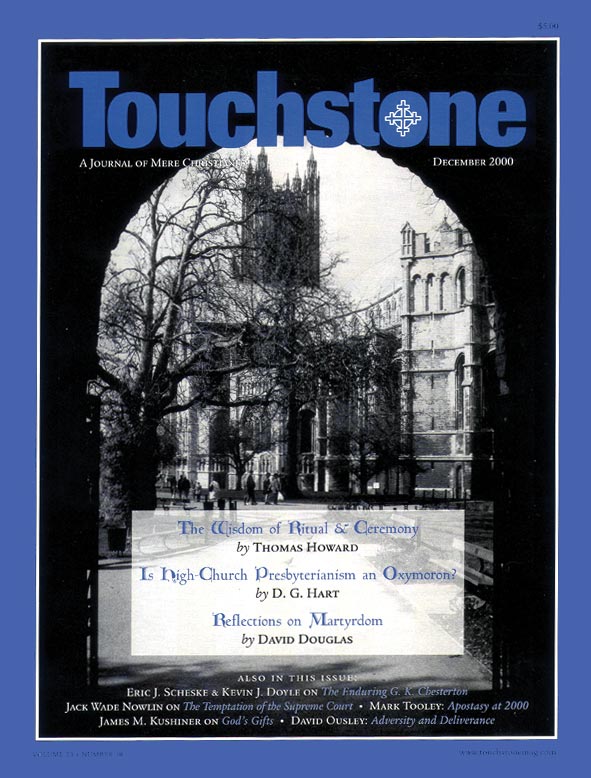
Rediscovering Mother Kirk by D. G. Hart
Rediscovering Mother Kirk
Is High-Church Presbyterianism an Oxymoron?
by D. G. Hart
The words “high church” and “Presbyterian” are seldom
found together, and for good reason. Anglo-American Presbyterians and their
Reformed siblings on the European continent have not distinguished themselves
for possessing either overly refined liturgical sensibilities or highly effective
mechanisms for protecting the prerogatives of clergy.
Of course, for the descendants of Calvin, theology is a breeze. But on the
Protestant ecclesiastical spectrum from low to high, the best Presbyterians
can do is position themselves about where Congregationalists do, toward the
middle, with Lutherans and Episcopalians above, and Methodists and Baptists
below. This may explain the old line about Baptists being Methodists with shoes,
and Presbyterians being Baptists who can read.
Still, as decent and orderly as it may be for Presbyterians to inhabit the
moderate middle of Protestant notions about liturgy and the ministry of the
Church, if left to their own devices they invariably descend to the nether regions
of churchly sensibilities. So for Baptists on the way up, the Presbyterian option
is a happy one since it rarely demands a significant adjustment beyond coming
to terms with infant baptism.
My wife and I both were reared in fundamentalist Baptist congregations and
now belong to the Orthodox Presbyterian Church (OPC), a largely low-church communion.
Five out of our six brothers and sisters have been members of the southern equivalent
of the OPC, the Presbyterian Church in America. Though anecdotal, such evidence
confirms the point that Presbyterianism is not a stretch for Baptists. In fact,
it may be the denominational preference for Baptists experiencing upward social
mobility.
But while Presbyterianism offers a more high-brow form of Protestant Christianity
for Baptists, its low-church impulses are legion to believers who desire a more
sober and formal expression of devotion. We may be too far from the publication
of Robert Webber’s Evangelicals on the Canterbury Trail
to claim that Presbyterians in search of serious worship are becoming Episcopalians.
That may have been true in the 1970s, but today Presbyterians seeking ecclesiastical
upward mobility have broadened their horizons and can now be found among the
Eastern Orthodox and Roman Catholics.
Rare is the Presbyterian congregation that offers such liturgically minded
souls a comfortable home. Other Presbyterian seekers, trying to extract liturgical
graciousness out of a tradition that appears to have none, turn to a high-brow
form of blended worship. Instead of introducing praise songs and choruses into
the average Presbyterian order of worship—the low-brow version—those
wanting greater formality import into Presbyterian services liturgical elements
from other high-church traditions.
Can Presbyterians Be High-Church?
But perhaps either turning to other traditions wholesale or supplementing
Presbyterian devotion with Anglican and Orthodox forms is unnecessary. Maybe
there is buried within the historical mass of low-church Presbyterianism a high-church
tradition every bit as divinely appointed and liturgically well conceived as
the best of the other traditions higher up the scale. If so, then low-church
Presbyterianism is the real oxymoron.
Many Christians might be surprised by the high-church tendencies within the
Reformed tradition, Presbyterians perhaps being the most amazed. So accustomed
are Protestants in North America to remembering the anti-papist sentiments of
the Reformation that they forget how many of the practices and beliefs of Christendom
were perpetuated in Calvinistic and Lutheran churches, chief among them a respect
for ritual, formality, and holy office. The Protestant Reformation, after all,
was just that, a reformation of forms and structures, not a repudiation of ritual
or legitimate ecclesiastical authority (a debatable statement, of course, to
Roman Catholics).
In fact, it is a gross distortion of the Reformed tradition specifically to
attribute to it the low-church characteristics that dominate Evangelicalism
in the United States. The early creeds of the Presbyterian and Reformed churches
assume a high regard for the ordained ministry of the Church, from the function
of pastors to the means of grace, as well as an adherence to correct forms in
liturgy and polity. The Roman Catholic Church may have been corrupt in the Reformers’
estimation, but nowhere did they show the kind of contempt for the visible church
and corporate expressions of Christian devotion that sometimes characterize
American Protestantism. Only in the seventeenth century, the age of pietism
and Puritanism, were such high-church views widely questioned.
Worship is the most obvious area in which high-church and low-church Protestantism
are clearly set apart. Leaving aside the Sacraments for the moment, high-church
liturgy is more formal and reserved, using approved forms and rituals, than
is low-church worship, which tends toward spontaneous and folksy expressions
of devotion. One searches in vain to find informality or room for individual
expression in the Reformed liturgies of the sixteenth and seventeenth centuries.
In fact, practically all the churches in the Calvinist wing of the Reformation
produced and used written forms and followed a set order of service. In other
words, liturgical unanimity prevailed as much among Reformed churches in the
Netherlands or Presbyterian churches in Scotland as it did among English Protestants
who followed the Book of Common Prayer.
This is precisely the point behind Charles Baird’s Presbyterian
Liturgies, a collection of forms and services from Reformed churches
in Europe and Britain. A young nineteenth-century American Presbyterian minister,
Baird assembled the liturgies of Reformed churches because of frustration with
his own church’s Directory for Public Worship. Baird
believed, on the one hand, that the Directory’s general
instructions for ordering the service prevented “the use of the best liturgical
compositions,” forcing instead, reliance “on our individual resources
of conception, however crude, and meager, and immature we may find them.”
Baird was concerned for the quality of liturgical expression, desiring worship
that was “performed with dignity and propriety” in order that, in
the words of the Westminster Directory, the service “may
not be disgraced by mean, irregular, or extravagant effusions.”1
Accordingly, Baird devoted three chapters to Calvin’s liturgies, one to
Reformed liturgies in France, two to Scottish Presbyterianism, three to English
developments among Puritans and the Church of England, one to the Dutch Reformed,
one to the German Reformed, and finally, one to American Presbyterianism of
a higher sort. All of the churches ordered their services after the general
pattern established by Calvin in Geneva, which ran as follows:
Invocation
Confession of Sins
Prayer for Pardon
Singing of a Psalm
Prayer for Illumination
Lessons from Scripture
Sermon
Collection of Offerings
Prayers of Intercession
Apostles’ Creed (sung while elements of Lord’s Supper are prepared)
Words of Institution
Instruction and Exhortation
Communion
Prayer of Thanksgiving
Benediction
Startling Prayers—Written!
With the exception of Presbyterian churches that follow the Praise & Worship
liturgy by dividing the service in half, with 30 minutes of singing and another
30 of preaching, most Presbyterian congregations today follow this order in
some fashion. And that is why the order of service is not a sufficient qualification
for inclusion in the high-church wing of Protestantism. More important than
a structured liturgy is the use of forms and written prayers.
Again, Presbyterians might be the most startled to learn how many prayers
the Reformers wrote, not just because those who heard their sermons or lectures
transcribed them, but because Protestant leaders composed prayers to be used
by other church members and officers. In the sense of a high-church Presbyterianism
that relies on written prayers, very few congregations would qualify, and those
that do use forms usually mix and match liturgical elements from non-Reformed
traditions, seemingly unaware of prayers used by their theological forebears.
So ingrained in the Presbyterian conscience is the low-church sensibility that
any hankering after a more dignified expression of worship results in scavenging
through Episcopalian or Eastern Orthodox liturgies.
But as books like Baird’s Presbyterian Liturgies
indicate, the leaders of Reformed and Presbyterian churches in the sixteenth
and seventeenth centuries not only supplied the order or worship, but also the
prayers and forms to be used. For instance, Calvin’s Genevan liturgy included
all the prayers, those of confession of sin, for illumination, and intercession.
The latter began in the following manner:
Almighty God, our heavenly Father! who hast promised to grant our requests
in the name of thy well-beloved Son: Thou hast taught us in his name also
to assemble ourselves together, assured that he shall be present in our midst,
to intercede for us with thee, and obtain for us all things that we may agree
on earth to ask thee. Wherefore, having met in thy presence, dependent on
thy promise, we earnestly beseech thee, O gracious God and Father! For his
sake who is our only Savior and Mediator, that of thy boundless mercy thou
wilt freely pardon our offences; and so lift up our thoughts and draw forth
our desires toward thyself, that we may seek thee according to thy holy and
reasonable will.2
Calvin not only wrote prayers for pastors to use in public worship but also
ones for parents to use at home. In fact, up until 1987 when it introduced its
new Psalter Hymnal, the Christian Reformed Church’s
hymnals included Calvin’s prayers for public and private worship, along
with prayers for church assemblies. The prayers for families ran to only four
in number, ones for the beginning and close of the day, and for before and after
meals.
If the reproduction of these prayers in hymnals is any indication, the practice
of the Continental branch of the Reformed tradition would have included formality
in expressions of devotion both at church and at home. The image that comes
to mind of Reformed liturgy and family worship is one where believers reach
not only for the Bible but also for another book, one that includes prayers
to express their praise, thanksgivings, and petitions to God.
Calvin’s Good Reasons
The image of Reformed believers with their eyes open in prayer, because of
the use of a prayer book, is one that would strike many contemporary Presbyterians
as a sign of spiritual rigor mortis. In many Presbyterian circles it is common
to assume that real faith expresses itself spontaneously, without the props
of formalism (i.e., “dead” orthodoxy).
But Calvin had good reasons for writing out prayers, not just for families
but also for pastors. “I highly approve of it that there be a certain
form,” he declared, “from which the ministers be not allowed to
vary: that first, some provision be made to help the simplicity and unskillfulness
of some; secondly, that the consent and harmony of the churches one with another
may appear; and lastly, that the capricious giddiness and levity of such as
affect innovations may be prevented.”3
What is striking about Calvin’s reasons for written prayers is that
they fall squarely within that range of sentiments that sometimes prompt Presbyterians
to look outside Reformed churches for high-church expressions of devotion. First,
he admits implicitly that some people pray better than others, and that worship,
which is designed for God’s pleasure, should use the best efforts that
the Church can produce. In other words, worship is not a form of spiritual affirmative
action that allows everyone equal time in the liturgy. Better to use the prayers
deemed superior, even if prepared by saints of the past, than to give precedence
to the words assembled by the current pastor simply because he is the one now
given the responsibility for praying.
Second, Calvin regards uniformity in liturgical expression as a good thing
rather than as a sign of complacency, a sentiment that stands in contrast both
to the liturgical diversity that now prevails among Presbyterians and to the
logic of cultural contextualization that often justifies such diversity of worship.
For Calvin, Reformed theology should be embodied in certain liturgical manners;
it is not a shapeless substance that can take any possible form as long as one
is sincere or earnest.
Finally, he believed written prayers prevented the kind of flippancy and disrespect
so often expressed in the practice of spontaneous prayer, especially when sincerity
and passion, more than dignity or truth, are the criteria.
All these reasons, in other words, suggest that if Calvin were living today
he would be looking for a high-church liturgy along with those disgruntled Presbyterians
attracted to Canterbury or Constantinople. Which is another way of saying that
the road to old Geneva might offer a form of worship just as sober and careful
as that of today’s high-church traditions.
The Supper as Visible Word & Sacrament
In addition to his understanding of prayer, Calvin’s estimate of the
Lord’s Supper gives further warrant to Presbyterians searching for high-church
liturgy. Any Presbyterian frustrated by the monthly to quarterly administration
of the Supper in most Presbyterian and Reformed churches will find Calvin’s
desire for weekly observance a welcome tonic. But even more important than the
liturgical adjustment that weekly observance of the Sacrament requires—not
just in the length but also in the gravity of the service—is Calvin’s
understanding of the Real Presence of Christ in the Supper.
The feature of Reformed worship that distinguishes it from the other Reformation
traditions is the centrality of the sermon. And it is precisely the practice
of a lengthy exposition of Scripture that appears to conflict with a high regard
(and frequent administration) of the Supper. Some have argued that by making
the Word of God so central in worship and thus placing great weight upon the
sermon, the Reformed tradition has neglected the latter half of Word and Sacrament.
Although later Reformed Christians and Presbyterians may have slighted the
Lord’s Supper, Calvin did not do so, nor did earlier generations of Reformed
believers. In fact, rather than regarding the Supper as something that supplements
the more central ministry of the Word, Calvin taught that the elements of Baptism
and the Lord’s Supper were visible forms of the Word. Just as the sermon
communicates verbally the promise of God’s forgiveness in Christ, so the
Sacraments represent those same promises graphically. Calvin wrote, “He
is mistaken who thinks that something more is conferred on him by the Sacraments
than is offered by the word of God and received by true faith.”
At the same time, if the Sacraments present no more than the Word preached,
the inverse can also be affirmed, namely that Baptism and the Supper confer
no less. As Brian A. Gerrish has argued, “the sacraments, like preaching,
are the vehicle of Christ’s self-communication, of the real presence.”
“Only the most perverse misreading,” Gerrish adds, “could
conclude that the sacraments for Calvin have a purely symbolic or pedagogical
function.”
For this reason it is fitting for those who stand in the Calvinist tradition
to speak of the Real Presence of Christ in the Lord’s Supper. Christ’s
presence in the Sacrament stems from the nature of signs as Calvin conceived
of them. Though it is possible to distinguish the sign from the thing signified,
Calvin wrote that this is a “distinction without division.” In other
words, it may be possible to distinguish the substance from the sign, but it
was impossible to separate them. And because Christ himself is the substance
of the Supper, the bread and wine are nothing less than, in the words of Gerrish,
“pledges of the real presence.”4
Liturgical Weight
For this reason, Reformed believers should also be comfortable with the language
of the means of grace. To be sure, the low-church outlook of today’s Presbyterians
makes them shudder at such a notion because of its associations with sacerdotalism.
Nevertheless, the first expressions of the Reformed tradition in the sixteenth
century were not hesitant to affirm that God used the means of Word and Sacrament,
in the words of the Westminster Shorter Catechism, to “communicate
the benefits of redemption” to believers. Not only does the Lord’s
Supper nourish and build up believers in the hope of the gospel, but as the
Shorter Catechism also explains, the worthy receivers, not
corporally or carnally, but by faith “partake of [Christ’s] body
and blood with all his benefits.”
Of course, to guard against sacerdotalism, the Reformed tradition has understood
the efficacy of the Sacraments to depend solely upon the blessing of Christ,
the work of the Holy Spirit, and the faith of the recipient. In other words,
the Supper does not automatically confer grace, though something always happens,
either in the form of blessing or curse.
Still, the means of grace for the Reformed are just that— means,
not merely symbols, whereby God works in the lives of his people. Given this
understanding of the Sacraments, the Reformed tradition is not opposed to rite
or ceremony. Instead, it is a question of which ordinances God has promised
to use for the blessing and edification of believers. The good rituals are the
Word and Sacraments; the bad ones are any rite or ceremony devised by human
wisdom, no matter how well intended, which have no sanction in Scripture.
Yet, a high view of the Lord’s Supper, according to Calvin, does not
diminish a high estimation of preaching. In fact, to read some of the early
Reformed creeds is to encounter a conception of preaching that makes today’s
Presbyterians, who stress good preaching (to the neglect of Sacraments) but
complain about thirty-minute sermons being too short, look tame.
As opposed to the contemporary image of the sermon as a teaching device that
equips the laity for “every-member ministries,” sixteenth- and seventeenth-century
Reformed Christians regarded preaching as a divine act. Inherent in Reformed
liturgy is the dialogical principle that regards worship as a holy conversation
between God and his people. God initiates through his Word, and believers respond
in praise, prayer, hearing the Word preached and read, and receiving the Sacraments.
But God’s speech does not simply extend to those elements of worship
where his Word is read, such as in the apostolic salutation, the lessons, words
of institution, or benediction. It also includes the very words of the minister
himself. According to the Second Helvetic Confession, chapter
one, “when this Word of God is now preached in the church by ministers
lawfully called . . . the very Word of God is proclaimed and
received by the faithful.”
Such a conception of preaching obviously raises the stakes for what transpires
when the minister goes to the pulpit. And the stakes escalate when Heinrich
Bullinger adds later in the Second Helvetic Confession that
preaching, even when conducted by an unregenerate man, is nevertheless the very
Word of God. Here the Reformed tradition appealed to Augustine’s argument
against the Donatists and contended that “the voice of Christ is to be
heard, though it be out of the mouths of evil ministers” in the same way
that the Sacraments are “effectual to the godly” even if administered
by “unworthy ministers” (chap. 18).
In this scheme preaching functions almost as a ritual, obviously without a
set form, but still carrying the liturgical weight of other elements because
the sermon itself is the time when God speaks through his under-servant to his
people. Preaching is not simply a common act of speech where the minister tries
to put across a particular moral or doctrinal truth. It is a holy activity that
God has ordained to reveal himself in worship.
Ministerial Keys of the Kingdom
A high view of the Word (preached) and Sacrament, in turn leads to a very
different picture of the minister than the one that prevails in contemporary
Presbyterian churches. Indeed, the special office of ordination is the place
where low-church Presbyterianism comes full circle and reduces the work of the
pastor to one of the many ministries that God’s people conduct in all
stations and walks of life. Here the doctrine of the priesthood of all believers
and the Great Commission have been perverted to mean that ministers render services
that are no different from what other believers do, except that pastors do it
full-time, whereas the laity does it as an avocation.
Yet, if preaching really is the Word of God and if the Sacraments really communicate
the benefits of redemption, then the people who perform such acts are clearly
different from other believers and should be set apart (ordained) to perform
such holy tasks. What is more, Christ’s words in Matthew 28:18–20
to go into all the world and make disciples are not a legitimate basis for every
Christian thinking that he is called to minister the Word.
Christ’s instructions make it clear that the means of discipling the
nations are Word (teaching) and Sacrament (baptism). And if Evangelical or low-church
Presbyterians are going to cite the Great Commission in challenging the uniqueness
of the special ministerial office, then they will need to make sure that in
addition to their Bibles they also carry some water for baptizing.
This is the logic behind the Reformed understanding of ordination, a conception
that adds yet one more piece to the mosaic of high-church Presbyterianism. Ordination
in most Christian traditions has to do with setting individuals apart for special
tasks within the Church. And since the work of ministers, as the Apostle Paul
put it, involves being a steward of the “mysteries of God” (1 Cor.
4:1), the vocation of ministers is a holy or sacred calling. They have been
set apart to do work that is holy, not common.
According to the Geneva Confession of 1537, such a high calling requires church
members to “receive the true ministers of the Word of God as messengers
and ambassadors of God,” to “hearken” to these ministers as
to Christ himself, and to consider the work of ministers “as a commission
from God necessary in the church.” Calvin added that the ministry was
not a “contrivance of men,” as if devised as a wise way to run the
church in the event of illiterate or lazy laity. Instead, the ministry was “an
appointment made by the Son of God,” and to reject or despise the Christian
minister was to rebel against and insult Christ himself.”5
Aside from the Pauline Epistles, the shapers of the Reformed tradition went
for biblical support to another set of texts that scares most low-church Protestants:
Matthew 16:19 and 18:15ff., where Christ instructs the apostles about the “keys
of the kingdom.” The obvious reason for low-church fear here is Rome’s
appeal to these passages for papal supremacy and authority. But that appeal
did not put off the earliest Protestants who were not interested in throwing
out the ministry altogether to be rid of papal claims. From their perspective,
Rome’s application of these texts was flawed, but not the idea of church
officers possessing the keys of the kingdom. For that reason, the Heidelberg
Catechism, Q&A 83 reads, “The preaching of the holy gospel
and Christian discipline toward repentance” are the keys of the kingdom,
both of which “open the kingdom of heaven to believers and close it to
unbelievers.”
To be sure, the Reformed took the keys away from the sacerdotal ministry of
individual priests and gave it to the declarative work of ministers and elders.
Still, just to avoid what they regarded as the errors of Rome, they did not
devise a conception of the Christian life that made church membership optional
or secondary to personal and parachurch forms of piety. Reformed and Presbyterian
Christians have asserted that membership in the church matters desperately,
so much so that the Westminster divines wrote of the visible church that, outside
of it, there is no “ordinary possibility of salvation” (
Westminster Confession of Faith 25.ii).
The Glorious Sabbath of the Lamb
The one area where the Reformed tradition obviously veers from other high-church
traditions is on the matter of a church calendar. Here, however, is one of the
great ironies of contemporary Presbyterianism since its low-church sensibilities
have cultivated a remarkable attachment to the “lite” variety of
the church calendar, namely, observing only Christmas and Easter. This is ironic
because if today’s Presbyterians who cling to their Christmas pageants
and revere their Good Friday services ever had to confront the high-church origins
of their favorite holy days, they might also quickly change their minds.
From its very beginning, the Reformed tradition, because of its application
of the regulative principle of worship, has opposed the celebration of any day
other than the Sabbath as a required assembly for church members. The regulative
principle teaches succinctly that the Church, corporately conceived, as opposed
to individual members, may only require what has clear and explicit warrant
in God’s Word. The church calendar, accordingly, may be a thoughtful way
to remind believers that the way they mark time is different from that of the
world. But lacking a clear warrant from Scripture, older generations of Presbyterians
rejected the calendar as a human invention, no matter how wise or venerable,
and therefore illegitimate for the church as a body. Individuals might observe
certain holy days, but church officers could only require observance of the
one holy day countenanced in the New Testament, namely, the Lord’s Day.
Obviously, the Reformed tradition looks incredible at this point (at least)
to others in more liturgical traditions. But the point here is not to convince
other high-church Protestants that the Reformed tradition is right or even plausible,
but to show how far contemporary low-church Presbyterianism is from its Reformed
origins. And as is the case with other liturgical expressions of the faith,
high-church Presbyterianism does not reject the church calendar as much as it
offers an alternative, one that revolves around the week-in and week-out observance
of the Sabbath. Reformed Protestants, then, have 52 holy days a year.
On these sacred days when Christians rest from their weekly labors and gather
for worship, they not only follow the pattern of days that God established in
the creation week, but they also look forward to the Sabbath rest that awaits
all God’s children when Christ returns. This is especially true in worship
itself when, as Reformed believe, the Church gathers spiritually on the Lord’s
Day with the rest of the saints and angels in the presence of Christ to perform
those acts of worship and service that prefigure the marriage supper of the
Lamb. Looking at the Sabbath in this high-church way, as a foretaste of glory,
can be helpful in avoiding the self-righteousness that has often surrounded
the virtuous Sabbath regimen of Presbyterians.
But do all of these Reformed practices a high-church Presbyterian make? By
looking at those observances that characterize high-church traditions and comparing
them with older Reformed practices, it should at least be evident that good
Presbyterians may have legitimate sympathy with the kind of piety that undergirds
high-church Lutheranism or Anglicanism.
The Puritans & Liberty of Conscience
Whether or not the Reformed convictions outlined so far qualify as high-church,
they clearly differ from the current practices of most Presbyterians. The question
remains, why the disparity between older and contemporary forms of Reformed
church life?
Probably the greatest hurdle within the Presbyterian tradition to a greater
recognition of the importance of liturgy in the life of Christians is the legacy
of Puritanism. Puritans rightly advocated the regulative principle of worship,
that is, the idea that whatever is done in public worship must find explicit
warrant from Scripture. If the Bible does not require it, then it may not be
done even if the thing proposed is not inherently sinful. So, for instance,
the Bible may not prohibit explicitly a time of testimonies during worship.
But unless testimonies find direct sanction in Scripture, they may not be included.
The regulative principle finds support in both the Continental Reformed and
Anglo-Presbyterian traditions and differs from Episcopalian and Lutheran practices
where the Bible is used primarily as a negative referent (i.e., “What
may not be done?”).
In Puritan hands, the regulative principle bred opposition to the Church of
England’s Book of Common Prayer. To be sure, some of
this hostility stemmed from Puritan hypersensitivity to any trace of Catholicism
extant in the liturgy. What is more, Puritans had a legitimate fear of centralized
church authority that could force a minister to say prayers or use forms that
ran contrary to his conscience.
Indeed, a point often lost in battles over worship or disputes about the regulative
principle of worship is that liberty of conscience is bound up with Calvinistic
understandings of worship. It’s not just that the Bible has to regulate
all that takes place in public worship—a fairly narrow conception. Puritans
also recognized that the Bible is the only legitimate authority to bind an individual’s
conscience—a notion that recognizes both the legitimacy of different opinions
on the circumstances of worship but also that public worship, whether intended
or not, forces all believers to submit to the liturgy by either participating
or refraining from the service. Corporate worship is something done by all.
And so because all church members should participate in all elements of worship,
the best way to compel such involvement is to demonstrate that the Bible requires
a given practice.
But as laudable as the Puritan effort was to protect the consciences of individuals
from unlawful rules, its issue has been liturgical chaos. The reasoning was
that any required liturgy in all congregations is an interference with liberty
of conscience, especially since the Bible nowhere elaborates a set order of
service. This logic was especially evident in the Westminster Assembly’s
Directory for Public Worship, which only made suggestions
about forms rather than actually offering prayers and forms that ministers should
use. The Directory was a concession to Congregationalists
and Independents who believed a set liturgy smacked of tyranny.
So strong has been the Reformed and Presbyterian desire to protect liberty
of conscience that even in those churches where there has been greater tolerance
of set liturgies, such as in Scotland and the Netherlands, higher assemblies
have been reluctant to require all churches to use approved forms. Instead,
Reformed and Presbyterian churches have gone against Calvin’s advocacy
of liturgical uniformity to protect the respective powers of local pastors,
sessions, and consistories.
At Odds with Order
Yet, the Presbyterian commitment to liberty of conscience, while admirable,
is at odds with the equally laudable Presbyterian desire for the unity of the
Church. Presbyterians have little difficulty assenting to theological and ecclesiological
unity, but draw the line when it comes to liturgical uniformity. For instance,
rare is the Presbyterian who wonders about the value of confessing the Westminster
Standards as the theological norm for ministerial fellowship.
Indeed, most conservative Presbyterians take pride in being theologically precise.
And Presbyterian confessionalism is likely responsible for the large measure
of theological unity that prevails in those communions that stress adherence
to the Westminster Confession of Faith and the Larger
and Shorter Catechisms.
Likewise, Presbyterians are generally sticklers for church polity. Here the
Form of Government and Book of Church Discipline
quench the Presbyterian thirst for decency and order. And even though these
documents governing church law do not have scriptural proof texts like the Westminster
Standards, few Presbyterians regard the rules governing church officers as overly
onerous. In fact, without them the church would be chaotic and arbitrary.
Why is it, then, that when it comes to worship Presbyterians get itchy and
let indecency and disorder prevail? If Presbyterians can assent to a detailed
set of confessional and catechetical documents, why not a book of common prayer?
And if Presbyterians can submit to the rigors of following proper procedure
in session and presbytery meetings, why no set order of worship? Liturgical
forms and written prayers may bind the conscience, but no more so than the Westminster
Standards or the Orthodox Presbyterian Church’s form for ordaining elders.
Yet, so wary are Presbyterians of liturgical formalism that they shun common
forms for worship.
The ironic exception is the OPC’s Directory for Public Worship
that includes a form for the dedication of a new building, complete with litanies
and prayers. Here, the same sort of voluntary assent that informs adherence
to creeds and polity needs to undergird the Presbyterian and Reformed use of
liturgy. As long as church officers assent to the confession and catechisms
of the church voluntarily with the idea of preserving the unity of the church,
why would it be such a stretch to add liturgy to creeds and polity?
“Warm Outgoings of the Heart”
The danger, of course, is that liberty of conscience can often be a smoke
screen for an experiential piety that is at odds with the formality inherent
in set liturgies. Ever since the revivals of the eighteenth century, which Presbyterians
mostly embraced, the Reformed tradition in North America has been afflicted
with the Evangelical assumption that for Christian devotion to be sincere it
cannot be expressed in words or forms devised by someone else.
Charles Hodge put that sentiment well when he wrote that written prayers “tend
to formality, and cannot be an adequate substitute for the warm outgoings of
the heart moved by the spirit of genuine devotion.”6 This outlook
has cultivated among Presbyterians the sense that if a minister or ordinary
believer uses a prayer book, he is simply going through the motions, or worse,
exhibiting dead orthodoxy. Here Presbyterianism took a wrong turn. It assumed
the yoke of enthusiasm, in the sense the term was used by R. A. Knox when
he wrote of “a new approach to religion” in which the Christian
faith shifts from “a matter of outward forms and ordinances” to
“an affair of the heart.”7
Of course, Presbyterians cannot blame their tradition’s affinity for
enthusiasm solely on revivalists such as George Whitefield or Jonathan Edwards.
The Scottish Presbyterian practice of communion seasons, as historians have
recently argued, where churches administered the Supper only two to four times
a year and did so with a week of festivities leading up to the Sacrament, also
worked enthusiatical leaven into the lump of Presbyterian practice. Those festivities
soon evolved into camp meetings and revivals where the excitement of receiving
the Spirit overwhelmed the experience of receiving the benefits of Christ in
the Supper. (Cf. William De Arteaga, “When Heaven Touches Earth,”
Touchstone 10.2, Spring 1997.)
Yet, however they came by their enthusiastic ways, the logic of Presbyterian
anti-formalism demands closer scrutiny. The notion that genuine religion has
to be expressed in a believer’s own words actually leads in charismatic,
not Presbyterian, directions. When Pentecostals speak in tongues, they display
a piety that is logically consistent with the Evangelical demand for expressing
the faith in a person’s own words. But if Presbyterians recognize that
using the words of others, such as the words of Scripture or those of the confession
of faith, are healthy and legitimate, then they should not balk at using the
words of others in worship.
In fact, the corporateness of worship requires such dependence since the demand
for order means that only one person speaks or prays at a time; or if everyone
speaks or prays, they do so in unison. Consequently, when my pastor prays the
intercessory prayer, since he is praying on behalf of the whole congregation,
I am using someone else’s words regardless of whether he wrote his own
prayer or is using one from a book. And in the case of congregational singing,
everyone in the church is relying on the words of a poet to express his praise
to God. Ironically, then, any congregation (Presbyterian included) not following
Quaker or Pentecostal patterns of worship that encourage individual expression,
automatically excludes the efforts of believers to express devotion in their
own words in corporate worship.
Anti-Clerical Flipside
The selectivity of Presbyterians on this point—not objecting to hymnals
but opposing prayer books—has as much to do with the flip side of Evangelical
piety. It is not simply that genuine devotion cannot legitimately rely on the
words of others—how else do we know if it is sincere?—but also that
the hierarchy implicit in a set collection of prayers is illegitimate. After
all, Evangelicalism in the United States has an anti-clerical impulse that seeks
to remove all barriers (i.e., authorities) that come between believers and their
God. Using approved prayers not only puts words in believers’ mouths,
but also forces them to submit to the clergy who wrote those prayers.
But again, evangelical anti-clericalism is unbecoming for Presbyterians since
Calvin’s spiritual heirs are willing to use the words of the Westminster
divines for their confession of faith, thereby assenting to the authority of
those ministers and elders, along with the church officers who chose the
Confession and Catechisms as the doctrinal standards
for American Presbyterian denominations. What contemporary Presbyterians become
edgy at is the prospect of submitting to present-day church officers. Such submission
appears to be a breach of the priesthood of all believers.
And yet, if they can acknowledge that God appoints human authorities to oversee
the civil and familial realms (i.e., magistrates and parents), why are ecclesiastical
authorities inherently suspect? In particular, if God has ordained pastors,
teachers, and evangelists to establish and nurture his people, why should church
members object to using the words written and approved by ministers for use
in worship?
More often than not, Presbyterians oppose liturgy because they also refuse
to acknowledge the legitimate authority of church officers. This connection
suggests that for Presbyterians to move in a high-church direction, using liturgies
is insufficient. It also requires a proper recognition of the work and authority
of holy office.
A Doomed Alertness
The abandonment of liturgical forms for heartfelt experience, so characteristic
of low-church Presbyterianism, is a significant departure from the genius of
the Protestant Reformation, and thus puts Presbyterians in the awkward position
of trying to accommodate John Calvin and John Wesley. What many contemporary
Presbyterians seem to forget is that the Reformation was just that, a reformation,
not a revival.
You can tell the difference between the two, according to the Belgic
Confession, Article 29, by determining whether the church uses the
correct forms—namely, is the Word being faithfully preached, are the Sacraments
being faithfully administered, and is discipline being properly administered?
The Belgic Confession, along with the rest of the Reformed
creeds from the sixteenth and seventeenth centuries, has nothing to say about
the typical way we spot a revival, that is, by a large number of new conversions
and greater earnestness on the part of believers. So for Protestant Reformers,
the issue was not whether a church was dead or alive.
The Evangelical concept of dead orthodoxy was virtually unknown prior to the
revivals of the eighteenth century. For the Reformers, the issue was whether
a church was false or true. For Luther, Calvin, and Cramner, the way to distinguish
the true Church was by looking above all at the forms used in worship and the
ways in which ordination took place. These were matters that were unambiguous—either
a prayer, sermon, or service of ordination conformed to the teaching of Scripture
or it did not (conceding that Episcopalians, Lutherans, and Reformed Christians
read the Bible in different ways at times on these points).
But to tell whether a church or person was spiritually alive, revived, or
dead was not so certain. And unfortunately, ever since the First Great Awakening,
Presbyterians have been more attentive to the invisible work of the Spirit rather
than the visible work of the Church, an alertness that is doomed to frustration
because of the Spirit’s mysterious movements.
The Church as Mother
Nevertheless, the answer to low-church Presbyterianism is not the introduction
of collects, forms for the administration of the Lord’s Supper, or the
weekly recitation of the Creed. As edifying and necessary as liturgical worship
is, low-church Presbyterians will not recognize its virtues unless, ironically,
they experience a change of heart. High-church liturgy requires a high-church
piety. The same goes for high-church polity and high-church confessionalism.
In other words, Presbyterians need to learn that the ministry of
the Church is a means of grace. According to the Westminster
Shorter Catechism (88), “the outward and ordinary means whereby
Christ communicates . . . the benefits of redemption are his
ordinances, especially the word, sacraments and prayer, all of which are made
effectual to the elect for salvation.” Taking care to use the right and
fitting words in the ordinances or rituals used in worship, or being careful
about what men are ordained to the ministry, are not luxuries. God himself has
promised to use and will bless faithful prayers, songs, sermons, and sacramental
forms of rightly ordained ministers.
For many American Protestants, too often the church is only an option for
expression of heartfelt devotion, a choice that is the equivalent of personal
forms of devotion or parachurch initiatives. To be sure, the church gathered
in worship and led by ministers is the place where believers corporately express
praise and adoration to their heavenly Father, and they should take great care
in the way they express themselves to the sovereign Lord of the universe. But
the church is also a place where, through his under-shepherds, God ministers
to his people. Especially in the Word read and preached, and in the administration
of the Sacraments, God reminds his people of his forgiveness and builds them
up in holiness and comfort.
A high view of the church, her worship, ministry, and creed, then, requires
a piety that recognizes the believer’s dependence on the means that God
has ordained to bless his children. If church is simply a way to display our
devotion or zeal, then forms and ministers can become a burden. But if church
is a place to go to hear the good news from men duly ordained, then liturgy
and clergy become, by the blessing of the Holy Spirit, the lifeblood of the
believer’s pilgrimage and devotion.
In other words, Presbyterians need to recover the notion of the Church as
mother. That idea is foreign to many of John Calvin’s theological heirs,
even though the Geneva Reformer wrote explicitly about the church’s nurturing
capacity. In book four of his Institutes, Calvin asserts
that the image of church as mother is one that expresses just how important
her work is to God’s children. “For there is no other way to enter
into life unless this mother conceive us in her womb, give us birth, nourish
us at her breast, and lastly, unless she keep us under her care and guidance
until, putting off mortal flesh, we become like angels” (IV.i.4). Calvin
taught, along with a large part of the early Reformed tradition, that without
the Church a believer would wither and die, just as a baby without his mother.
The Church, through her ministers, rites of preaching and Sacraments, care
and instruction, sustains the Christian through his pilgrimage, just as God
provided for the Israelites during their wilderness wanderings. The means of
grace that God has ordained the Church to minister are like the manna and quail
he fed to the Israelites until they reached the Promised Land.
But to recognize the Church as mother, Presbyterians also need to remember
their pilgrim status. And chances are that an impoverished estimate of the Church
stems directly from an overly high estimate of ourselves. Which is only to say
that Calvin’s high view of the Church and the care she provides was bound
up with a sober view of the need believers have to be sustained and built up
in the faith.
The common attitude toward the Church among low-church Presbyterians is strikingly
evident in their infrequent observance of the Lord’s Supper. What does
it say, for instance, about Presbyterian piety that most congregations celebrate
the Sacrament at most twelve times a year? Some might respond that such infrequency
reflects a high view of the ordinance—to observe it weekly could encourage
indifference and nonchalance. But just as likely does such irregularity communicate
the impression that we really do not need the grace that comes with the Supper.
As believers we are relatively strong, and the Word read and preached is sufficient
to recharge our spiritual batteries.
“Pupils All Our Lives”
And thus is one’s estimate of the Church tied to one’s assessment
of the Christian life. In this case it looks as if low-church Presbyterians
have adopted the attitude of the Israelites when they complained about their
diet in the wilderness. The difference is that Presbyterians are not grumbling
about the monotony of the fare as much as they are following a new diet that
denies them the bread and cup of eternal life three out of every four weeks.
Had the Israelites refused the manna with the same frequency, chances are they
would have perished well before reaching the banks of the Jordan.
But since the only way for Presbyterians to have a high view of the Church
is to recover Calvin’s idea of the Church as mother,
they also will need to abandon the notion of the Church as
personal trainer. For too many people in the Reformed tradition, the conception
of the Christian life is one of perpetual motion. God requires many good works
to be performed, from mid-week Bible studies to developing a Christian view
of the arts, and the church’s task is simply to supply pep talks and programs
for personal improvement. The real work of the Church, then, is what God’s
people do throughout the workweek, with Sunday providing a form of continuing
education.
But this view of the church and the Christian life does not recognize how
needy and frail God’s people are, and how perilous is the battle in which
Christian pilgrims must fight. Less confidence about our abilities and a greater
recognition of our infirmities would lead to a different view of the church.
If Presbyterians continue to think of the church as a place for pep rallies,
then all the formality and liturgy in the world will not make them high-church.
It will only take away the zip from their gatherings, which are supposed to
add spice to the Christian life.
Perhaps Christ’s instruction in John 6 is the only thing that will break
through the low-church mentality. In this passage Christ tried to redirect his
followers’ earthly desires to a hunger for the Bread of Life. And to do
so he told them that the manna the Israelites received in the wilderness prefigured
not the bread and fish that he had fed to the five thousand but his own Body
and Blood. “I am the bread of life,” he said. “Your fathers
ate manna in the wilderness, and they died. This is the bread which comes down
from heaven, that a man may eat of it and not die. I am the living bread which
came down from heaven; if any one eats of this bread he will live for ever;
and the bread which I shall give for the life of the world is my flesh”
(48–51). Christ continued, “for my flesh is food indeed, and my
blood is drink indeed” (55).
Many of Christ’s disciples responded to this teaching by remarking how
difficult it was: “Who can listen to it?” (60). For low-church Presbyterians,
learning about the ministry of the Church is similarly difficult, almost as
hard as overcoming 250 years of Presbyterian church history in the United States.
But if Calvin was correct, if “our weakness does not allow us to be
dismissed from [the church’s] school until we have been pupils all our
lives”—if, in fact, “away from her bosom one cannot hope for
any forgiveness of sins or any salvation” ( Institutes,
IV, i.4), it may be time for Presbyterians to start undoing their past and relearning
their tradition. The health of the doctrine and church order they hold so dear
actually depends on it.
Notes:
1. The Presbyterian Liturgies: Historical Sketches (1855;
Grand Rapids: Baker Book House, 1957), pp. 5, 7.
2. From Baird, Presbyterian Liturgies, p. 38.
3. Quoted in Baird, Presbyterian Liturgies, p. 23.
4. B. A. Gerrish, “John Calvin and the Reformed Doctrine of the Lord’s
Supper,” McCormick Quarterly 22 (Jan. 1969), pp. 90,
91.
5. J. L. Ainslie, The Doctrines of Ministerial Order in the Reformed
Churches of the Sixteenth and Seventeenth Centuries (Edinburgh: T.
& T. Clark, 1940), pp. 8–9.
6. Hodge, “Presbyterian Liturgies,” in The Church and
Its Polity (London: T. Nelson, 1879), p. 162.
7. Knox, Enthusiasm: A Chapter in the History of Religion
(Oxford: Clarendon Press, 1950), p. 2.
An elder in the Orthodox Presbyterian Church and a former professor
of church history at Westminster Seminary in Philadelphia, D. G. Hart became academic dean and professor of church history at Westminster
Seminary in California in September. His recent publications include The
University Gets Religion: Religious Studies and American Higher Education
(Johns Hopkins University Press, 1999) and The Dictionary of the Presbyterian
and Reformed Tradition in America (InterVarsity Press, 1999).
D. G. Hart works for the Intercollegiate Studies Institute (www.isi.org) and is an elder in the Orthodox Presbyterian Church. He is the author of A Studen't Guide to Religious Studies (ISI Books) and John Williamson Nevin: High Church Calvinist (P&R Books). |