




A Word on Humanitarianism
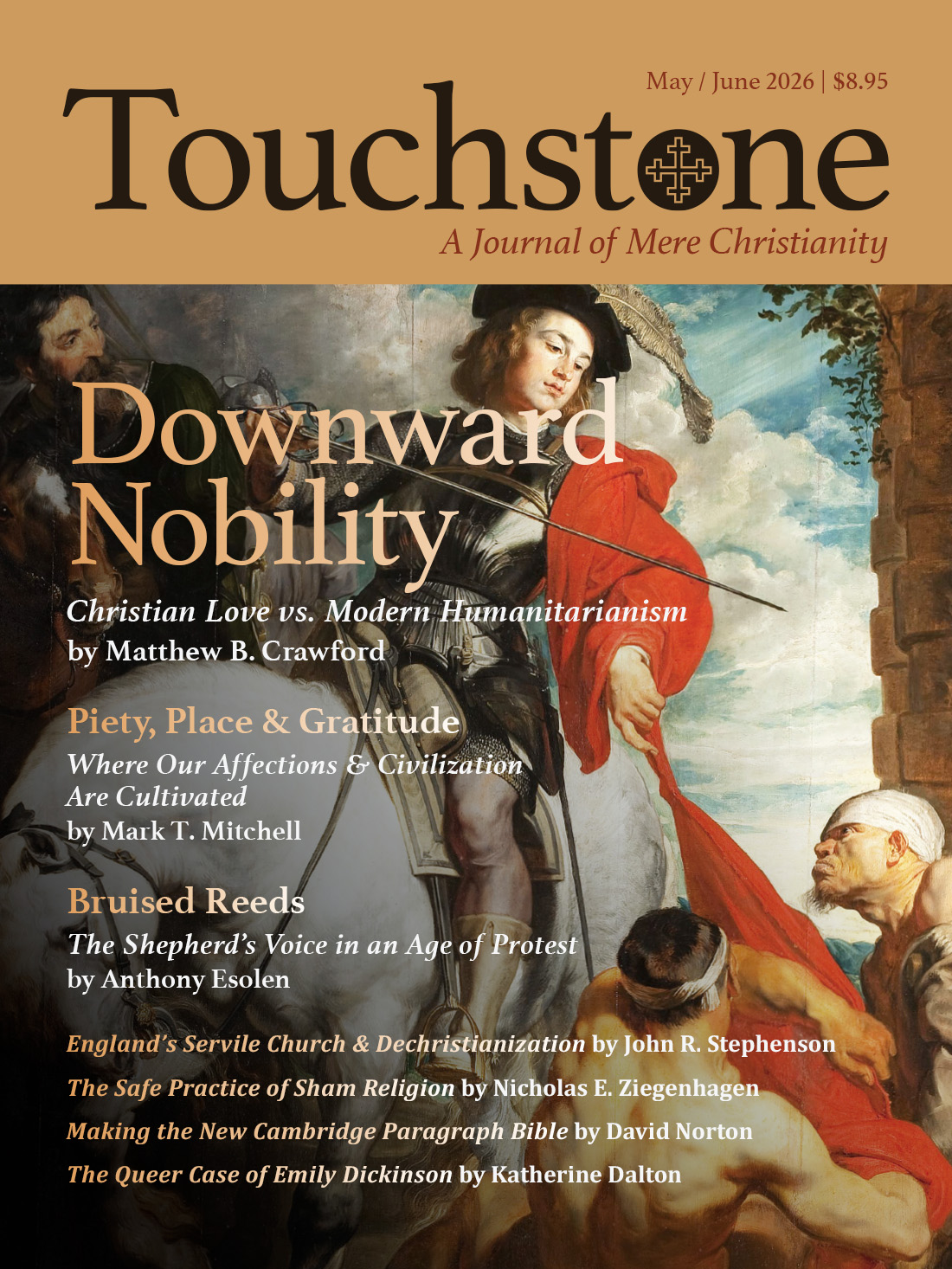
Near the conclusion of his 2025 Touchstone conference talk, Matthew Crawford said that “the humanitarian focuses on suffering because the existence of suffering is thought to impugn God’s rule. This animus against God is the real source of the animus against hierarchy.”
While most readers today might regard this as a bit of a stretch, it would have been a case of stating the obvious to those who coined and promoted humanitarianism in the nineteenth and early twentieth centuries.
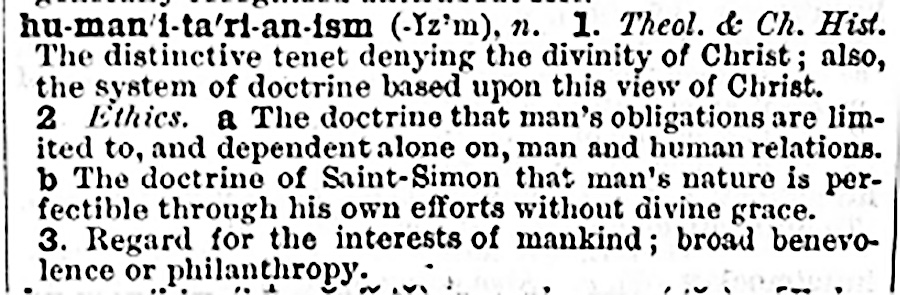
The following image comes from the 1929 edition of the Merriam-Webster Dictionary (an 1889 entry in The New Century Dictionary is essentially identical):
A parallel entry appears in the 11th edition of the Encyclopedia Britannica (1910–1911):
HUMANITARIANS, a term applied (1) to a school of theologians who repudiate the doctrine of the Trinity and hold an extreme view of the person of Christ as simply human. The adoption of this position by men like NathanielLardner, Joseph Priestley and Theophilus Lindsey in the middle of the 18th century led to the establishment of the first definitely organized Unitarian churches in England. (2) It is also applied to those who believe in the perfectibility of man apart fromsuperhuman aid, especially those who follow the teaching of Pierre Leroux (q.v.). The name is also sometimes given to the Positivists, and in a more general sense, to persons whose chief principle of action is the desire to preserve others from pain and discomfort.
John Dewey was the most prominent of the 34 academics, journalists, philosophers, and Unitarians who signed the Humanist Manifesto in 1933. This document asserted among its fifteen points that the universe and mankind were uncreated, that human values have no supernatural foundation, and that “the time has passed” for Christian beliefs and the values flowing from them. The signatories hoped to establish a new morality on secular terms, where “a good humanitarian man” could stand alone and supplant what they saw as the oxymoronic “good Christian man.”
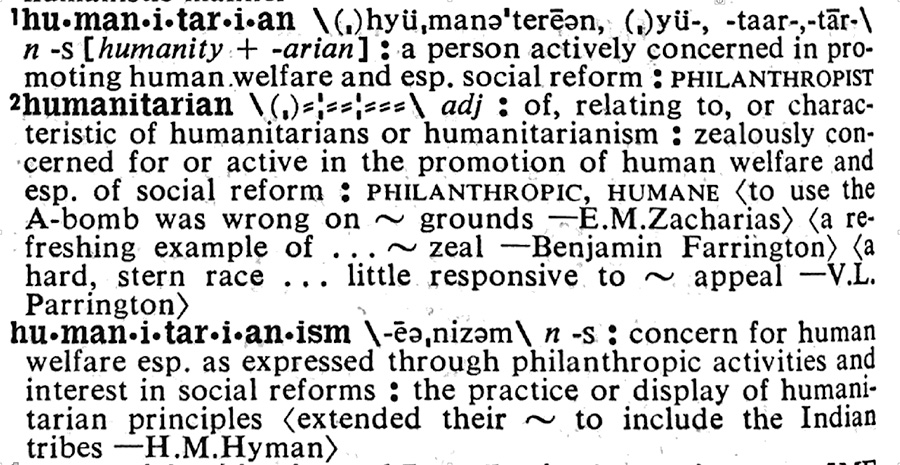
By the time Webster’s published its Third New International Dictionary in 1961 (known as “W3” to dictionary enthusiasts), the transformation of the term “humanitarianism” was complete. A humanitarian was now defined simply as one devoted to promoting human welfare. A human who is for humans—it really is a ridiculous word when one stops and thinks about it.
The beliefs upon which the word was coined and which were reflected in the definition only three decades earlier—denial of Christ’s divinity and belief in the perfectibility of man apart from grace—were stricken from the newer lexicon:
Today we rarely hear anyone referred to as “a humanitarian.” Instead the word is usually used as an adjective to denote great human suffering, as in the expression “a great humanitarian crisis.” Yet even in this modern usage, the original animus—the focus on suffering as evidence against a just or sovereign God—still lingers just beneath the surface.
J. Douglas Johnson is the executive editor of Touchstone and the executive director of the Fellowship of St. James.
A Journal of Mere Christianity—Delivered to Your Door
- Essays on theology, culture, and the Church
- Contributors from across the Christian traditions

Six print issues (one year) of Touchstone, plus full online access and PDF downloads for only $39.95.

Get a one-year full-access subscription to the Touchstone online archives for only $19.95.
bulk subscriptions
Order Touchstone subscriptions in bulk and save $10 per sub! Each subscription includes 6 issues of Touchstone plus full online access to touchstonemag.com—including archives, videos, and pdf downloads of recent issues for only $29.95 each! Great for churches or study groups.
Transactions will be processed on a secure server.
more from the online archives

28.2—March/April 2015
Why Scientism's Cherished Progress Narrative Fails by Jonathan Witt

25.4—July/August 2012
The Corrosive & Far-Reaching Fallout of the Sexual Revolution by Anthony Esolen

17.6—July/August 2004
Old Science Confronts a Formidable Challenge in the Scientific ID Movement by Jay W. Richards
calling all readers
Please Donate
"There are magazines worth reading but few worth saving . . . Touchstone is just such a magazine."
—Alice von Hildebrand
"Here we do not concede one square millimeter of territory to falsehood, folly, contemporary sentimentality, or fashion. We speak the truth, and let God be our judge. . . . Touchstone is the one committedly Christian conservative journal."
—Anthony Esolen, Touchstone senior editor
