





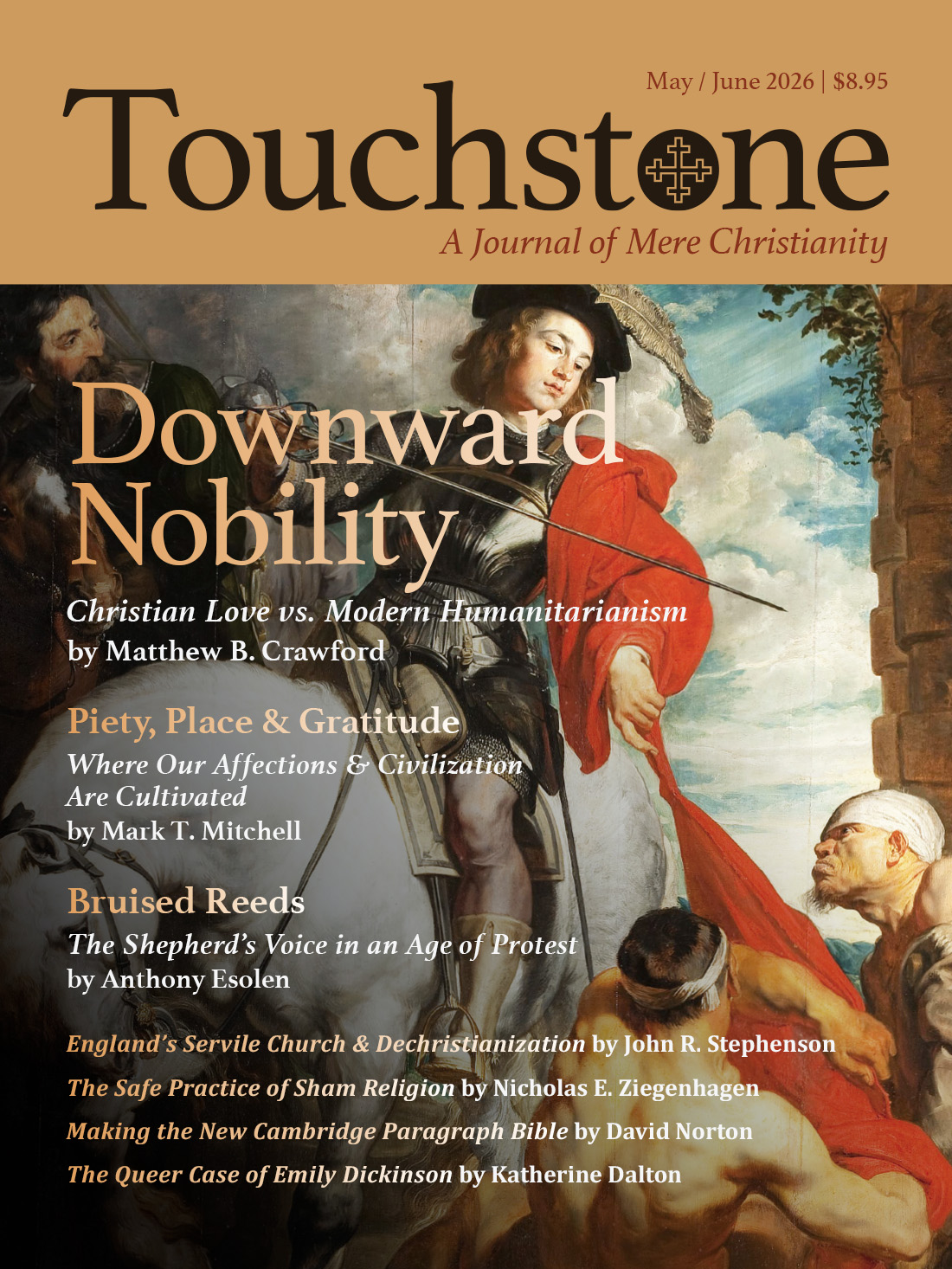
Downward Nobility
Christian Love vs. Modern Humanitarianism
The pre-eminent political question in Europe is mass immigration. Those who regard borders as morally illegitimate generally do so as humanitarians. Humanitarianism looks, from a certain angle, like Christian love. Accordingly, many young right-wingers who object to what they see as a flood of reverse colonization from the “Global South” have begun to suspect that Christianity is at the root of our problems. In this, they are able to invoke Nietzsche’s savage critique of Christian love.
I want to get into this quarrel. The stakes are somewhat personal for me, as a recent convert who as a young man was much impressed with Nietzsche’s description of Christianity as something sickly and effeminate, well suited to serve as an excuse for irresponsible capitulation in the realm of politics. This is connected to a broader cultural issue.
The Problem of the Male
Our time is marked by a crisis of the male. Young men, if their souls are intact, by nature have a longing for greatness. They want some hard path to follow, some high task demanded of them, some call to sacrifice and overcoming. But the surrounding society of consumerism and careerism offers them nothing like this. More than that, the moral outlook of progressivism that prevails in institutions looks with suspicion on their most vital inclinations in this direction. Their resulting frustration has accumulated and come to self-awareness. Hence the rise of the “new right,” with its distinctly masculine energies.
Following Nietzsche, one wing of this new right traces the flattened and degraded moral landscape of the present to the influence of Christianity. I am referring to figures such as the internet personality Bronze Age Pervert. These men have revived the idea of “vitalism,” which has a long pedigree going back to William James and Henri Bergson, among others. Vitalism is a response to the claustrophobia of modern life. It begins with the feeling that some kind of cowardice is being urged upon us from every quarter.
There is a strand in the tradition, call it Christian humanism, that shares some of the intuitions of the vitalists (think of C. S. Lewis’s magnificent essay “Men Without Chests”) but offers as well a much fuller anthropology, and ultimately a cosmology, that today’s vitalists lack, and which is sorely needed if they are to pass beyond rebellion and help rebuild the kind of civilization that supports what is best in the human spirit. My aim here is to bring this anthropology to the surface.
Vitalism and Christianity share a positive intuition that human beings are called out of themselves toward something higher, and that to refuse this call is to lead a diminished life of self-satisfaction. They also share an adversary in modernist metaphysics. Reductive materialism and determinism give us a picture of reality that can make no demand upon us, subsuming man to a realm of dumb causation, from which it is hard to imagine any resplendent deed shining forth. Nor is such a determinate world one into which the divine can intrude, so experiences of grace and wonder are declared unreal.
To be struck by these continuities is a minority position. Nietzsche is, again, one of the figures most associated with vitalism, and he was also the most powerful critic of Christianity in modern times. He found in this religion something profoundly anti-life. At the root of it is what he called ressentiment. This is what we need to dig into, by way of clarifying what is at stake in this emerging quarrel on the right, which has implications that go well beyond politics, in particular for education.
The Idea of Ressentiment
The great discovery of Nietzsche, in his genealogy of morals, is that resentment can become an orienting posture toward the world and achieve a kind of fecundity, generating new tables of values. He uses the French word ressentiment. Whereas in English, “resentment” can be an appropriate response to a discrete episode of injury, in the French usage, one can be “a man of ressentiment”; it can be an enduring disposition.
The basic idea of ressentiment is captured in Aesop’s fable of the fox and the grapes. Driven by hunger, a fox tries to reach some grapes hanging high on the vine but is unable to, although he leaps with all his strength. As he walks away, the fox remarks, “Oh, you aren’t even ripe yet! I don’t need any sour grapes.” To indulge in ressentiment is to deny that something is good, which is one way of responding to one’s impotence to achieve it. Instead of accepting his limitations and preserving his admiration for what he cannot achieve, one’s vain smallness of soul leads him to tear down what is high, placing himself above it. So his ressentiment amounts to an inversion of value, carried out as an act of revenge against those who embody the ideal he is impotent to achieve.
The revenge is accomplished, not straightforwardly by inflicting a reciprocal harm, but through an effort to gain moral leverage over one’s superiors and thereby reverse the humiliation one feels in their presence, by recasting one’s unchosen impotence as virtue and recasting the real virtues of the strong and noble as vices. Nietzsche writes, “Weakness is to be made meritorious.” Likewise, ugliness is to be made beautiful.
Matthew B. Crawford is a Senior Fellow of the Institute for Advanced Studies in Culture and the Future of Freedom Fellow at the Independent Institute. This essay is based on his talk at the 2025 Touchstone conference, Great & Wonderful Days.
A Journal of Mere Christianity—Delivered to Your Door
- Essays on theology, culture, and the Church
- Contributors from across the Christian traditions

Six print issues (one year) of Touchstone, plus full online access and PDF downloads for only $39.95.

Get a one-year full-access subscription to the Touchstone online archives for only $19.95.
bulk subscriptions
Order Touchstone subscriptions in bulk and save $10 per sub! Each subscription includes 6 issues of Touchstone plus full online access to touchstonemag.com—including archives, videos, and pdf downloads of recent issues for only $29.95 each! Great for churches or study groups.
Transactions will be processed on a secure server.
more on conference talk from the online archives

36.4—Jul/Aug 2023
Our Political Void & the Disintegration of Truth by Michael Hanby
more from the online archives

27.5—Sept/Oct 2014
on Growing Vegetables as a Primer in Moral Philosophy by Rachel Lu
33.1—January/February 2020
on a Saint's Charism That Cures Toxic Perfectionism by Colleen Carroll Campbell

27.3—May/June 2014
Religious Freedom & Why It Matters
Working in the Spirit of John Leland by Robert P. George
calling all readers
Please Donate
"There are magazines worth reading but few worth saving . . . Touchstone is just such a magazine."
—Alice von Hildebrand
"Here we do not concede one square millimeter of territory to falsehood, folly, contemporary sentimentality, or fashion. We speak the truth, and let God be our judge. . . . Touchstone is the one committedly Christian conservative journal."
—Anthony Esolen, Touchstone senior editor
