





Wilderness Training
on How the Temptations of Jesus Expose the Gospel of Self
The wilderness has always been God’s proving ground, where Moses was called, Israel wandered, Elijah heard the whisper of God, and John the Baptist thundered. And when the Spirit descended upon Jesus, he was driven not to the palace, not to the temple, but to the desert.
The wilderness strips away illusions. No crowds. No applause. No distractions. Only hunger, silence—and the hiss of the Enemy. Jesus entered that barren place carrying the weight of Adam’s failure and Israel’s rebellion. In the place where bread once became complaint, golden calves were built from fear, and prophets once fled in despair, he would stand.
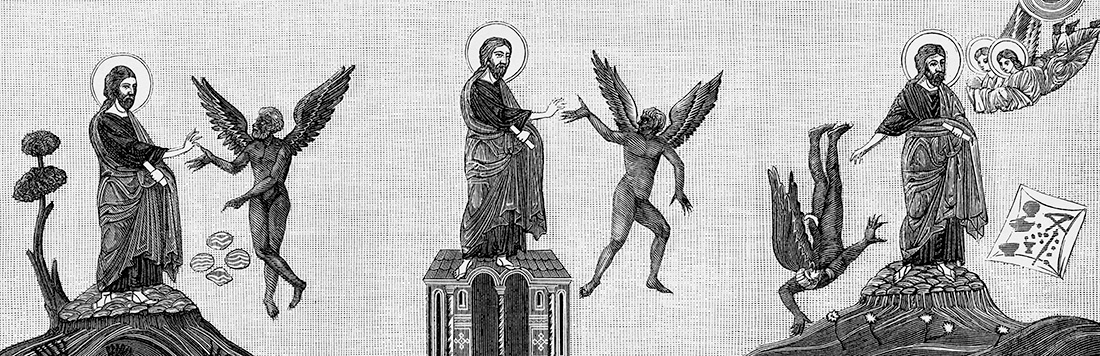
And the voice that met him there has never fallen silent. It is the same voice that undid Eden and echoes still in our culture. The temptations in that desert were not random. They were a script, precise and rehearsed. Stones into bread. A leap for spectacle. A throne at a price. Subtle at first, blatant at last. Survival, spectacle, sovereignty. The gospel of self in three acts.
This is why the desert still speaks. Because every age is asked the same questions. Whom will you trust for provision? Where will you look for validation? What kingdom will you bow to in exchange for power? The wilderness is not ancient history. It is our present moment.
Stones into Bread
Jesus was truly hungry. Forty days without food had hollowed his body. Stones littered the ground at his feet. The suggestion came quiet but cutting, “If you are the Son of God, tell these stones to become bread.”
This was no invitation to worship Baal or burn incense to Caesar. It was more subtle. Use your power for yourself. Satisfy your hunger. Take survival into your own hands. The whisper beneath the words was clear: your life is not secure in the Father’s care. You must feed yourself.
This is the first and most constant temptation we all face: to measure God’s goodness by how quickly he gratifies our needs; to survive at any cost, even if obedience must bend. Israel had fallen here. When food was scarce, they grumbled. When thirst grew, they demanded. Their stomachs became their god.
And has our age not joined the same choir? Stones into bread has become the creed of consumerism. What do many of the “creature comforts” of our age promise, if not to turn stone into bread? Secure yourself. Protect your own. Amass the savings, secure the career, pad life with comforts, even if compromise is required. Safety has become our sacrament, and we will mortgage truth to purchase it.
The temptation still comes in quiet ways. A congregation softens truth to keep its pews full. A believer compromises convictions to keep a job. A generation chooses silence rather than risk rejection. Stones into bread. Survival instincts baptizing disobedience.
But Jesus answered with the words of Deuteronomy, “Man does not live by bread alone, but by every word that comes from the mouth of God.” Bread sustains for a moment. The Word sustains forever. The wilderness exposes the lie: that our provision rests in our hands. Jesus chose hunger rather than distrust.
A. W. Tozer warned, “What comes into our minds when we think about God is the most important thing about us.” If we believe him stingy or untrustworthy, we will grasp at stones. If we do not see the full measure of his love for us, we will hoard, fear, and bend to every whisper of scarcity. But if we trust him as Father, we will find obedience is nourishment.
The Spectacle of Self
The next scene rose above the city. The devil set Jesus on the pinnacle of the temple, the highest point in Jerusalem, overlooking priests, pilgrims, merchants, and worshipers. The lure was clear: “Throw yourself down. For it is written, he will command his angels concerning you.”
This temptation was not about survival but spectacle. Prove yourself with a sign. Turn faith into performance. Make God your stagehand and Scripture your script.
It’s chilling how the Enemy used the Word here. He did not deny it. He quoted it. He wielded it as a tool for self-exaltation. This is how temptation often comes: not by rejecting Scripture but by misusing it, twisting it to sanctify our hunger for validation. The gravest threat is not Scripture denied, but Scripture redefined until it echoes the voice of the age. This is how, for example, even woke ideology seeps into the Church. It cloaks its rebellion in the language of compassion and baptizes cultural slogans with biblical words.
We live in an age addicted to spectacle. Platforms define truth. Visibility becomes worth. Leaders are trained to build brands more than to bear crosses. Even in the Church, the temptation throbs. Craft the sermon that trends. Build the worship set that entertains. Throw yourself down from the heights of the digital temple and let the angels of applause catch you.
But Jesus refused: “You shall not put the Lord your God to the test.” The Father is not a prop for our performance. His promises are not currency for our marketing.
Martin Luther warned of the “theology of glory,” which seeks validation in success and spectacle, as opposed to the “theology of the cross,” which embraces humility and suffering. Kierkegaard echoed it when he wrote, “The crowd is untruth.” To chase spectacle is to trade truth for applause, substance for show.
Christ chose obscurity over spectacle. He chose a cross outside the city, not a stunt inside the temple. In doing so, he revealed that our culture cannot comprehend that the kingdom comes, not by being seen, but by being surrendered.
The Kingdom at a Price
The third temptation was the climax. No more subtlety. From a mountain’s height, the Enemy displayed the kingdoms of the world in their splendor. “All this I will give you, if you will bow down and worship me.”
This was the shortcut. Bypass the cross. Gain the crown without the nails. Take sovereignty without suffering. One bow, one moment, and the world could be yours. But what is offered always comes at the cost of true worship. Every false kingdom is bought with compromise.
This temptation has undone nations and churches alike. Israel fell into it repeatedly, mixing the Lord with Baal, compromising baptism as strategy. The modern church does the same when it weds itself to political power, when pulpits are bent to echo parties, when leaders barter integrity for influence.
But it is not only institutions that bow. It happens in quiet hearts as well. A believer bends truth to keep peace at home. A worker hides conviction to keep a job. A student softens faith to keep a seat at the table. The exchange is always the same. One small bow in the hope of retaining what we fear to lose. Stones into bread and leaps for spectacle prepare the way for this final bow. Comfort, performance, and then sovereignty. The script has not changed.
Dietrich Bonhoeffer saw it happen in Germany, with devastating results. The church chose nationalism over Christ, thinking compromise would secure influence. Bonhoeffer’s words still speak to us today: “When Christ calls a man, he bids him come and die.”
And so, from the heights, Jesus replied, “Worship the Lord your God, and serve him only.” He would not take the kingdom at the Enemy’s price. He would bear the cross at the Father’s command. The wilderness ended, but the battle had only begun.
The Failure of the Self
The gospel of self still makes the same promises. Feed yourself. Prove yourself. Secure yourself. But the result is always exhaustion and isolation. Stones cannot satisfy. Spectacle cannot heal. Power cannot redeem.
Many walk away from the faith not with fists raised in hatred of God but with hearts weary of a church that echoes the culture too closely. It’s always about “finding yourself.” At first, it feels like freedom. But the more you chase it, the emptier it becomes. You must reinvent yourself every day. You can never rest. The self cannot carry the self. Thrones built of mirrors always crack. Crowns fashioned from desire always cut.
Augustine said it centuries ago: “You have made us for yourself, O Lord, and our hearts are restless until they rest in you.” The restlessness of our generation is proof that the gospel of self is bankrupt. It promises liberty but delivers chains. It preaches life but drains us into despair.
The Shepherd’s Call
When the Enemy left Jesus, angels came and attended to him. That detail is no afterthought. Jesus left the desert not defeated but confirmed, not starved but strengthened. This is the pattern for the Church. We, too, are called to walk into the desert. Every time we shepherd people through cultural confusion, we stand on that sand again. Every time we resist accommodation, every time we refuse to turn faith into spectacle, every time we decline the deal for power, we walk where Christ walked.
But the cost can be heavy. Parents who refuse to bow to cultural idols may be mocked as unloving. Pastors who preach Christ instead of affirming the self may be branded intolerant. Believers who decline to bend may lose jobs, friends, reputations. The wilderness is not for the faint of heart.
Yet it’s in the wilderness that sons and daughters are revealed, worship is purified, and the Church learns not to survive by bread alone, not to dazzle with spectacle, not to bow for power, but to trust, obey, and worship the One who reigns.
Calvary & Our Desert
The desert was never the end. It pointed forward. Each temptation was a shortcut around the cross. But Jesus chose the harder road: hunger over self-indulgence, obscurity over spectacle, the cross over compromise. And because he chose these things, he broke the old pattern for us and showed us a better way.
The wilderness’s power ends on Calvary. The One who denied himself bore the weight of every false worship. The One who refused spectacle was lifted up on a cross. The One who bowed only to his Father received the name above every name. His victory is not his alone. It is also ours in him.
The desert is not just history. It’s the present battleground. The culture still whispers the same litanies to us: feed yourself, prove yourself, secure yourself. The altars are still raised. The sacrifices are still demanded. But the Word that silenced the Enemy still speaks.
The wilderness is long, but not endless. At its far edge waits the cross. Beyond the cross, resurrection. The gospel of self dies in the sand. The gospel of Christ endures forever. And so the questions fall to us: Will we choose survival at the price of obedience? Will we choose spectacle at the expense of truth? Will we bow for power, or will we kneel before the cross?
The wilderness waits. The voice still hisses. But so also does the Shepherd still speak. And the fire that once fell in the desert will fall again.
Mark Carrara has served as senior pastor of Highpoint Church in Port St. Lucie, Florida, since 2000, and is founding pastor of Foundations Christian Academy. He writes on faith and culture with a pastoral voice shaped by decades of ministry in the Assemblies of God.
A Journal of Mere Christianity—Delivered to Your Door
- Essays on theology, culture, and the Church
- Contributors from across the Christian traditions

Six print issues (one year) of Touchstone, plus full online access and PDF downloads for only $39.95.

Get a one-year full-access subscription to the Touchstone online archives for only $19.95.
bulk subscriptions
Order Touchstone subscriptions in bulk and save $10 per sub! Each subscription includes 6 issues of Touchstone plus full online access to touchstonemag.com—including archives, videos, and pdf downloads of recent issues for only $29.95 each! Great for churches or study groups.
Transactions will be processed on a secure server.
more from the online archives


28.1—January/February 2015
on State Impositions & Church Acquiescence by Stephen Baskerville
28.3—May/June 2015
Of Bicycles, Sex, & Natural Law
Describing Human Ends & Our Limitations Is Neither Futile Nor Unloving by R. V. Young
calling all readers
Please Donate
"There are magazines worth reading but few worth saving . . . Touchstone is just such a magazine."
—Alice von Hildebrand
"Here we do not concede one square millimeter of territory to falsehood, folly, contemporary sentimentality, or fashion. We speak the truth, and let God be our judge. . . . Touchstone is the one committedly Christian conservative journal."
—Anthony Esolen, Touchstone senior editor
