




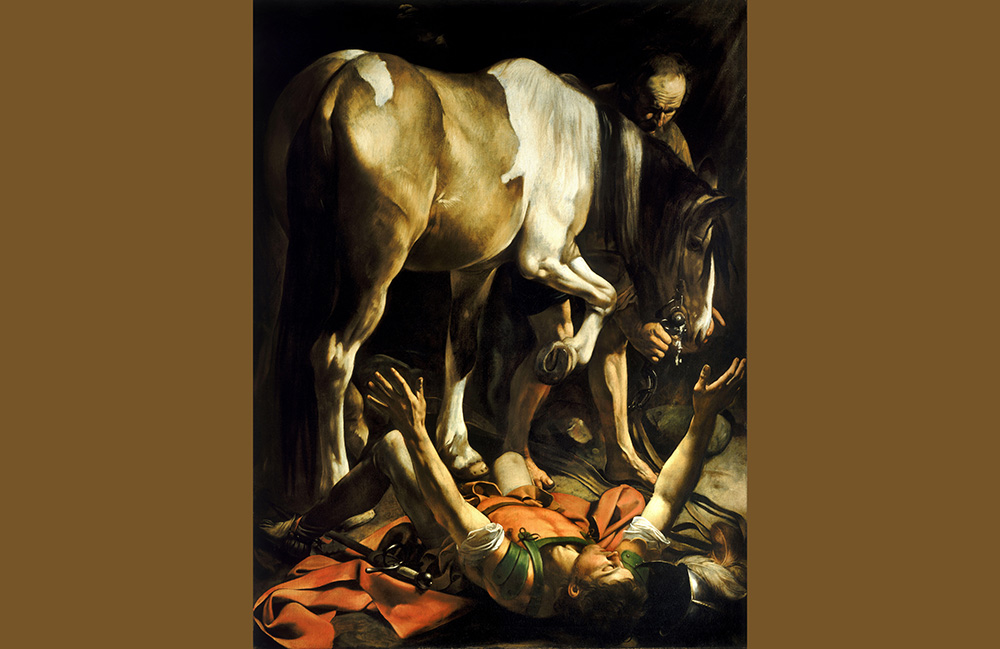
Caravaggio’s The Conversion on the Road to Damascus
It is AD 1600 and Pope Clement VIII has declared a Jubilee year. Nearly three million pilgrims are expected to come to Rome. The vast majority of them will enter Rome through the Porto del Popolo on the northern edge of the city, so that the first church they encounter will be Santa Maria del Popolo. There they will find themselves face to face, or perhaps head to head, with Caravaggio’s Conversion on the Road to Damascus.
It is probably not like anything they have seen before. Conventional representations of the scene generally showed an operatic event, with the future saint knocked from his rearing (and non-scriptural) horse by a dramatic blast of light and the appearance of Christ in the sky. Not so here: Caravaggio’s version takes place in near blackness, illuminated by a strong fall of light from the right. The dramatic moment is past. The horse, though still foaming at the mouth, has been stilled by the frowning and anxious groom and now stands quietly with one foot upraised. Oddly, he occupies the greater part of the panel and blocks off the interior space like a wall. Paul, who fills barely the bottom fourth of the panel, lies sprawled on his back with his head toward the viewer.
The Conversion hangs in a funerary chapel commissioned by the pope’s treasurer-general, Tiberio Cerasi. The chapel is narrow and the panel is placed close to the altar, so that the viewer doesn’t see the painting at once, but only when he has come completely inside, and is suddenly confronted with the stricken Paul (Figure 1). St. Paul, or more properly at this moment, Saul, is depicted as a young man, dark, clean-shaven, and curly-haired, not the elderly man we generally picture. After his conversion, Paul spent fourteen years in study before beginning his formal ministry; this is the “before” picture.
THIS ARTICLE ONLY AVAILABLE TO SUBSCRIBERS.
FOR QUICK ACCESS:
Mary Elizabeth Podles is the retired curator of Renaissance and Baroque art at the Walters Art Museum in Baltimore, Maryland. She is the author of A Thousand Words: Reflections on Art and Christianity (St. James Press, 2023). She and her husband Leon, a Touchstone senior editor, have six children and live in Baltimore, Maryland. She is a contributing editor for Touchstone.
A Journal of Mere Christianity—Delivered to Your Door
- Essays on theology, culture, and the Church
- Contributors from across the Christian traditions

Six print issues (one year) of Touchstone, plus full online access and PDF downloads for only $39.95.

Get a one-year full-access subscription to the Touchstone online archives for only $19.95.
bulk subscriptions
Order Touchstone subscriptions in bulk and save $10 per sub! Each subscription includes 6 issues of Touchstone plus full online access to touchstonemag.com—including archives, videos, and pdf downloads of recent issues for only $29.95 each! Great for churches or study groups.
Transactions will be processed on a secure server.
more from the online archives
31.1—January/February 2018
on Taking the Measure of the Deserving & the Undeserving Poor by Martin Bordelon
19.8—October 2006
on the Good Father’s Quiet Desperation by Russell D. Moore
25.3—May/Jun 2012
Calls for Freedom, Democracy & Secularism End Up with None of the Above by Hunter Baker
calling all readers
Please Donate
"There are magazines worth reading but few worth saving . . . Touchstone is just such a magazine."
—Alice von Hildebrand
"Here we do not concede one square millimeter of territory to falsehood, folly, contemporary sentimentality, or fashion. We speak the truth, and let God be our judge. . . . Touchstone is the one committedly Christian conservative journal."
—Anthony Esolen, Touchstone senior editor
