





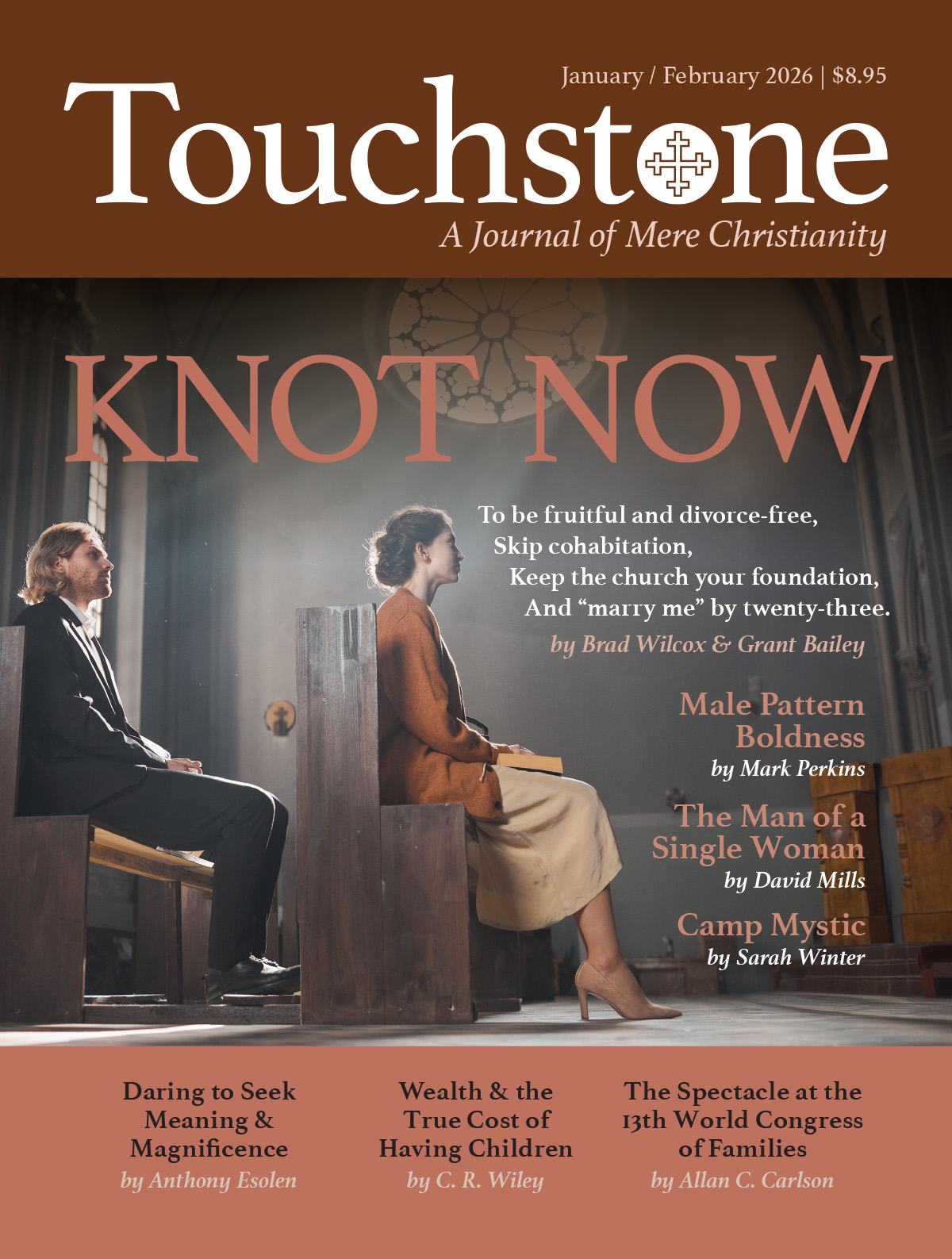
Male Pattern Boldness
Restoring Masculinity Outside the Feminist Frame
Sometime in the last century we became the first society in world history to perceive the ills of exploitative male violence against women —so the myth of modern feminism tells us, never mind the Old Testament’s rather thorough documentation of this problem. What is true, however, is that we are the first society in the history of the world to forget that male weakness is an equally dangerous problem, that male cowardice is a generally necessary condition for the perpetuation of male violence.
Because we have forgotten this, we have also forgotten how to form masculine strength in healthy directions. Indeed, we have forgotten the good of masculinity altogether, seeking refuge from masculinity through a widespread cultural embrace of emasculation. No wonder, then, that we see a new and disturbing emergence of what some are calling “neo-pagan masculinity.” If we give our young men a choice between emasculation and exploitation, we should not be surprised when some choose the latter. Fortunately, this is a false choice.
The Progressive Solution: Be More Like Women
There are any number of ways to describe our broad, culture-wide failure to produce healthy masculine strength, not least the now decades-long decline of male outcomes in education, the workplace, and overall health. The current “toxic war on masculinity,” as Nancy Pearcey puts it in her book of the same name, has something to do with this failure, but, as Pearcey’s book argues, the roots are deeper and harder to resolve —connected not only to the erosion of the Church and the family in the past sixty-odd years but also to the centuries-long and gradually intensifying disembodiment and dislocation wrought by industrial and postindustrial economic systems.
Whatever the origins of our present masculinity crisis, mainstream media is finally starting to acknowledge male decline as a problem. Perhaps the most important book in changing contemporary conversation thus far has been Richard Reeves’s 2022 Of Boys and Men: Why the Modern Male Is Struggling, Why It Matters, and What to Do About It. While Reeves’s book did not make the New York Times bestseller list, it seems to have been read by everyone who writes for the Times —and The Atlantic and The New Yorker and so forth. It did indeed, as the publisher claims, “spark a national conversation,” at least among the literati.
Reeves is an economist with the Brookings Institution, and he brings an economist’s attention to the data documenting male decline. Men are becoming less successful at school (3–17) and at work (18–30). So-called “deaths of despair” have skyrocketed among men (60–63). Absentee fatherhood is increasingly common —and this absence causes tangible and measurable harms (40–42). To his credit —and in marked contrast to progressive gender ideology —Reeves acknowledges “natural sex differences” (85), and he insistently (and only somewhat apologetically) argues that the struggles of boys and men are worth our attention. Reeves affirms that a child needs a mother and a father, not just two sets of generic parental hands, and that the emptying out of the meaning and purpose of fatherhood is a profound cultural problem (169f). He argues cogently against the counterproductive pathologizing of maleness inherent in the concept of “toxic masculinity” (107f). In short, Reeves deserves credit for pushing mainstream elite conversation in a more pro-masculine direction.
But the solutions on offer in Of Boys and Men are insufficient. The primary suggestion for reforming education —so-called “redshirting,” keeping boys back a year in school (133f) —is peripheral to the problems besetting K–12 education in general and boys in particular. Reeves’s call to increase the number of male teachers (140f) is more promising, but he does not adequately engage the question of why so many men do not want to teach in the first place. No doubt salaries and “stigma” have something to do with it, but even with better salaries and less stigma, relatively few men would want anything to do with the progressive, pseudo-therapeutic culture of college education departments —and the men who might thrive in such contexts are unlikely to serve as models of healthy masculinity in the classroom.
This failure hints towards the ironic besetting sin of Reeves’s book: the repeated implication that the solution to our masculinity crisis is for men to become more like women. Although Reeves intends to chart a third way —neither “the Left [which] tells men, ‘Be more like your sister’” nor “the Right [which] says, ‘Be more like your father’” (xii) —he repeatedly gives the same old leftist answer, though without the usual misandry.
Restoring Meaning to Fatherhood
This is especially evident in his approach to fatherhood. Reeves acknowledges that “for at least the last few thousand years” (33) cultures across the globe have upheld distinct but complementary roles for mothers and fathers —specifically, maternal nurture and caring paired with paternal protection and provision. Of course, good fathers have always nurtured, and mothers are proverbially protective of their young. The distinction is not absolute, but it is seemingly universal, and it is rooted in bodily differences that were enormously significant in pre-industrial societies. Broad sex-correlated differences in size and strength matter, but a woman’s ability to get pregnant and nurse babies made the husbandly role of provider and protector absolutely necessary.
This is less obviously true in our post-agrarian society. The steadily sharpening decline in the per capita number of children born, as well as the substitution of technological know-how and professionalized childcare for the traditional demands of pregnancy and childrearing, have radically diminished the apparent social significance of sex difference. Meanwhile, in the postindustrial workplace, bodily difference matters less than ever before, and the widespread entry of women into the workplace beginning in the 1970s destabilized the old protector-nurturer partnership.
In truth, though, the shift of economic productivity from the homestead to the factory or office had already undermined the old framework in the century or so preceding the “women’s liberation” movement of a half-century ago. Contrary to Reeves’s depiction (34), for instance, Willy Loman in Arthur Miller’s Death of a Salesman is not a traditional breadwinner. His despair is rooted not in the constraints of tradition but rather in the radical dislocation of economic productivity from the family home. Wendell Berry, among others, has persuasively argued that “women’s liberation” was at least in part a reaction against this new situation. To put it in the words of one of my former students —who was drafting a thesis statement for her paper defending second-wave feminism —“Men abandoned the home thanks to the industrial and market revolutions, so women should be able to abandon the home too.”
In any event, as physical strength has become less obviously relevant to the protection of the family, and as men are no longer assumed to be primary economic providers, the meaning of fatherhood has been cast into doubt. “The role of mothers,” Reeves says, “has been expanded to include breadwinning as well as caring, but the role of fathers has not been expanded to include caring as well as breadwinning” (32). To be precise, it is not that “breadwinning” is now considered a maternal trait per se, but rather that the move of women into the workplace has not undermined cultural recognition of the enduring and irreplaceable significance of a mother’s distinctive nurturing role. What it has undermined is the notion of breadwinning as a distinctive fatherly role.
If you doubt this, try out the following sentences the next time you are in a casual conversation about parenting. First, say, “Aren’t mothers wonderful nurturers?” Then try, “Fathers are admirable breadwinners, wouldn’t you say?” Outside of Moscow, Idaho, perhaps, there are not many circles —even traditional, conservative ones —where the latter sentence could be uttered unironically. Meanwhile, there are very few places, other than particularly progressive departments at your local university, where the former sentence would sound discordant.
In the face of this challenge, Reeves calls for a redefinition of fatherhood in a more nurturing direction, along with more equitable paid leave and child support systems for both mothers and fathers (173f). Whatever these policies might accomplish, it is hard to see how they could restore meaning to fatherhood as such, given that they are explicitly designed to eliminate differences between mothers and fathers. Of course fathers nurture, just as mothers protect and provide, but nurturing as such is not a distinctly paternal trait and never will be. If children really do need not just two parents in general but rather a mother and father specifically, then fatherhood must add something distinct from motherhood to a child’s formation. Reeves identifies this distinctive something —specifically, “protection and teaching” (169) —and while he notes that such traits must look different in our context, none of his preferred policies have anything to do with restoring or honoring these fatherly distinctives. Instead, his proposals would make fatherhood more like motherhood —not so much resolving as reinforcing the problem.
The Best Mainstream Culture Has to Offer
Reeves’s response to the decline of traditionally male-dominated professions falls short in similar ways. He does propose “a massive investment in male-friendly vocational education and training” (145), and he acknowledges that seeking equal representation in many fields is a fool’s errand, because disproportionate representation reflects apparently innate differences in interest. More men than women want to be engineers; fewer want to be therapists (97–99). Nevertheless, his primary proposal is increasing “the share of men in [traditionally female] HEAL occupations —health, education, administration, and literacy” (152) —through a combination of male-oriented marketing and Title-IX-style mandates. He does not expect male representation in these fields to equal that of women —just to become somewhat less unequal. (He cites one study that purports to demonstrate that the underlying interest gap is not as wide as the actual participation gap in nursing and education [99–100, 125].) Once again, whatever the potential economic benefits of this policy, the unspoken —and, presumably, unintended —premise is that men would be better off if they were a bit more like women.
Again, this is the maximally pro-masculine argument available to contemporary progressivism. Reeves is so far out of step with elite hostility to masculinity that two of the back-cover blurbs describe his book as “courageous.” Yet his dissidence is not exactly that of La Résistance in Vichy France. He is at pains throughout to affirm his feminist bona fides. He repeatedly insists that “we can be passionate about women’s rights and compassionate towards vulnerable boys and men” (x, emphasis original); that “we can help men without . . . trying to turn back the clock” (128); that “doing more for boys and men does not require an abandonment of the ideal of gender equality” (184). He follows the standard intersectional playbook with chapters on race and class, although the gender portion of his intersectional trifecta focuses “on the challenges faced by cis heterosexual men” (xii).
Still, Reeves may well be courageous by the standards of his own set. Every essay, podcast, or interview about the book that I have come across in the mainstream press includes an apology —in both senses of the word —for daring to talk about male problems in the first place. Nevertheless, as Reeves explicitly affirms, his entire argument takes place within the feminist frame. At the outset, he characterizes his purpose as building “a prosocial masculinity for a postfeminist world” (xiii). He concludes the book by describing his work as an extension of feminism, which, “as a liberation movement . . . has not gone far enough. Women’s lives have been recast. Men’s lives have not” (184). The feminist recasting of womanhood has made women more like men —as Reeves implicitly acknowledges and Abigail Favale conclusively shows in The Genesis of Gender. Just so, Reeves ultimately wants to make men more like women. This is no way out of our masculinity malaise but only a deepening of the crisis.
Given that this is the best mainstream culture offers men, we should not be surprised by the rise of “neo-pagan masculinity” and the “vitalist right,” as documented by Aaron Renn and others. In reaction to culture-wide emasculation, these neo-pagans praise masculine strength oriented towards violence and exploitation. As Renn says of the online men’s influencer Jack Donovan, neo-pagans “idolize a mythic past” and “seek to return to a Hobbesian world.” Perhaps the most infamous neo-pagan is the pseudonymous “Bronze Age Pervert” (BAP), who rejects equality, kindness, and civilization writ large. His heroes are self-serving rulebreakers —pirates, conquistadors, and all who take what they want from the weak by force. As C. Bradley Thompson summarizes, BAP’s “new-model man will be spurred to act by . . . the ‘demoniac and violent madness underlying things,’ the ‘unquenchable lust for power,’ the ‘instincts to conquer and expand the domain of his action,’ and the ‘wolfish and predatory instinct.’”
The historian might be tempted to object that this is all so much wishcasting —“LARPing” through the pages of an imagined “High T” past. Outside the mind of Hobbes, there never was a Hobbesian world. Conquistadors —like everything related to Iberian Catholicism —are a complicated lot not reducible to a manifestation of masculine libido dominandi. But such historical argumentation misses the point. The vitalists are not engaged in historical reconstruction at all. Like the feminists, they are mythmakers. And although it is not yet clear that neo-pagan masculinity has much purchase beyond the more unappealing corners of the too-online right, it is clear that our neo-pagans are responding to real failures in contemporary culture.
But they respond poorly. None of these pirates or conquistadors or ancient warrior kings were glorying in masculine strength per se —the very notion is unthinkable outside of a feminist frame. Like Reeves’s postfeminist masculinity, the neo-pagan masculinist does not escape so much as reinforce the dominant feminist frame. Although in one sense the vitalist pirate is the opposite of the effeminate man, the two exist symbiotically. The appeal of neo-pagans is in their transgressive rejection of mainstream anti-masculinity; meanwhile, the fear of neo-pagan “toxic masculinity” only further entrenches anti-male hysteria. Neither offers anything like a healthy, mature masculinity. Whereas Reeves and mainstream culture tell men to become like women, BAP and his like uphold childish self-indulgence as peak masculinity. Their exploiter is a sad shadow of masculinity —an overgrown child unwilling or unable to control his passions.
There is another way.
Raising Up Ron Swansons
Earlier this year I found myself among a group of conservative scholars discussing the significance of the neo-pagan manosphere. I commented that what we are seeing is simply a new iteration of the age-old problem of weak men and abusive men, and I suggested that what we need is a masculinity that is both good and strong. “Yes,” mused another, “where’s Ron Swanson when you need him?”
I quipped that, personally, I had been thinking of Jesus Christ. But, then again, perhaps Swanson —the gun-toting, bacon-inhaling, libertarian tough guy with a heart of gold from the television show Parks & Rec, who often acts as a kind of paternal protector for female characters —perhaps Swanson is, in his own peculiar way, a Christ figure. At the least he is an achievable approximation of healthy masculinity in contemporary America, though certainly not the only model. As Renn has said, quoting an unnamed pastor, healthy masculinity has to include everyone from Mr. T to Mr. Rogers. Ideally, Mr. T —at least in his public persona —would have a bit more of Mr. Rogers in him, and Mr. Rogers could certainly use a dose of Mr. T, but the point stands.
How can we raise up more Ron Swansons, more Misters T and Rogers? In that same conversation I claimed that the solutions —the conditions necessary for raising boys into healthy, strong manhood —are pretty simple. That statement provoked skepticism. There are, after all, no silver bullets. A young person is a person, not a machine, and there is no set of inputs that can guarantee a certain output. Further, while the generally necessary conditions for masculine formation are fairly straightforward, they are extraordinarily difficult to effect in contemporary America.
As Jason Craig argues in Leaving Boyhood Behind: Reclaiming the Gift of Manhood and Traditional Rites of Passage, restoring these conditions requires recovering traditional rites of passage —the method by which cultures across time and space have brought their boys into mature manhood. Rites of passage involve three distinct parts. First, a boy is temporarily removed from his domestic family. He is then initiated into manhood through challenge —often with a kind of funereal quality, because the boy must die for the man to emerge. Finally, he is assimilated into an adult vocation and into a group of peers —his band of brothers, who are the men of the community.
These rites work because adolescence is a time of passage, liminal and transitional by definition. Puberty removes a boy from his childhood, whether he likes it or not, and he only exits adolescence when he has achieved some degree of settled adulthood. Adolescent rites of passage are effective precisely because they do not create but rather honor this given reality —which is the reason we find them practically everywhere. When we consciously remove a boy from the domestic sphere, purposefully separating him from his childhood, when we then initiate him into manhood through challenge, and then assimilate him into an adult vocation and community, we are honoring the givenness of his development.
Like liturgy, these rites must be authorized and recognized by a community. Modern American weddings —by which I mean made-for-TikTok attempts to turn the solemnization of matrimony into yet one more manifestation of expressive individualism —fail to live up to the reality of holy matrimony. And yet we must admit that these anti-liturgical weddings still work at a basic level because marriage is real, and because the community still recognizes a husband and wife as being something they were not before. The still-enduring power of matrimony in the face of every attempt to empty it of all meaning should give us hope that we can recover these lost rites of passage.
This process of removal, initiation, and assimilation is fairly simple to describe and understand, but our culture makes it extraordinarily difficult to enact. Initiatory challenges work best when boys learn embodied competencies from men and then are able to demonstrate their own budding competence in a way that brings recognition from both peers and mentors. Some of these skills ought to involve a degree of danger and risk, and they ought to be directed towards constructive ends. Cliff diving, for instance, demonstrates courage and can build solidarity —but its lack of communal usefulness limits its power as a rite of passage. What is needed, then, is a place for boys to experience adult responsibilities, challenges, and risks within a thick community, which is itself embedded in a coherent culture upholding a strong sense of what manhood is. Rites of passage require, in short, cultural conditions that were once commonplace but are now largely extinct.
Indeed, ours might be the first society custom-designed to prevent the formation of healthy masculinity. We have few thick communities in which boys are deeply known by adult mentors —few communities with mature, self-confident men ready to confer manhood upon boys. Meanwhile, we give our young people little room to experience adult freedom and demonstrate adult responsibility. We are perhaps the first culture in world history in which a 17-year-old boy’s daily routine and responsibilities are more like those of his 11-year-old little brother at home than his 20-year-old brother who is off at college or working and living independently.
The exception —the one way in which we practice “free-range parenting” —is in giving our youth free rein to digitally explore our incoherent if not malignant culture. Consider: no one will call Child Protective Services if you hand a 12-year-old a smartphone with unmediated access to the internet —but if you let that same boy wander in the woods without adult supervision, you might get a knock on the door.
To riff on a common line in educational circles, our culture is perfectly designed to achieve the results we are getting.
Raising Up Christian Men
Forming and sending mature Christian men is the mission of St. Dunstan’s Academy, a farm, trades, and classics boarding school for high-school boys that is being built on a 176-acre farm in the Blue Ridge Mountains of Virginia. We chose our rural campus to give boys the freedom to explore God’s good creation and as a fitting setting for the challenges of strength and endurance that come from hiking the Blue Ridge Mountains, playing rugby, and splitting the wood that will warm them through the winter.
The prototypical rite of passage in our pre-launch phase at St. Dunstan’s involves felling a large tree with a chainsaw. Done rightly, after careful instruction and practice and with a skilled mentor at the elbow, this is not especially risky —driving to campus is riskier —but it still involves real danger. More importantly, it feels quite frightening to the neophyte. Conquering that fear is part of the challenge. Felling a tree is also a productive act. These trees are used in our building projects, and their removal improves the ecology of our forests in keeping with our timber-management plan. And it is a tangible accomplishment that rightly draws the admiration of others. There is nothing quite like the enormous “WHOMP!” heard and felt when a massive red oak crashes to the forest floor.
Challenges like these are part of the recipe for growth into healthy masculinity, but they are not enough to bring boys into mature Christian manhood. For that, we must turn to the man Jesus Christ. At the beginning of the one story we have from Jesus’ youth, St. Luke describes our Lord as “the boy Jesus” (2:43) —the sixth time he calls Jesus either the baby or the boy. Up to this point in St. Luke’s Gospel, our Lord is never just plain “Jesus.” But then, at the end of the story, we read, “And Jesus grew in wisdom and stature, and in favor with God and man” (2:52). Over the course of three days, Jesus leaves his boyhood behind. As I have argued elsewhere (“Rites of Passage Can Help Boys Become Men,” Christianity Today, June 27, 2024), following Craig, Jesus does so through a rite of passage. He is removed from his domestic sphere, initiated into manhood through challenge and a kind of death, and then assimilated into an adult vocation and community.
After Jesus goes missing for three days, his parents find him in the temple, among the teachers of Scripture. When his mother addresses him with a classic parental mixture of relief and exasperation —“Son, why have you treated us so? Behold, your father and I have been searching for you in great distress” (2:48) —Jesus seems surprised. “Why did you seek me?” he asks. “Did you not know that I must be about my Father’s business?” (2:49).
The word translated “must” here —“it is necessary” —is one of Luke’s favorites. It shows up once each in the Gospels of Matthew and Mark. Luke uses it eleven times in his Gospel and then a further seventeen times in Acts, and it usually communicates a messianic necessity pertaining to God’s plan of salvation, as in: “Was it not necessary that the Christ should suffer these things and enter into his glory?” (24:26); “I must be about my Father’s business.” Being about his Father’s business leads Jesus slowly, surely, inevitably back to Jerusalem, where he will once again go missing in Jerusalem for three days before being found alive.
Ultimately, rites of passage foreshadow, anticipate, and echo the true rite of passage: baptism. In baptism, a child is removed from the literal arms of the domestic family, then “buried with Christ” and raised to walk in “newness of life,” and finally presented to his new family —the family of God. The rites of passage by which we initiate our boys into manhood build upon and confirm their fundamental identity in Christ. They also prepare young men to live out the gospel in marriage, as icons of Jesus the Bridegroom —whose sacrificial love for his Bride answers masculinity crises, contemporary and ancient.
Mark Perkins is a priest in the Anglican Province of America and Chaplain and Assistant Headmaster of St. Dunstan’s Academy in Roseland, Virginia.
A Journal of Mere Christianity—Delivered to Your Door
- Essays on theology, culture, and the Church
- Contributors from across the Christian traditions

Six print issues (one year) of Touchstone, plus full online access and PDF downloads for only $39.95.

Get a one-year full-access subscription to the Touchstone online archives for only $19.95.
bulk subscriptions
Order Touchstone subscriptions in bulk and save $10 per sub! Each subscription includes 6 issues of Touchstone plus full online access to touchstonemag.com—including archives, videos, and pdf downloads of recent issues for only $29.95 each! Great for churches or study groups.
Transactions will be processed on a secure server.
more on fatherhood from the online archives

14.1—January/February 2001
A Sociologist Looks at Fatherlessness & Its Causes by David Blankenhorn
19.8—October 2006
on the Good Father’s Quiet Desperation by Russell D. Moore
14.1—January/February 2001
The Christian Heart of Fatherhood
The Place of Marriage, Authority & Service in the Recovery of Fatherhood by John M. Haas
more from the online archives

37.5—Sept/Oct 2024
The Death of Conservatism & the Negative World by J. Douglas Johnson

30.2—March/April 2017
The Education of Children Takes Generations of Fidelity by W. Ross Blackburn

calling all readers
Please Donate
"There are magazines worth reading but few worth saving . . . Touchstone is just such a magazine."
—Alice von Hildebrand
"Here we do not concede one square millimeter of territory to falsehood, folly, contemporary sentimentality, or fashion. We speak the truth, and let God be our judge. . . . Touchstone is the one committedly Christian conservative journal."
—Anthony Esolen, Touchstone senior editor
