





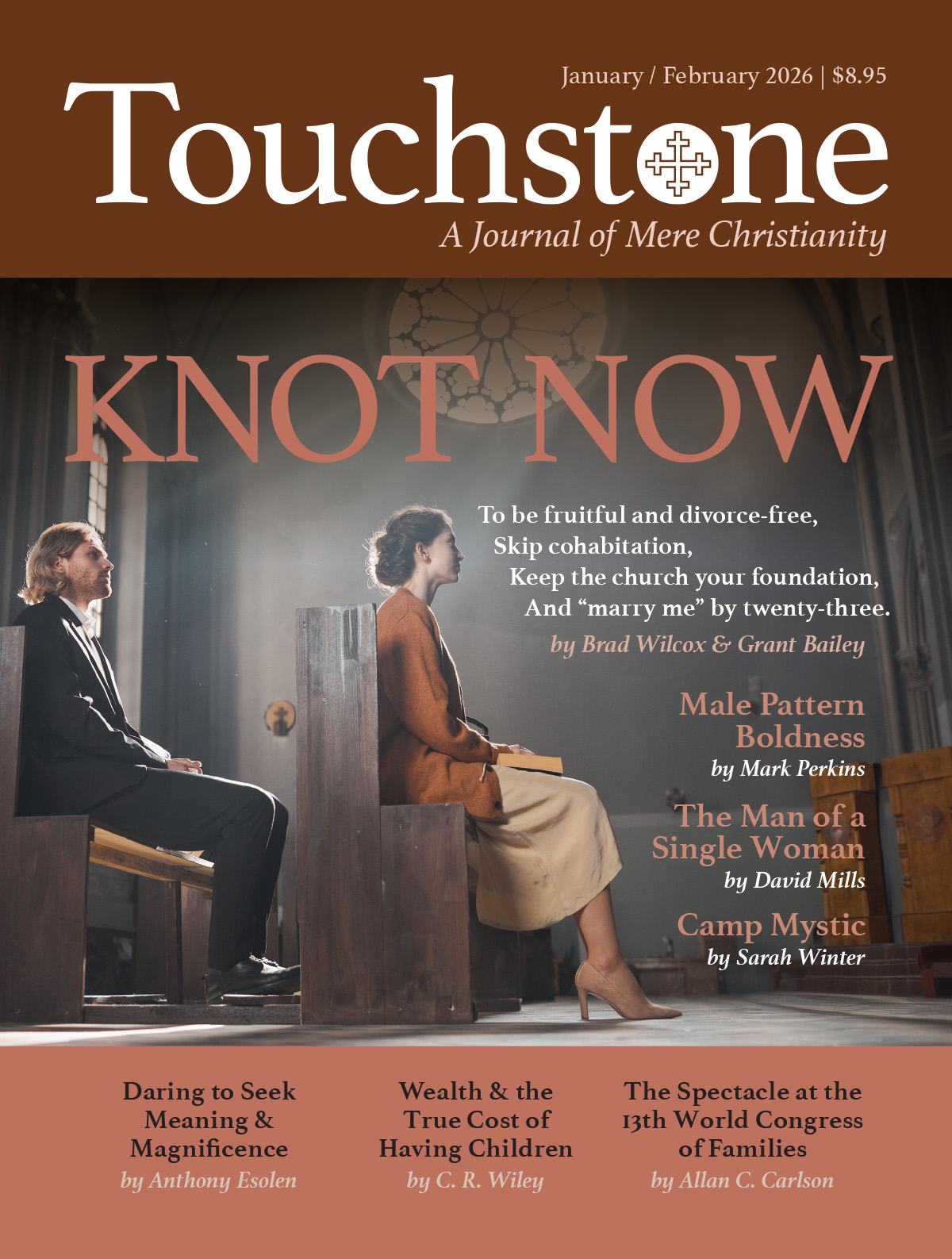
Male Pattern Boldness
Restoring Masculinity Outside the Feminist Frame
Sometime in the last century we became the first society in world history to perceive the ills of exploitative male violence against women —so the myth of modern feminism tells us, never mind the Old Testament’s rather thorough documentation of this problem. What is true, however, is that we are the first society in the history of the world to forget that male weakness is an equally dangerous problem, that male cowardice is a generally necessary condition for the perpetuation of male violence.
Because we have forgotten this, we have also forgotten how to form masculine strength in healthy directions. Indeed, we have forgotten the good of masculinity altogether, seeking refuge from masculinity through a widespread cultural embrace of emasculation. No wonder, then, that we see a new and disturbing emergence of what some are calling “neo-pagan masculinity.” If we give our young men a choice between emasculation and exploitation, we should not be surprised when some choose the latter. Fortunately, this is a false choice.
The Progressive Solution: Be More Like Women
There are any number of ways to describe our broad, culture-wide failure to produce healthy masculine strength, not least the now decades-long decline of male outcomes in education, the workplace, and overall health. The current “toxic war on masculinity,” as Nancy Pearcey puts it in her book of the same name, has something to do with this failure, but, as Pearcey’s book argues, the roots are deeper and harder to resolve —connected not only to the erosion of the Church and the family in the past sixty-odd years but also to the centuries-long and gradually intensifying disembodiment and dislocation wrought by industrial and postindustrial economic systems.
Whatever the origins of our present masculinity crisis, mainstream media is finally starting to acknowledge male decline as a problem. Perhaps the most important book in changing contemporary conversation thus far has been Richard Reeves’s 2022 Of Boys and Men: Why the Modern Male Is Struggling, Why It Matters, and What to Do About It. While Reeves’s book did not make the New York Times bestseller list, it seems to have been read by everyone who writes for the Times —and The Atlantic and The New Yorker and so forth. It did indeed, as the publisher claims, “spark a national conversation,” at least among the literati.
Reeves is an economist with the Brookings Institution, and he brings an economist’s attention to the data documenting male decline. Men are becoming less successful at school (3–17) and at work (18–30). So-called “deaths of despair” have skyrocketed among men (60–63). Absentee fatherhood is increasingly common —and this absence causes tangible and measurable harms (40–42). To his credit —and in marked contrast to progressive gender ideology —Reeves acknowledges “natural sex differences” (85), and he insistently (and only somewhat apologetically) argues that the struggles of boys and men are worth our attention. Reeves affirms that a child needs a mother and a father, not just two sets of generic parental hands, and that the emptying out of the meaning and purpose of fatherhood is a profound cultural problem (169f). He argues cogently against the counterproductive pathologizing of maleness inherent in the concept of “toxic masculinity” (107f). In short, Reeves deserves credit for pushing mainstream elite conversation in a more pro-masculine direction.
But the solutions on offer in Of Boys and Men are insufficient. The primary suggestion for reforming education —so-called “redshirting,” keeping boys back a year in school (133f) —is peripheral to the problems besetting K–12 education in general and boys in particular. Reeves’s call to increase the number of male teachers (140f) is more promising, but he does not adequately engage the question of why so many men do not want to teach in the first place. No doubt salaries and “stigma” have something to do with it, but even with better salaries and less stigma, relatively few men would want anything to do with the progressive, pseudo-therapeutic culture of college education departments —and the men who might thrive in such contexts are unlikely to serve as models of healthy masculinity in the classroom.
This failure hints towards the ironic besetting sin of Reeves’s book: the repeated implication that the solution to our masculinity crisis is for men to become more like women. Although Reeves intends to chart a third way —neither “the Left [which] tells men, ‘Be more like your sister’” nor “the Right [which] says, ‘Be more like your father’” (xii) —he repeatedly gives the same old leftist answer, though without the usual misandry.
Restoring Meaning to Fatherhood
This is especially evident in his approach to fatherhood. Reeves acknowledges that “for at least the last few thousand years” (33) cultures across the globe have upheld distinct but complementary roles for mothers and fathers —specifically, maternal nurture and caring paired with paternal protection and provision. Of course, good fathers have always nurtured, and mothers are proverbially protective of their young. The distinction is not absolute, but it is seemingly universal, and it is rooted in bodily differences that were enormously significant in pre-industrial societies. Broad sex-correlated differences in size and strength matter, but a woman’s ability to get pregnant and nurse babies made the husbandly role of provider and protector absolutely necessary.
Mark Perkins is a priest in the Anglican Province of America and Chaplain and Assistant Headmaster of St. Dunstan’s Academy in Roseland, Virginia.
A Journal of Mere Christianity—Delivered to Your Door
- Essays on theology, culture, and the Church
- Contributors from across the Christian traditions

Six print issues (one year) of Touchstone, plus full online access and PDF downloads for only $39.95.

Get a one-year full-access subscription to the Touchstone online archives for only $19.95.
bulk subscriptions
Order Touchstone subscriptions in bulk and save $10 per sub! Each subscription includes 6 issues of Touchstone plus full online access to touchstonemag.com—including archives, videos, and pdf downloads of recent issues for only $29.95 each! Great for churches or study groups.
Transactions will be processed on a secure server.
more on fatherhood from the online archives

30.2—March/April 2017
The Education of Children Takes Generations of Fidelity by W. Ross Blackburn
26.1—Jan/Feb 2013
Manly Chastity, Hedonism & the Law of Non-contradiction by Anthony Esolen
more from the online archives

22.8—November/December 2009
Looking for Beauty & Justice 150 Years After Darwin’s Classic by Charles Taliaferro

33.3—May/June 2020
Human & Divine Societies Require Careful Thought & Discourse by Anthony Esolen

calling all readers
Please Donate
"There are magazines worth reading but few worth saving . . . Touchstone is just such a magazine."
—Alice von Hildebrand
"Here we do not concede one square millimeter of territory to falsehood, folly, contemporary sentimentality, or fashion. We speak the truth, and let God be our judge. . . . Touchstone is the one committedly Christian conservative journal."
—Anthony Esolen, Touchstone senior editor
