





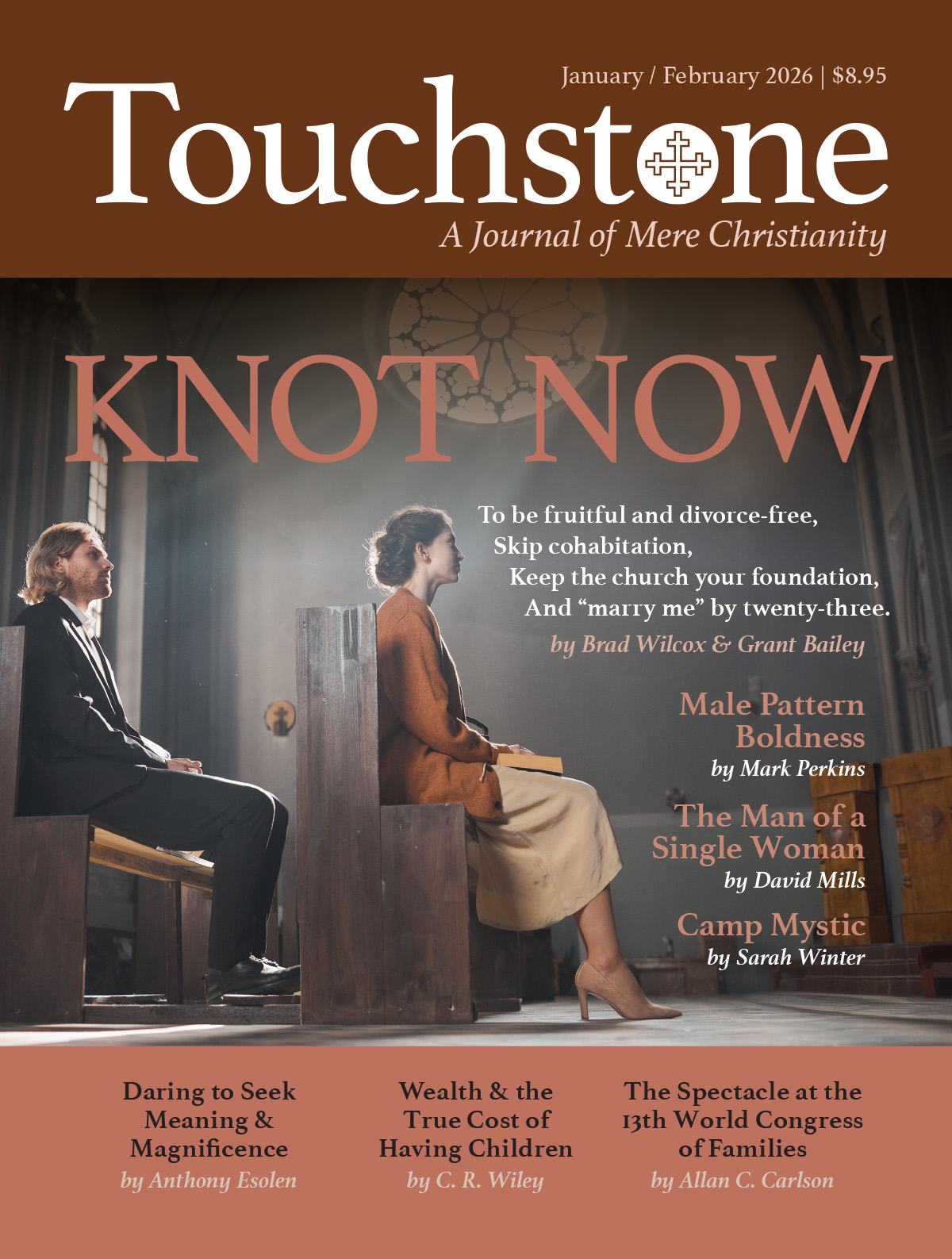
Knot Now
Brad Wilcox & Grant Bailey on the Case for Twenty-Something Marriages
I definitely want to be married by 25,” Justin Bieber, then 17 years old, told the paparazzi when asked about his future family plans. What followed was a minor inquisition. Oprah Winfrey asked Bieber in a later interview whether the reports were true, if he really wanted to get married by 25. Bieber confessed that he did, to which Oprah pressed in: “Rethink that, will you? . . . [Y]our whole 20s is about discovering who you are, and you owe that to yourself.”
Despite Winfrey’s stern admonition, Justin Bieber married at the age of 24. But Bieber is an outlier, both among the celebrity class and the public broadly. For decades, the median age at marriage has steadily climbed, from 22 in the 1960s to almost 30 in recent years. Young marriages have until quite recently become somewhat taboo. Young adults have been told to wait, for a host of reasons: to enjoy their freedom, to find themselves, to travel, to climb the corporate ladder, and to get settled in life before settling down. If you get hitched too early, the conventional wisdom has held, you’ll miss out on having the best time of your life in your footloose and fancy-free twenties, and you’ll probably get divorced to boot.
Fortunately, the tide is now shifting, in a long overdue course correction. From online influencers like Brett Cooper to public intellectuals like Ben Shapiro to tech billionaires like Palmer Luckey, young marriage is being talked up again as an attractive option for starting a family.
After noting on X that he wishes he’d married his wife earlier, for instance, Luckey commented on the pushback his comment engendered: “It says something about society that the most controversial thing I have said in recent history is that I wish I would have married my wife sooner. Not that whales might have better oral history than humans, not that America should restart nuclear testing, marrying young!”
Discouraging & Delaying, Left & Right
This is not to say this idea is likely to be popular in all circles. The Left has long discounted the value of marriage, and especially younger marriage, particularly for women. Articles telling women things like, “Married heterosexual motherhood in America . . . is a game no one wins,” in this case by the writer Amy Shearn in The New York Times, are a regular staple of mainstream media commentary regarding marriage. More recently, the anti-marriage message has come from the right, with manosphere influencers likeAndrew Tate telling his millions of followers that there is “zero statistical advantage” for men who marry. Brian Atlas, host of the highly viewed Whatever podcast, insists that there is “absolutely no reason to get married,” and that marriage is “all risk” for men, partly because he thinks the risk of divorce for contemporary couples is still sky-high.
With shots coming at marriage from left and right in recent decades, it’s no wonder that Americans have been placing less emphasis on matrimony and more emphasis on other priorities. In recent years, a kind of “Midas mindset” has emerged, where young adults are prioritizing status-seeking activities like education and especially work. According to Pew Research, 71 percent of Americans say that having an enjoyable career is important for a satisfying life, whereas only 23 percent say the same about marriage. Me-focused pursuits have eclipsed love, marriage, and family.
One’s twenties, then, are supposed to be devoted to sowing wild oats and making it, not finding a mate and getting married. One apostle of the sexual revolution, Helen Gurley Brown, former editor-in-chief of Cosmopolitan, urged young adults in her book Having It All that it’s better “to be single in your twenties and thirties when a lot of people have the hots for you and you can have as many affairs as you care to fit in, and married when you’re older.” This kind of hedonism and the Midas mindset help explain the rise of the so-called capstone model of marriage, where young adults marry close to 30, and the decline of the cornerstone model of marriage, where they marry in their early twenties.
But with a growing number of voices on the right questioning the capstone model, the question remains: What is the best age to get married?
The Ideal Age to Marry
Brad Wilcox is Distinguished University Professor of Sociology at the University of Virginia, senior fellow at the Institute for Family Studies, and the author of Get Married: Why Americans Must Defy the Elites, Forge Strong Families and Save Civilization.
Grant Bailey is a Research Fellow at the Institute for Family Studies.
A Journal of Mere Christianity—Delivered to Your Door
- Essays on theology, culture, and the Church
- Contributors from across the Christian traditions

Six print issues (one year) of Touchstone, plus full online access and PDF downloads for only $39.95.

Get a one-year full-access subscription to the Touchstone online archives for only $19.95.
bulk subscriptions
Order Touchstone subscriptions in bulk and save $10 per sub! Each subscription includes 6 issues of Touchstone plus full online access to touchstonemag.com—including archives, videos, and pdf downloads of recent issues for only $29.95 each! Great for churches or study groups.
Transactions will be processed on a secure server.
more on Marriage from the online archives

28.1—January/February 2015
on State Impositions & Church Acquiescence by Stephen Baskerville

24.1—January/February 2011
Marriage Thrives in Reality, Not in Our Dreams by Nathan Schlueter

more from the online archives
19.4—May 2006
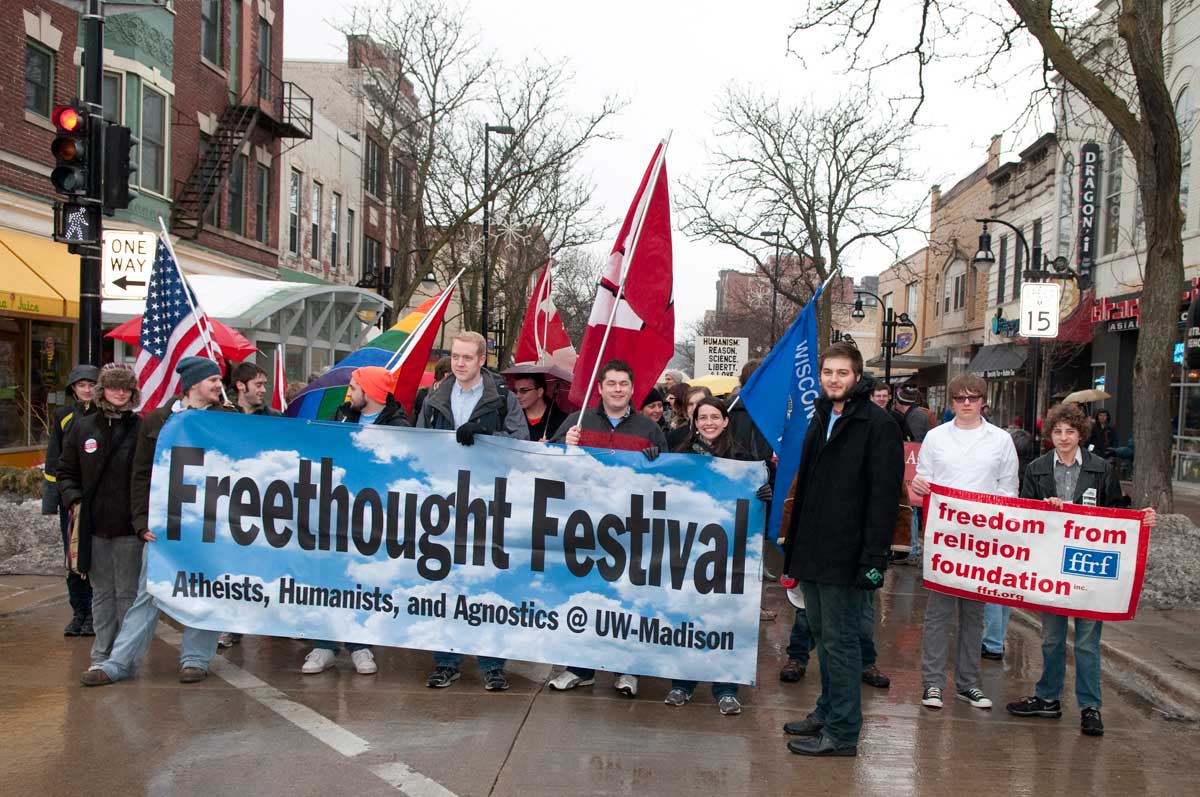
The Culture War Is Between Religious Believers on Both Sides by Howard P. Kainz

24.1—January/February 2011
Ruminations on the Monstrous Envy of the Soul-Devouring State by Anthony Esolen

32.2—March/April 2019
Flight from the Absolute: Cynical Observations on the Postmodern West, Volume II by Paul Gosselin by Louis Markos
calling all readers
Please Donate
"There are magazines worth reading but few worth saving . . . Touchstone is just such a magazine."
—Alice von Hildebrand
"Here we do not concede one square millimeter of territory to falsehood, folly, contemporary sentimentality, or fashion. We speak the truth, and let God be our judge. . . . Touchstone is the one committedly Christian conservative journal."
—Anthony Esolen, Touchstone senior editor
