




The Trinitarian Factor
on the Key to Cultural Recovery
"If you need a moment of Zen . . .” the announcer said bizarrely while encouraging people to tune their dials to Minnesota Public Radio (MPR) for their classical music listening, as if there were anything Zen-like about Western classical music.
Sometimes I encounter such intriguing signposts of Western civilization’s fracturing. I do not mean the mere decay of cultural standards—though, of course, that is there. No, I mean the more tragic and ironic efforts to lift the whole cultural edifice of Christendom and plop it down on pagan foundations with the expectation of solid results. Christian culture is built on the firm foundation of the one, true, and triune God and his gospel. The Trinity is the bedrock of a truly flourishing civilization and all its fruits, but the West, having discarded public acknowledgement of the true God, is in a desperate and tragicomical effort to grasp unity and diversity, with no principle to bring these together. Rejecting the Trinity means a double-minded dance between oneness and plurality, just as rejecting the freedom of Christ means surrender to either chaos or coercion (Europe has generally preferred coercion, America chaos, but we may yet change our minds).
Take my region’s public university, the University of North Dakota (UND), for instance. Here is an institution with consciously Christian foundations, for I have perused an early (1902) advertisement in which it was attested that all the faculty members were Christian, that daily chapel services were held in the morning and also on Sunday evening, and that transportation was available to help students get to church on Sundays. At its founding, UND was more Christian than most Christian colleges are today; yet it was not a private Christian university but a state university in a Christian culture. Its consciously Christian foundations were (if unconsciously) Trinitarian foundations: a fundamental principle for unity and diversity in the cosmos, the sense that existence was rational and could be rationally understood.
But today UND follows the pattern typical of American universities. It has jackhammered out those Christian foundations as thoroughly as it could. There is an interfaith chapel on campus, but the cross there is merely one symbol in a secularized pantheon. Christianity has been privatized into (blessedly thriving) student organizations. It is not that the official organs of the school are entirely divested of religion—there is yoga, the Lotus Meditation Center, and a Pride Center. These bearers of Eastern oneness and Western plurality are within the institution, but the Trinity is “on the outs.” Rational investigation of the many fields of knowledge is still pursued, but in tension with the implicit acknowledgement of fundamental irrationality.
Not at Home
To return to where I began, consider classical music. The first thing to notice is contemporary Christianity’s criminally poor stewardship of its own heritage. Christian radio stations will give you all the CCM (contemporary Christian music) you desire, but for Bach you must go to the pagans. A Luddite who still turns on the radio in the car for music must turn to public radio for classical music.
So it was that I (said Luddite) heard the MPR announcer boosting for his station something to this effect: “In the craziness of the day, if you need a moment of Zen, tune in to MPR classical.” It struck me as both a comical error (because classical music is not at home in the worldview of Zen Buddhism) and a (doubtless unconscious but nonetheless sinister) undermining of Christianity.
For while there are surely some contemporary innovators who attempt to bring a far-Eastern fusion to it, classical music is not the sound of Zen. Zen is a sect of Buddhism, and, as such, its music emphasizes oneness, emptiness, the monotone chant. Silence is nearer to Zen than is the symphony.
On the other side of things, I write this in the month of June, what some observe as the “holy month” of LGBTQIA2S+ paganism. The status of the rainbow ideology as a religious movement is a subject for another day, but I think the fact that the “2S” in the above acronym (from the UND Pride Center) stands for “two-soul” rather clinches the point. In any case, MPR, of course, gives its homage with wishes for a happy Pride and special programming.
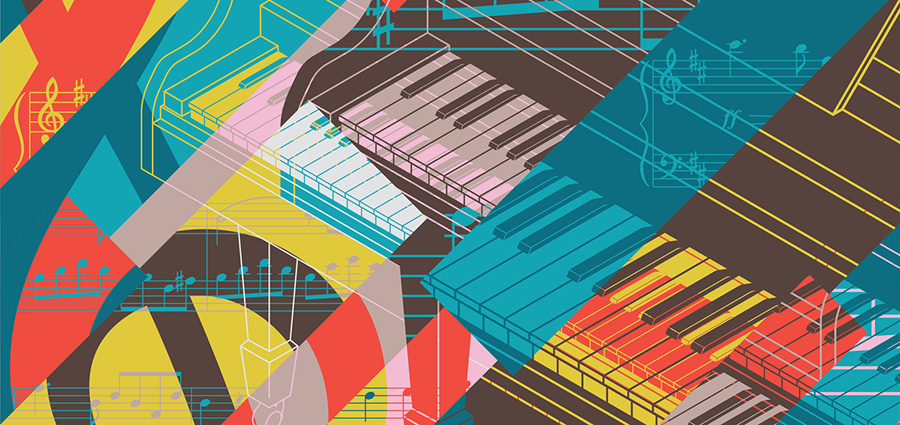
But classical music is not at home in paganism, Eastern or Western, ancient or modern. It is at home in Christendom. This is true not only historically but also in terms of its aesthetic architecture. The symphony reflects a worldview grounded in the Trinity. This obtains even when the composer is not a Christian, as theologian Robert Letham illustrates:
Beethoven was working within a genre that owed its development to the Christian faith. The whole notion of tonal harmony, of developing a theme, of moving progressively and purposively to a goal, of returning after a myriad of complex modulations to a resolution, of a variety of instruments playing different notes that are all part of a single score, is based in the matrix of realities found in the created order, which the Holy Trinity put there in the work of creation itself and which reflect who he is. The turbulent rationalist Beethoven, the angst-ridden Mahler, the syphilitic Schubert, the scatological Mozart, as well as the pious Bruckner and Johann Sebastian Bach, all testify—whether deliberately as in the case of the last two, or unwittingly as with the others—to the triune God who made them and the world around them, to his own unity-in-diversity, purpose, structure, and beauty that such human creativity mirrors. (The Holy Trinity, rev. ed., 531)
Neither the oneness of Zen nor the plurality of Pride can do justice to the unity-in-diversity of the symphony. But the announcer cannot say, “In this crazy world, if you want some music that by its ordered harmony points to the majesty of the triune God, tune in to MPR classical.” The Lord is not on the approved list of gods. And even if he were, he would be just one among others (as in the UND chapel), merely a god, not God.
There lies the tragedy of Western civilization. Its denizens still want the fruits of Christendom—at least some of them. They still want the university, with its promise of knowledge. A few of them still want the sublime beauty of classical music. But they don’t want the foundational doctrine of the Trinity that gives coherence to unity and diversity. They want creation but not the Creator.
Witnessing & Retrieving
What good is this observation? Can we go beyond bewilderment and bemusement to something beneficial? I hope so.
First, it is a point of contact with transcendent truths. In a world that still longs for beauty, truth, and goodness, we can witness that these things have their source and end (telos) in the one, true, and triune God. The longings of humanity are openings for the gospel. The fracturing of Western civilization is an opportunity to present the coherence of the Christian worldview. Fractures can be mended; rifts can be healed; there is a center of coherence to uniqueness and universality. Christ is the missing key to the paradox of culture: “For by him all things were created, in heaven and on earth, visible and invisible, whether thrones or dominions or rulers or authorities—all things were created through him and for him. And he is before all things, and in him all things hold together” (Col. 1:16–17).
Second (and related), we can cultivate our own retrieval of the Christian intellectual and aesthetic heritage. The fact that learning and art are far less important than faith, hope, and love does not mean they have no place at all in the Christian life—which is often the impression churches give. What if families and church communities rediscovered the treasures of the Christian cultural heritage? Could we see the growth of a deeper Christian culture in the midst of decadent Western civilization?
Certainly. Such growth is likely to be slow, but that is how oaks grow, little by little; in our case, one church, one household at a time.
Joshua Steely is the Lead Pastor of Grace Baptist Church in Grand Forks, North Dakota. His articles have appeared in Evangelical Review of Theology, Touchstone, The Christian Post, and other publications.
A Journal of Mere Christianity—Delivered to Your Door
- Essays on theology, culture, and the Church
- Contributors from across the Christian traditions

Six print issues (one year) of Touchstone, plus full online access and PDF downloads for only $39.95.

Get a one-year full-access subscription to the Touchstone online archives for only $19.95.
bulk subscriptions
Order Touchstone subscriptions in bulk and save $10 per sub! Each subscription includes 6 issues of Touchstone plus full online access to touchstonemag.com—including archives, videos, and pdf downloads of recent issues for only $29.95 each! Great for churches or study groups.
Transactions will be processed on a secure server.
more from the online archives

29.5—Sept/Oct 2016
on the Loss of True Community & Rising Political Desperation by Karl D. Stephan
31.4—July/August 2018
Labels & the Ecumenism of Discipleship by James M. Kushiner
calling all readers
Please Donate
"There are magazines worth reading but few worth saving . . . Touchstone is just such a magazine."
—Alice von Hildebrand
"Here we do not concede one square millimeter of territory to falsehood, folly, contemporary sentimentality, or fashion. We speak the truth, and let God be our judge. . . . Touchstone is the one committedly Christian conservative journal."
—Anthony Esolen, Touchstone senior editor
