




Panopticon Control
The great seventh-century theologian Maximus the Confessor famously insisted that the world is the embodiment of God. I agree, though I’d like to replace the noun embodiment with the verb embodying. Verbs are action words, and God is constantly embodying himself, continuously making himself present in a created mode. Embodying is what God does all the time.
I have a particular liking for the verbal form because it makes clear that the created world—including us human beings—exists in a dependent mode, ever relying upon God’s creative and providential activity. God’s merciful gaze brings the world into being, and should he remove his watchful eye for just a moment, creation would return to nothingness. Apart from God, nihil est—nothing exists—without God, and apart from him, we can do nothing (John 15:5).
To be sure, the metaphor of God casting his eye upon the world has its drawbacks. It may seem to imply distance between God and the world—the very thing we try to avoid by talking of God embodying himself. Vision, for us moderns, implies a gap between subject and object. But it wasn’t always so. For the ancient world, and for much of the Christian tradition, vision implied unity. It was thought that a subject unites himself with an object by means of vision. Vision allows the object’s nature or form to enter the subject. As a result, when I merely look at my wife, she already becomes part of me. The ancients recognized, better than we do, both the beauty of a relational, ocular world and the dangers of looking at the world in a haphazard or unseemly manner. To them, God gazing at the world implied that the world is part of him.
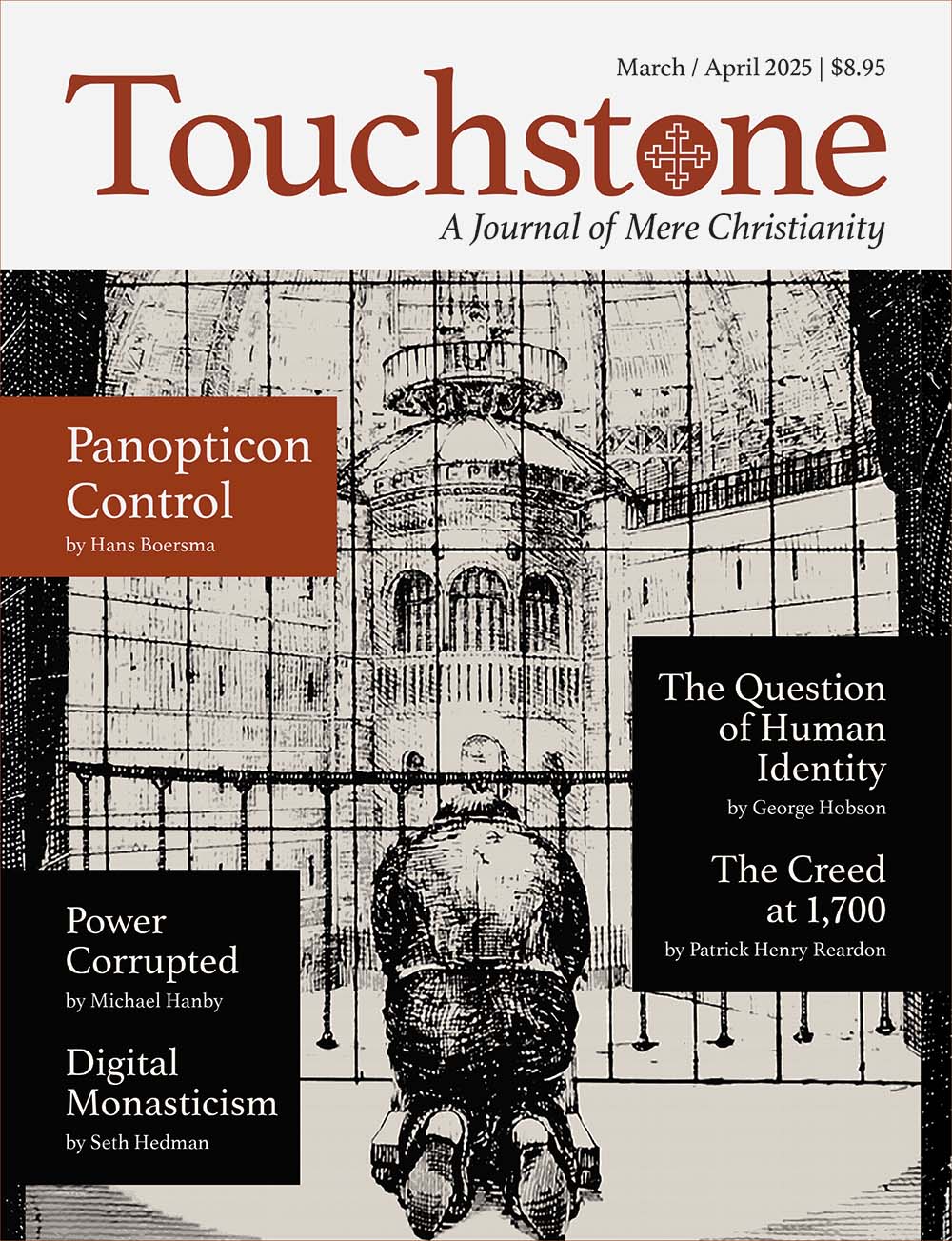
It is not without reason that, for us moderns, vision has come to imply distance. We like it that way. Insisting on a gap between two separate substances (subject and object, or God and world) is a way for us to assert control over the world around us. Back in the eighteenth century, the English philosopher Jeremy Bentham designed a glass prison, circular in shape, so that the jailers, from the center of the building, would be able to observe each and every cell around them at all times. The prison was meant to serve as a panopticon, an all-seeing eye. The same architectural control could be exercised in other settings, mused Bentham—workplaces, hospitals, asylums, and so on. Bentham’s dystopian plan for society was grounded in the notion that vision separates and enables managerial control. He appears to have forgotten that reality is relational in its very nature and that the jailer’s all-seeing eye would end up incarcerating jailer and prisoner alike.
Thankfully, most of us get nervous when we think about the panopticon’s imperious reach and would like to avoid panoptic social structures. Still, the way we think about reality—our metaphysics—operates on the same assumption as Bentham’s prison: moderns assume a gap between God and world, between subject and object. For our day-to-day affairs, the panopticon approach yields the mastery we crave.
Things Seen & Unseen
Christian Platonists—which is to say, the large majority of Christian philosophers and theologians until the rise of modernity in the late Middle Ages—have always implacably opposed any kind of gap between God and the world. Turning to Plato, they think of invisible realities (Plato’s world of forms or ideas) as the “really real” and of visible things as the shimmering forth or mirroring of these “really real” forms in a dependent, created mode.
St. Paul insists that “we look not at the things which are seen, but at the things which are not seen: for the things which are seen are temporal; but the things which are not seen are eternal” (2 Cor. 4:18). The contrast is between visible and invisible things; the former being temporal, the latter eternal. The reason Paul suggests that we look to invisible, eternal things is, no doubt, that they are more real than visible, temporal things. The former are, in Platonic terms, the “really real.”
The same kind of Christian Platonism shines through in the Letter to the Hebrews. Moses had seen the very dwelling-place of God on top of Mount Sinai, and the Lord instructed him to make the earthly tabernacle like his own, heavenly dwelling place (Ex. 25:40). The Letter to the Hebrews speaks of the relationship between the two in markedly Platonic terms, insisting that God’s heavenly sanctuary is “the true tabernacle, which the Lord pitched, and not man” (Heb. 8:2). By contrast, earthly priests serve at “the example and shadow (hypodeigmati kai skiai) of heavenly things” (8:5). Christ the High Priest came, therefore, “by a greater and more perfect tabernacle, not made with hands, that is to say, not of this building” (9:11). God’s heavenly dwelling is the really real tabernacle, serving as the pattern for the shadowy tabernacle on earth.
Contrast, but Not Separation
The contrast may seem to imply a dualism: heaven and earth, truth and shadow, invisible and visible, eternal and temporal. And indeed, a kind of contrast is definitely in play. In each of these pairs, the first is more real and greater than the second. This should not surprise us since—on a Christian understanding—the really real archetypes of created things have their place within the eternal Logos of God. God is utterly transcendent. Many Christian Platonists speak of God, therefore, as beyond being (hyperousios)—indicating that God infinitely outstrips created categories, such that the human intellect cannot possibly comprehend him, whether now or in the hereafter.
Hans Boersma is the Saint Benedict Servants of Christ Professor in Ascetical Theology at Nashotah House Theological Seminary.
A Journal of Mere Christianity—Delivered to Your Door
- Essays on theology, culture, and the Church
- Contributors from across the Christian traditions

Six print issues (one year) of Touchstone, plus full online access and PDF downloads for only $39.95.

Get a one-year full-access subscription to the Touchstone online archives for only $19.95.
bulk subscriptions
Order Touchstone subscriptions in bulk and save $10 per sub! Each subscription includes 6 issues of Touchstone plus full online access to touchstonemag.com—including archives, videos, and pdf downloads of recent issues for only $29.95 each! Great for churches or study groups.
Transactions will be processed on a secure server.
more on culture from the online archives

30.6—Nov/Dec 2017
Christ, Individualism & the Meaning of Cultural Diversity by Anthony Esolen
more from the online archives

32.1—January/February 2019
on Down Syndrome & the Lives That Matter by David F. Watson

27.2—March/April 2014
Higher Education Should Advance the Glorious Liberty of the Sons of God by Anthony Esolen

31.6—November/December 2018
on the Church's Response to the Anti-marriage Tide by Diane Woerner
calling all readers
Please Donate
"There are magazines worth reading but few worth saving . . . Touchstone is just such a magazine."
—Alice von Hildebrand
"Here we do not concede one square millimeter of territory to falsehood, folly, contemporary sentimentality, or fashion. We speak the truth, and let God be our judge. . . . Touchstone is the one committedly Christian conservative journal."
—Anthony Esolen, Touchstone senior editor
