




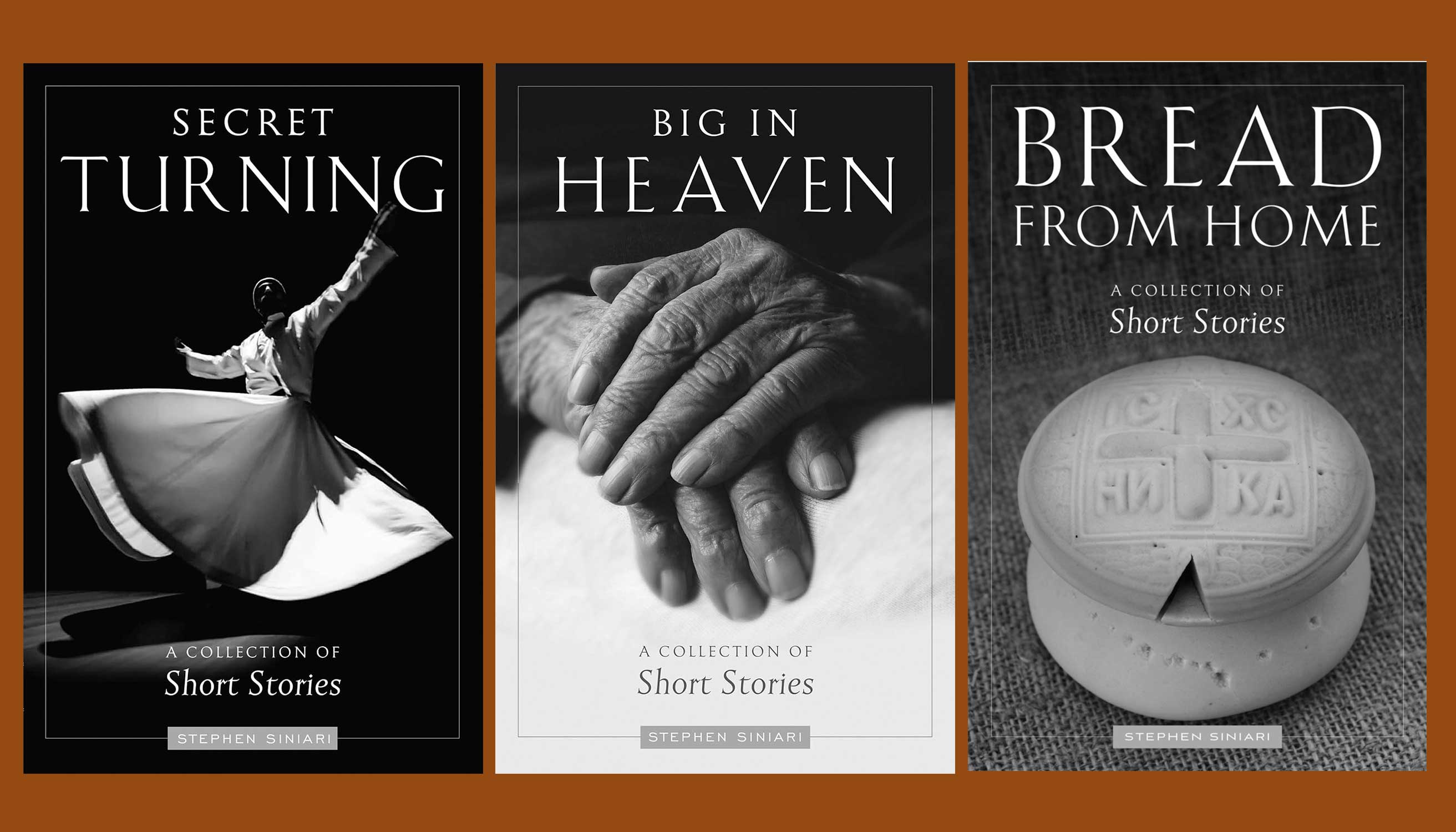
Short Stories of Stephen Siniari
Big in Heaven by Stephen Siniari
Secret Turning by Stephen Siniari
Bread from Home by Stephen Siniari
reviewed by John Thompson
I have long suspected that if C. S. Lewis were writing The Screwtape Letters today, he would cast it as an infernal version of Wikileaks. Those who have read this now-classic work are familiar with his ingenious pretext: he has somehow come into possession of a series of letters written by a senior tempter (Screwtape), giving advice to a junior tempter (Wormwood) about how to provide the latter’s human “patients” with effective temptations. Through this device, Lewis lays bare the ways in which demonic forces capitalize on our weaknesses in order to lead us further and further away from God. In one of the most famous of these letters, we are given a glimpse of how these tempters view the Church:
One of our great allies at present is the Church itself. Do not misunderstand me. I do not mean the Church as we see her spread out through all time and space and rooted in eternity, terrible as an army with banners. . . . But fortunately it is quite invisible to these humans. All your patient sees is the half-finished, sham Gothic erection on the new building estate. When he goes inside, he sees the local grocer with rather an oily expression on his face bustling up to offer him one shiny little book containing a liturgy which neither of them understands, and one shabby little book containing corrupt texts of a number of religious lyrics, mostly bad, and in very small print. When he gets to his pew and looks round him he sees just that selection of his neighbours whom he has hitherto avoided. You want to lean pretty heavily on those neighbours. Make his mind flit to and fro between an expression like “the body of Christ” and the actual faces in the next pew. . . . Provided that any of those neighbours sing out of tune, or have boots that squeak, or double chins, or odd clothes, the patient will quite easily believe that their religion must therefore be somehow ridiculous. (excerpt from Letter 2)
Admittedly, it is not often, if ever, that we see the “body of Christ” as the tempters see it, “terrible as an army with banners.” Yet in our unvarnished, down-to-earth encounters with other believers, there is often a hidden beauty, a brush with the divine. This is the reality which Fr. Stephen Siniari tries to express in these three remarkable books of short stories. The stories are based on his experiences as a parish priest and come mostly from his years serving an Albanian Orthodox parish, which, in these books, goes by the name of St. Alexander the Whirling Dervish Parish in the Fishtown neighborhood of Philadelphia. Although most of these stories are set in a community of second-generation immigrant families who are Orthodox Christians, there is much here that applies to the interpersonal dynamics that can be found in any Christian congregation.
Sneaking Past Our Defenses
A parish priest has to deal with a little bit of everything—marital infidelity, priestly arrogance, irrational anger, sexual abuse. And there are a lot of less “critical” but no less important issues: people drifting away from the church, children with disabilities, uncooperative parish council members, rivalry between women, financial difficulties, and on and on. Of course, it’s not all grit and grime. There are understated miracles here and there, a godly bishop, and many unpublicized acts of kindness, some of them continuing for years.
Siniari’s genius lies in his rich depictions of characters and situations. There is nothing preachy or manipulative in these stories, and they don’t all have happy endings, but you sense that they take place in a world where God is at work. God’s work is veiled, subtle, and gradual, but it is nevertheless transforming the lives of many who stay long enough to see past the idiosyncrasies of their neighbors. Siniari understands that God is indeed very hard at work in the less-than-ideal conditions in which ordinary people actually live. Through these carefully crafted stories, he gently, often indirectly, sneaks past our defenses and shows us things that he could never express in a sermon or a book of theology.
In these stories we meet people who work at the putty factory in Fishtown, eat a lot of jelly doughnuts, or are members of the Teuta Ladies Baking Society. They are as colorful a cast as one might find in a Charles Dickens novel. Truth be told, some of them are people whom, if we were to meet them in real life, we might avoid like the plague.
Consider this scenario: A young Albanian boy, born and baptized by his Orthodox parents in the old country, is brought to the United States. After growing up, he marries a Roman Catholic woman, leaves behind the Orthodox community of his youth, relocates hundreds of miles away, and never again enters an Orthodox church. As he is dying, he pleads with his wife to give him an Orthodox burial at the parish where he grew up. With great reluctance, his family accedes to his wishes, which they see as a costly and unnecessary inconvenience. In Siniari’s story, “Across the Space,” the fictional priest Fr. Naum is given the task of performing the funeral for this lapsed Orthodox Christian.
At first, I was shocked when I read this story. It did not even involve a deathbed conversion. Didn’t it simply depict another quasi-superstitious attempt to earn favor with God through the performance of a superficial ceremonial funeral rite?
Not in Fr. Naum’s eyes. For him, the funeral was more than putting a thin veneer of Orthodoxy over a life lived more or less indifferently to the Orthodox faith. Rather, the grace of God was at work, not in spite of, but through the ancient ceremonies of the church. This is beautifully expressed in the short meditation Fr. Naum delivers at the funeral.
In stories like this, Siniari captures the subtle beauty of the church’s sacramental life. He also lays bare the inner workings, the successes and failures, of men and women who have struggled through the years to keep their parish alive. In his way of doing this, I found him getting past my judgmental attitudes.
As our Lord repeatedly reminds us in the Gospels, judgmentalism is endemic to the human condition. It is an ingrained, constant, and universal reaction toward those who differ from us. It certainly is one of the more pervasive effects of the fall of mankind. True to form, this term applies to all sorts of other people, but oh so rarely to myself. . .
There is another tendency that operates in tandem with judgmentalism that inhibits the growth of genuine community in our churches. And that is our longing for the perfect community.
Our desires are legitimate. We want to be part of a healthy church family, a community of Christians who are warm, accepting, insightful, forgiving, hospitable, funny, and intelligent. In other words, people like us. Right? But whom do we encounter in our churches? People who are at best partly whole. Some who are scarred or broken. Some who are misguided or overbearing or irritating. And a few who keep to the fringes.
What Stories Show Us
Why are short stories so important? They show us, sometimes with stunning clarity, what may be going on inside someone else that is completely invisible to us. (Don’t we each know so well how to put on a face?) We approach each encounter with assumptions about ourselves and about those we encounter, and we look for clues about what is going on.
A well-crafted short story can show us that our observations and supposed insights are very often incorrect. So often are they incorrect, indeed, that they should perhaps not be relied upon at all.
What, then, can we rely on? Siniari’s vivid stories help to point the way. In the background of his stories is the only proper assumption that we can make: that God, in his mercy, is present, both in me and in the other person whom I encounter. That God is seeking the healing, the restoration, and the flourishing of each of us. And that he may choose a highly unqualified sinner like myself to serve or intervene in someone else’s life.
Siniari’s gift is to show how a strange cast of characters, some of whom who inhabit the St. Alexander the Whirling Dervish Orthodox Church, manage to stumble together into the kingdom of God. (If you have a subscription to Audible, you can hear these characters come to life as Siniari narrates his own stories.) Like the members of our real-life churches, they are friendly and hard-working, but they also are stuck in their ways, tempted by terrible sins, and scarred by traumas from the recent or distant past. Nevertheless, they are able to grow together into the Body of Christ—under less than ideal conditions.
There is so much going on in our lives, too. Work. Family. Church. Relationships. We are each living our own stories, and few of us would consider our present situation to be “successful.” So it is easy to be swept along, forgetting that God is at work in our midst, in every circumstance, in every unreasonable request made of us, in every situation, whether frustrating or gratifying. These stories show the multiple and unexpected ways that God, through the ministries and sacraments of his Church, strengthens and encourages us along the way.
This is where we work out our salvation. It is not a matter of a flash of insight or of a single act of kindness, but of a life committed to moving forward towards the light, taking each opportunity to be kind, to assist those around us, and to be available to assist others even when their needs occur at the worst times for us. As Siniari might explain to us, the growth of the kingdom of God in our midst takes place under conditions that are far less than ideal.
John Thompson is a librarian and professor at Waynesburg University, Waynesburg, Pennsylvania
A Journal of Mere Christianity—Delivered to Your Door
- Essays on theology, culture, and the Church
- Contributors from across the Christian traditions

Six print issues (one year) of Touchstone, plus full online access and PDF downloads for only $39.95.

Get a one-year full-access subscription to the Touchstone online archives for only $19.95.
bulk subscriptions
Order Touchstone subscriptions in bulk and save $10 per sub! Each subscription includes 6 issues of Touchstone plus full online access to touchstonemag.com—including archives, videos, and pdf downloads of recent issues for only $29.95 each! Great for churches or study groups.
Transactions will be processed on a secure server.
more from the online archives

25.6—Nov/Dec 2012
The Loss of Aristotelian Logic & the Social, Moral & Sexual Consequences by Peter Kreeft

24.1—January/February 2011
Marriage Thrives in Reality, Not in Our Dreams by Nathan Schlueter

calling all readers
Please Donate
"There are magazines worth reading but few worth saving . . . Touchstone is just such a magazine."
—Alice von Hildebrand
"Here we do not concede one square millimeter of territory to falsehood, folly, contemporary sentimentality, or fashion. We speak the truth, and let God be our judge. . . . Touchstone is the one committedly Christian conservative journal."
—Anthony Esolen, Touchstone senior editor
