




Peter Leithart’s Theopolitan Vision
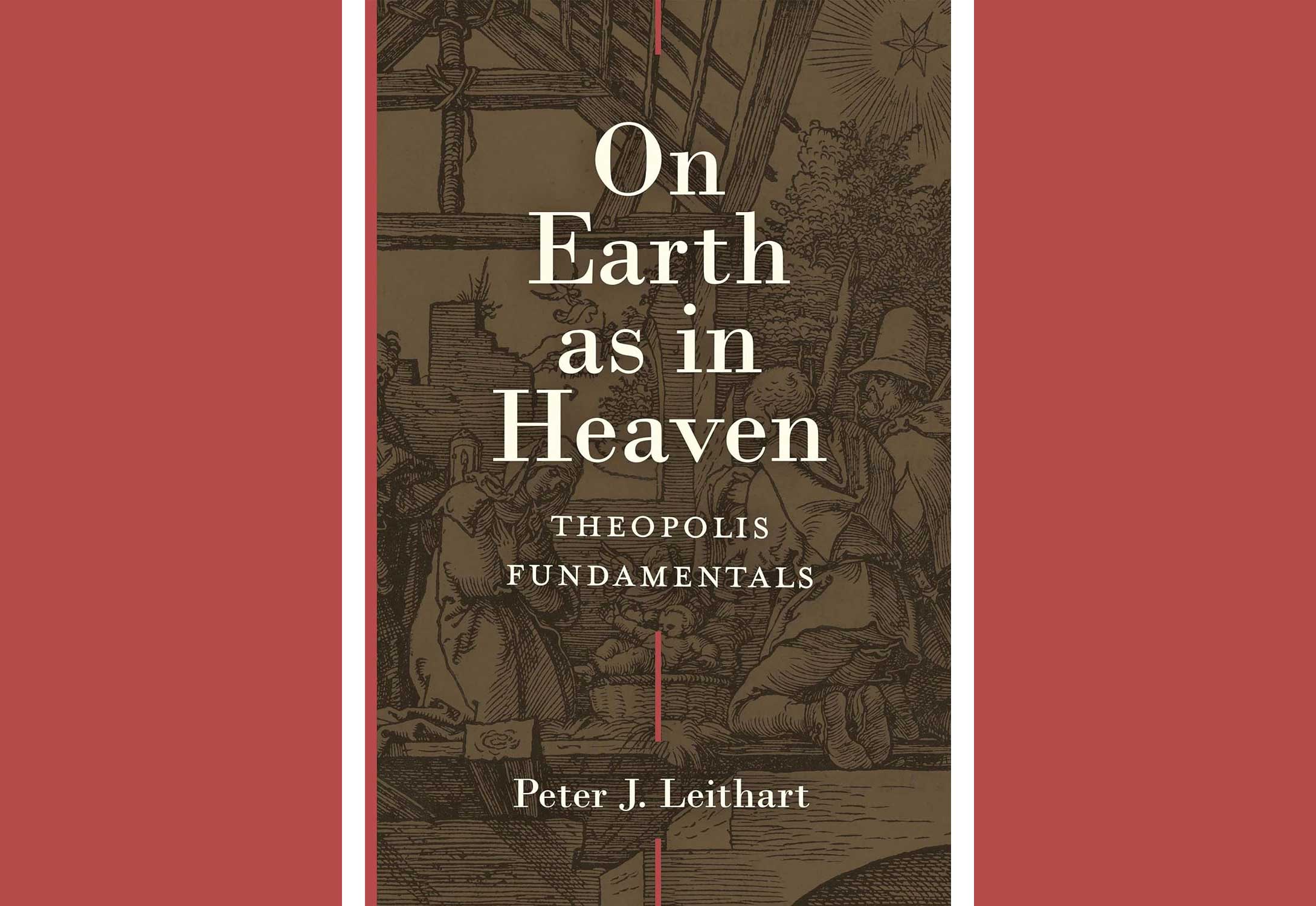
On Earth as in Heaven: Theopolis Fundamentals by Peter J. Leithart
Lexham Press, 2022
(460 pages, $34.99, hardcover)
Peter Leithart is one of the most creative theologians writing today. Full disclosure: he was my theology and literature teacher in my undergraduate days, but I think the range of his oeuvre speaks for itself. He has published studies on theology, biblical theology, literature, liturgy, worship, history, and even a collection of children’s stories. On Earth as in Heaven gathers and summarizes this multifaceted legacy of scholarship and presents Leithart’s central vision for how a rich biblical and liturgical theology impacts the world and culture. He calls this the “Theopolitan vision.” Leithart is the president of the Theopolis Institute, a think tank and training center in Birmingham, Alabama.
What does “theopolis” mean? “The Theopolitan vision is a view of the church and her role in the world” (xvii). The four parts of the book explicate the central features of this vision: (1) the church and city of God, (2) worship, (3) the symbolic universe of Scripture, and (4) mission. The Theopolitan vision is thus an ecclesio-centric vision and is relentlessly focused on the centrality of liturgical worship rooted in the rich symbolism of the Bible and the historic wisdom of the church (xviii).
For this reason, some readers might assume that this is just a “church” book, a book for pastors, theologians, or liturgists. They couldn’t be more wrong. The Theopolitan vision is focused on the church, but it also recognizes that when the church is faithful in its task, it impinges upon, challenges, and transforms the cities of men. A liturgical church is a countercultural institution, and it cannot help heading into collisions with man-centered cultures. Leithart reminds us that the primary weapons of our warfare are the Word, the Eucharist, liturgical worship, radically cruciform mission, and the Holy Spirit, who unites the fragmented nations of the world in an ongoing Pentecost. Therefore, for every Christian who wants to change the culture, or get involved in politics, this book lays out the game plan.
Eternally Applicable Principles
Activists will be frustrated at the lack of a detailed program to, for instance, regain control of the House of Representatives. Instead, they will find a recipe for building strong churches, brave pastors, joyfully courageous congregations, and thoughtful Christians in every sector of life and culture. That’s because Leithart keeps the main thing the main thing. There are plenty of applications of biblical and liturgical principles to the practical challenges of life, but part of Leithart’s accomplishment here is demonstrating that the biblical and historical principles of liturgical worship and typological reading of Scripture are evergreen and eternally applicable throughout the flux of cultural revolutions. Some examples:
Every time we portray the heavenly city in the Supper, we call attention to the injustice, violence, greed, and wickedness of the earthly city. Every time we celebrate the Supper, we are reminded of our own evils and violence and are called to repentance. Through celebration of this meal, we become a city of witness, a witness against the fallen city because we are a witness to the city that is to come. (35–36)
The liturgies of the human city encourage unchecked consumerism, insatiable desire for goods, 24/7 consumption; the liturgy of the city of God is a liturgy of thankfulness and contentment. The liturgies of the human city celebrate nearly infinite sexual freedom and treat Christian sexual ethics as repressive; the liturgy of the city of God is a liturgy of chastity, marital faithfulness, union in sexual difference. The liturgy of the human city places hope in the next Great Leader; the liturgy of the city of God confesses one Lord, Jesus the Christ. We enact the Christian liturgy for the sake of the cities of men so that their cultural liturgies are dismantled and transformed, so that their civic habits and values conform to the word of the King whom we worship (100–101).
Walking Through the Bible
This is a book to be read slowly. Every page has a new insight or fresh connection that should prompt readers to pause and reflect. Leithart walks through the Bible with us, sharing insights garnered from decades of study, all presented in a conversational tone. He takes themes and types of the Bible, like Adam and Eve, Noah’s ark, or sacrificial meals, and shows how they are developed, expanded, and fulfilled throughout the grand narrative of Scripture. It is truly a panoramic view, but he never loses the trees as he flies over the forest.
Leithart’s focus on types and themes—what he terms “spiritual reading”—forms part of the strength of this book. Because these types and themes transcend time and are bigger than their original context, anyone can see himself in these biblical patterns and can understand his own time in biblical terms. Consider, for example, Leithart’s especially helpful and insightful treatment of how the type of Adam develops throughout the Bible:
Adam is a child. The Last Adam is the fully-formed adult. Every character in the Bible is somewhere between the first and Last, somewhere between first and final glory. So are each of us, stretched out between creation and new Jerusalem. For the story of the first and Last Adam is also our story, and we find our bearings by remembering our beginning and anticipating our end. Reading Scripture trains our senses to read our lives. (178)
A Book for All
This book will appeal to a wide variety of Christians because it not only expresses “mere Christianity” but is also anchored in what we might call “deep Christianity.” Leithart’s approach is rooted in patristic exegesis and is historically savvy, but this is not a history book or summary of ancient ways to read the Bible. Leithart applies the insights of the past in fresh ways, but the emphasis is always on letting the Bible speak for itself.
Leithart’s discussion of liturgy transcends the expressions of Lutheran, Anglican, Catholic, or Orthodox worship because it is rooted in the sacrificial sequences of Leviticus. He argues that the liturgies of the ancient and historic church generally follow this pattern, but he also challenges all traditions to rediscover the deep patterns of liturgical action and biblical interpretation.
Pastors and church leaders will be most encouraged by this book, and Leithart stresses the crucial importance of their calling. But all Christians should be inspired to recommit themselves to the worship and work of their local church, to serious Bible study, and to pursuing a life transformed by the Spirit. In all these ways, the city of God will continue to resurrect and renew the cities of men.
Gregory Soderberg teaches and mentors students of all ages at Logos Online School, Kepler Education, the BibleMesh Institute, and Redemption Seminary. He writes at gregorysoderberg.substack.com and gregorysoderberg.wordpress.com.
A Journal of Mere Christianity—Delivered to Your Door
- Essays on theology, culture, and the Church
- Contributors from across the Christian traditions

Six print issues (one year) of Touchstone, plus full online access and PDF downloads for only $39.95.

Get a one-year full-access subscription to the Touchstone online archives for only $19.95.
bulk subscriptions
Order Touchstone subscriptions in bulk and save $10 per sub! Each subscription includes 6 issues of Touchstone plus full online access to touchstonemag.com—including archives, videos, and pdf downloads of recent issues for only $29.95 each! Great for churches or study groups.
Transactions will be processed on a secure server.
more from the online archives
20.4—May 2007
A Short & Surprising History of Protestantism & Contraception by Allan C. Carlson
calling all readers
Please Donate
"There are magazines worth reading but few worth saving . . . Touchstone is just such a magazine."
—Alice von Hildebrand
"Here we do not concede one square millimeter of territory to falsehood, folly, contemporary sentimentality, or fashion. We speak the truth, and let God be our judge. . . . Touchstone is the one committedly Christian conservative journal."
—Anthony Esolen, Touchstone senior editor
