




Delivered From Evil
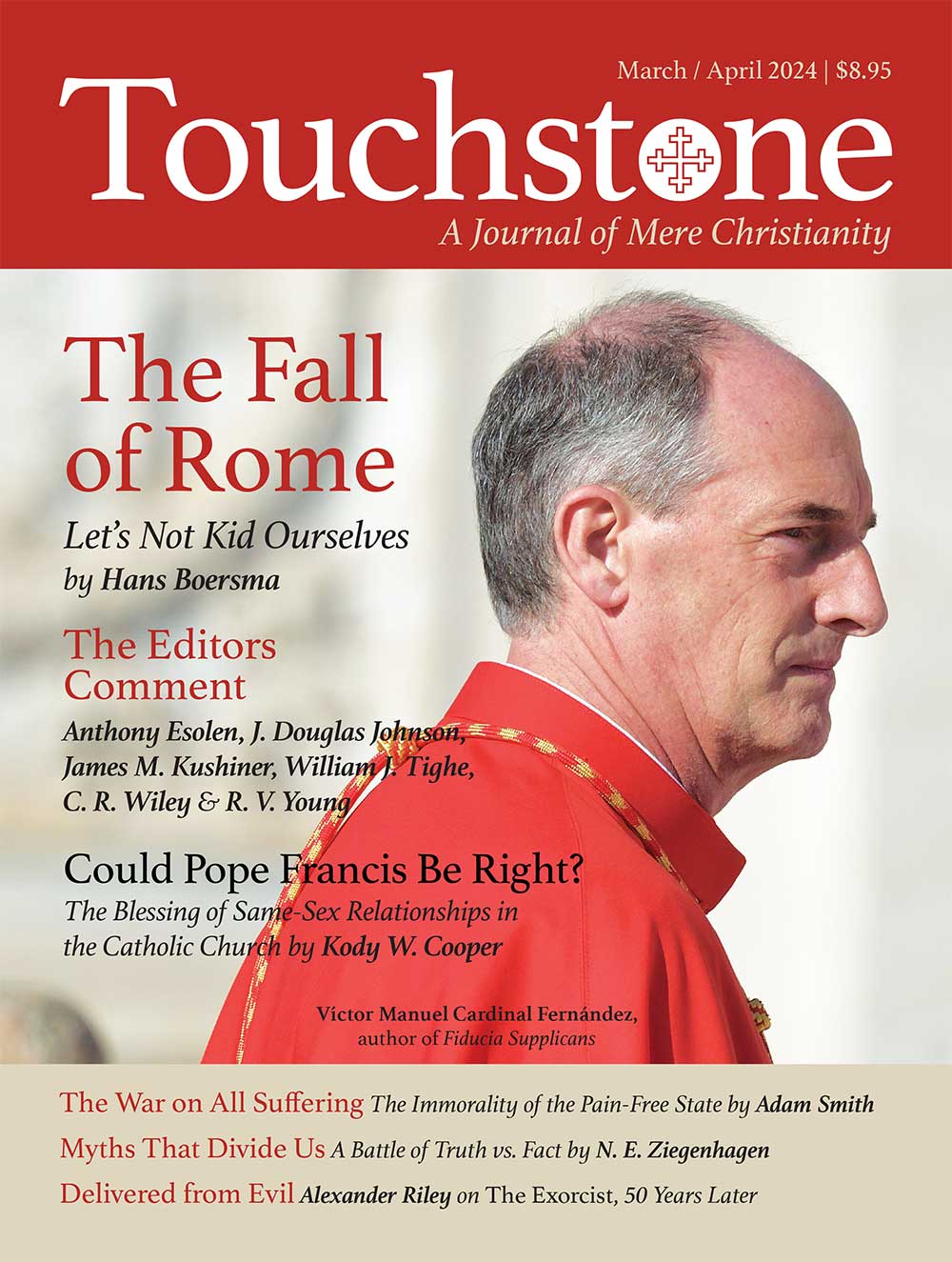
Alexander Riley on The Exorcist, 50 Years Later
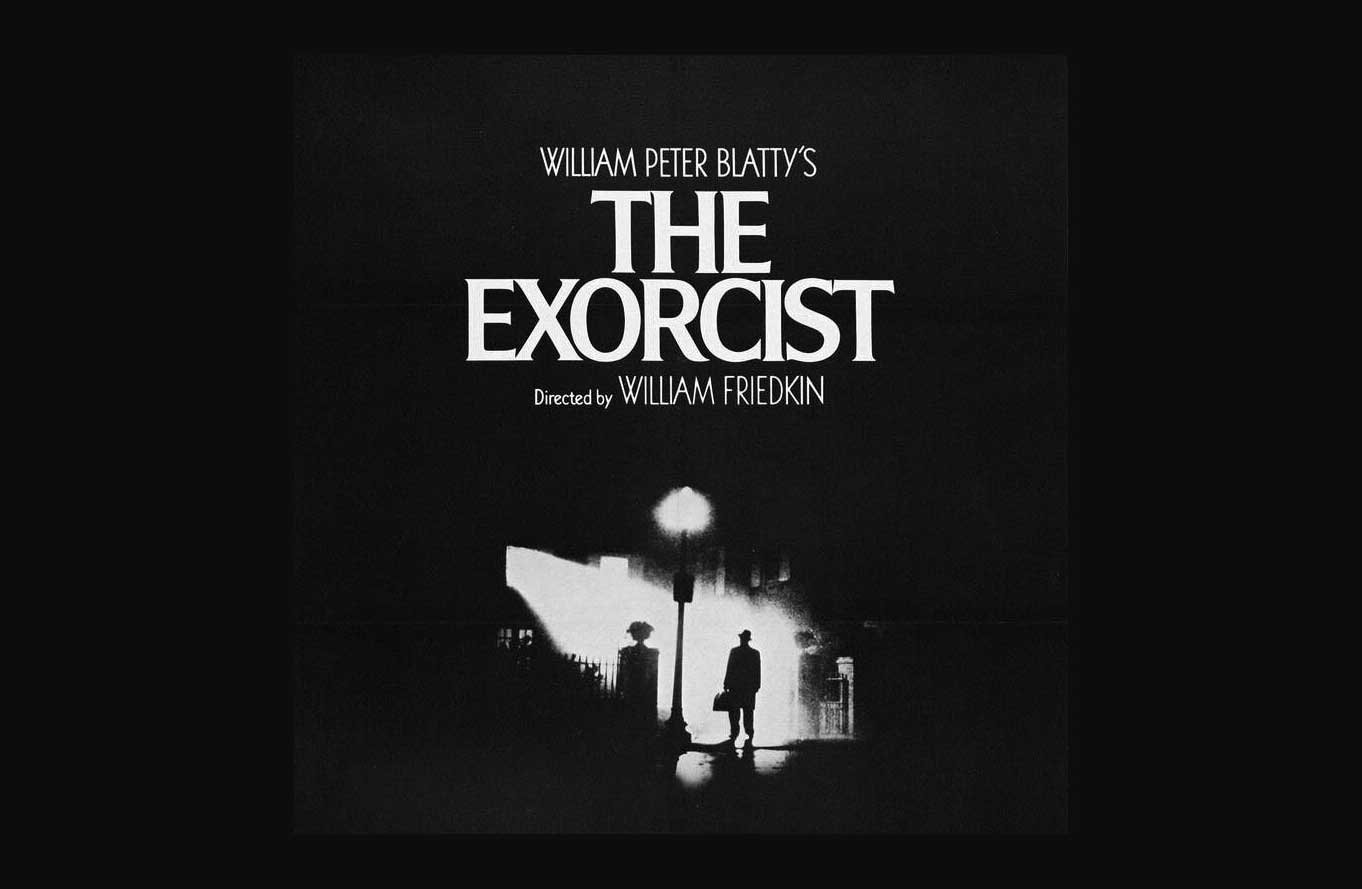
The American film director Bill Friedkin died in August of last year. In one of those coincidences that make it difficult not to believe that things are being purposefully organized, the film for which he is most known, The Exorcist, an adaptation of William Peter Blatty’s best-selling novel, celebrated its fiftieth anniversary in December.
There was another recent death among the central players in the making of that important and often misunderstood film. Max von Sydow, one of the outstanding screen actors of his generation, passed away on March 8, 2020, at the age of 90. The towering, gaunt, intensely emotive Swede is perhaps best known to world cinema fans as the crusader knight Antonius Block in The Seventh Seal. But he also portrayed one of the greatest religious characters to appear in a Hollywood film, Father Lankester Merrin, the character referred to in the title of The Exorcist.
But as superb as Friedkin’s film is, and notwithstanding the scintillating acting by von Sydow and by Jason Miller as the story’s second priestly protagonist, Fr. Damien Karras, one must look to Blatty’s novel to find the full development of the Christian narrative at the story’s heart. (And isn’t it always the case that the novel is superior to the film?)
Blatty created the Merrin and Karras characters as complex priestly archetypes, heroic warriors for God against evil who were nonetheless themselves struggling with serious internal weaknesses and contradictions. It is a complex and honest Christianity that is depicted in this novel and the film based on it. One almost never finds such a depiction in American popular culture today, which may explain why The Exorcist is widely misapprehended by the general American public as merely a horror story.
Consumed by Doubt & Guilt
At the center of the narrative of The Exorcist is an exploration of the nature of religious faith in a modern world that presents endless seemingly rational reasons to disdain Christianity’s metaphysical claims about the nature of evil. Thus, when actress Chris MacNeil’s teen daughter Regan begins to behave strangely, Chris does what all modern parents would do as a first move: she consults medical science for an answer. When the doctors cannot resolve the problem, however, it is they who suggest an exorcism.
Of course, they do this not because they accept the supernatural basis of such a rite but because Regan’s behavior suggests to them that she is suffering from an auto-suggestive pathopsychological syndrome. In the medical experts’ view, the girl has become convinced of the reality of demonic possession. Consequently, in her fear, her unconscious mind has latched on to this idea in such a profound way as to produce the conditions of her illness: “[Exorcism] used to work, in fact, although not for the reason they thought, of course. . . . The victim’s belief in possession helped cause it . . . and in just the same way his belief in the power of the exorcism can make it disappear.”
So Chris consults Fr. Karras, whom she knows socially, but the priest, who also has a medical degree in psychiatry, informs her that the church has moved away from the rite. “Many educated Catholics . . . don’t believe in the devil anymore,” he says. Karras is perhaps, at this point in the novel, among those educated Catholics. We encounter him in the midst of a serious crisis of faith, and he is considering leaving the priesthood altogether. His elderly mother, who lived in abject poverty in New York City, which on his priest’s salary he could do nothing to alleviate, has just died, and he is consumed by guilt. If he had gone into medicine instead, he could have made a good living and taken her out of the city. As her funeral concludes, her brother tells him, “Never mind, she’s in heaven now . . . she’s happy.” In desperation, Karras thinks, “Oh, God, let it be! . . . Oh, God, please be!” We know, though, that he is agonizingly unsure of it.
The demon that has possessed Regan is a cunning exploiter of human psychological weaknesses and is especially talented at determining the chief areas of vulnerability in an individual human soul and then launching a terrifying assault at just these weak points. In the cat-and-mouse game of Karras’s effort to discover the root of the problem with Regan, the malevolent entity uses the priest’s doubts about the existence of the supernatural to mislead and confound him. Moreover, the game is designed to amplify Karras’s skepticism regarding God and thereby to separate the priest from him still further.
During one exchange between Karras and the possessed girl, the demon proves capable of carrying on a conversation in Latin. Karras immediately notes to himself mentally that knowledge of a previously unfamiliar language is one of the signs of possession accepted by the Catholic Church. But the demon quickly taunts the scientifically trained priest by suggesting that there might be an explanation consistent with a purely medical explanation; he then watches Karras’s disappointment and indecision with malicious relish: “That is why I’m fond of you,” the demon cackles. “That is why I cherish all reasonable men.”
Alexander T. Riley is a senior fellow at the Alexander Hamilton Institute for the Study of Western Civilization and a member of the board of directors of the National Association of Scholars.
A Journal of Mere Christianity—Delivered to Your Door
- Essays on theology, culture, and the Church
- Contributors from across the Christian traditions

Six print issues (one year) of Touchstone, plus full online access and PDF downloads for only $39.95.

Get a one-year full-access subscription to the Touchstone online archives for only $19.95.
bulk subscriptions
Order Touchstone subscriptions in bulk and save $10 per sub! Each subscription includes 6 issues of Touchstone plus full online access to touchstonemag.com—including archives, videos, and pdf downloads of recent issues for only $29.95 each! Great for churches or study groups.
Transactions will be processed on a secure server.
more from the online archives

32.2—March/April 2019
Finding Him Again Through the Patriarchal Group by Anthony Esolen
29.3—May/June 2016
Our Choice Is Obedience or Jesus as Anti-Christ by Anthony Esolen

28.6—Nov/Dec 2015
on the Deepest Longings of the Restless & the Lonely by William Graddy
calling all readers
Please Donate
"There are magazines worth reading but few worth saving . . . Touchstone is just such a magazine."
—Alice von Hildebrand
"Here we do not concede one square millimeter of territory to falsehood, folly, contemporary sentimentality, or fashion. We speak the truth, and let God be our judge. . . . Touchstone is the one committedly Christian conservative journal."
—Anthony Esolen, Touchstone senior editor
