




Who Is My Mother?
on Parenthood & the Commercialization of Infants
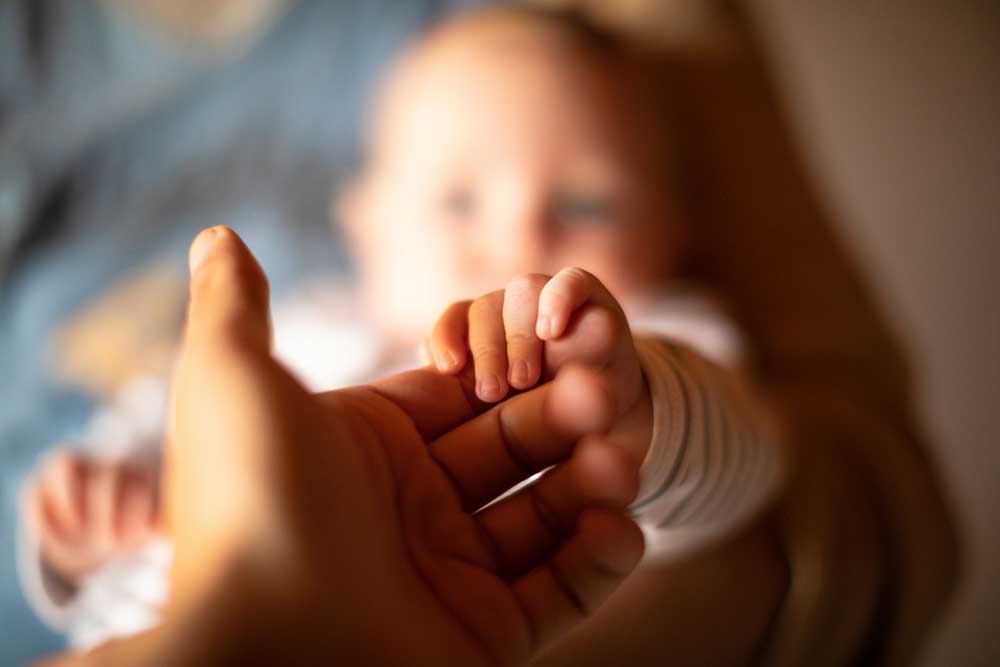
When my children were little, I read to them the children’s book by P. D. Eastman, “Are You My Mother?” The book tackles a deep existential question of origins in a simple story that a small child can understand. A baby bird hatches out of an egg, falls to the ground, and asks, “Where is my mother?” Not seeing her, he sets off on an adventure to find his mother, asking in turn first a kitten, then a hen, a dog, a cow, a car, a boat, and a truck, “Are you my mother?” All say no, and he ends up back in his nest, where his mother appears with a worm for him and asks, “Do you know who I am?” Now the baby bird knows, and he answers, “You are a bird and you are my mother.” But today might a child have to look in a petri dish to know his mother? Or, in the near future, consider his maternal origin from some amniotic tank that has been his artificial womb? Are we only a product of a chemical mixture? This raises basic questions about nature and relationships.
Young adults from their classrooms to their iPhones are awash in messaging that means to undermine their understanding of their origins in the natural family and the reality of God’s creation. Pope Benedict XVI liked to remind people, “I do not come from myself; rather, I come from another.” At the most basic level of consciousness, he would say, there is a primitive awareness of a transcendent source of our being. Yet there is a great need these days to remind many people who they are. “When God is forgotten,” said the fathers of the Second Vatican Council, “the creature itself grows unintelligible” (Gaudium et Spes, 22).
Today’s culture talks a lot about identity—ethnic identity, racial identity, sexual identity, and so on. However, there is an identity for the human person that is deeper and more important than any of these. Each of us is a creature made by God—this is our prime identity. Therefore, our first and most essential relationship is with God. In his book Ordering Love, Dr. David L. Schindler wrote, “To be a creature is to bear a relation to God that presupposes a ‘space’ inside what is deepest and most original in the creature” (35).
Our First Life Experience
But how can we relate to someone we don’t know? Here is the question we need to invite everyone to consider in some depth. We encounter people all the time who live as though their lives simply sprang out of material causes (e.g., “it is only a sperm and an egg that make a baby”). This assumption affects everything they do and say, and causes them to become unmoored from the primal reality of their existence.
Such people do not thank God for giving them life, and they ignore his directions for how to flourish and how to overcome evil, whether exterior or interior. They don’t know how to distinguish truth from lies. The society around them is doing badly, and they don’t know why. They may have inherited bits of truth and righteousness from their forebears, but they don’t know how to pass them on to the next generation, or even why they should. So let us remind them, as well as ourselves, of our origin, which also tells us that a man “shall leave his father and mother and be joined to his wife” unto his ultimate return to God.
A central reality for each of us is that our very first life experience was that of being with another—our mother—in the womb. As Joseph Ratzinger said, “The child in its mother’s womb just makes us most vividly aware of the nature of human existence as a whole”; the human person “can exist only with the other person and from him and is thus forever dependent on this being” (Truth and Tolerance, 247). The child in the womb develops and bonds with his mother and begins language development from hearing his mother’s voice. What that child is doing is amazing, says Dr. Thomas Verny in The Secret Life of the Unborn Child. He is learning all the time, both from hearing his mother and father talk and from hearing music and the sounds in the environment. These in utero experiences will affect the child’s intellectual and emotional development after birth and will have an influence on the kind of person he becomes.
Thus, as Jennifer Lahl of the Center for Bioethics and Culture Network has emphasized, pregnancy cannot be outsourced to a surrogate womb without significant short-term and long-term consequences for both mother and baby:
The biological link between mother and child is undeniably intimate, and when severed has lasting repercussions felt by both. In places where surrogacy is legalized, this potential harm is institutionalized. . . . [There are] health risks that include: preterm birth, stillbirth, low birth weight, fetal anomalies, and higher blood pressure.
Commercialized Conception
Yet this crucial beginning to human well-being is being threatened by commercial fertility companies that use surrogate wombs as well as in vitro fertilization (IVF) and genetic testing to produce a baby “on demand” for would-be parents. This “baby-buying” process treats the human infant like a commercial product that has no need for relational bonding with its mother. The IVF-conceived child is implanted in the womb of a woman with whom it bonds for nine months but from whom it is then taken away immediately upon birth. The surrogate mother has no right even to hold the baby after birth. Instead of focusing on the personal and relational needs of mother and baby, the commercial fertility process places the greatest importance on picking and choosing the physical and intellectual traits that suit the wants of the person(s) paying for the child.
Celebrity Paris Hilton epitomizes this attitude. In early 2023, she told an interviewer that despite having already conceived and frozen 20 unborn boys via IVF, she had recently undergone the process again and was “waiting for the results to see if there’s any girls.” Her words to her husband in planning the IVF process are revealing: “What do you think about us making embryos?” (LifeSiteNews, 2/28/23). At the time of the interview, she had one child born through surrogacy, and she mentioned that she had chosen to go with a surrogate rather than birth her child herself because she was terrified of the pain involved with childbirth. So for nine months she was not with her child but was instead a stranger whom the child first met after birth.
A Journal of Mere Christianity—Delivered to Your Door
- Essays on theology, culture, and the Church
- Contributors from across the Christian traditions

Six print issues (one year) of Touchstone, plus full online access and PDF downloads for only $39.95.

Get a one-year full-access subscription to the Touchstone online archives for only $19.95.
bulk subscriptions
Order Touchstone subscriptions in bulk and save $10 per sub! Each subscription includes 6 issues of Touchstone plus full online access to touchstonemag.com—including archives, videos, and pdf downloads of recent issues for only $29.95 each! Great for churches or study groups.
Transactions will be processed on a secure server.
more from the online archives

30.3—May/June 2017
C. S. Lewis Assesses the Religion of Mohammed by Jacob Fareed Imam

17.6—July/August 2004
Old Science Confronts a Formidable Challenge in the Scientific ID Movement by Jay W. Richards

11.5—September/October 1998
Speaking the Truths Only the Imagination May Grasp
An Essay on Myth & 'Real Life' by Stratford Caldecott
calling all readers
Please Donate
"There are magazines worth reading but few worth saving . . . Touchstone is just such a magazine."
—Alice von Hildebrand
"Here we do not concede one square millimeter of territory to falsehood, folly, contemporary sentimentality, or fashion. We speak the truth, and let God be our judge. . . . Touchstone is the one committedly Christian conservative journal."
—Anthony Esolen, Touchstone senior editor
