





Overcoming Anti-Body Christianity
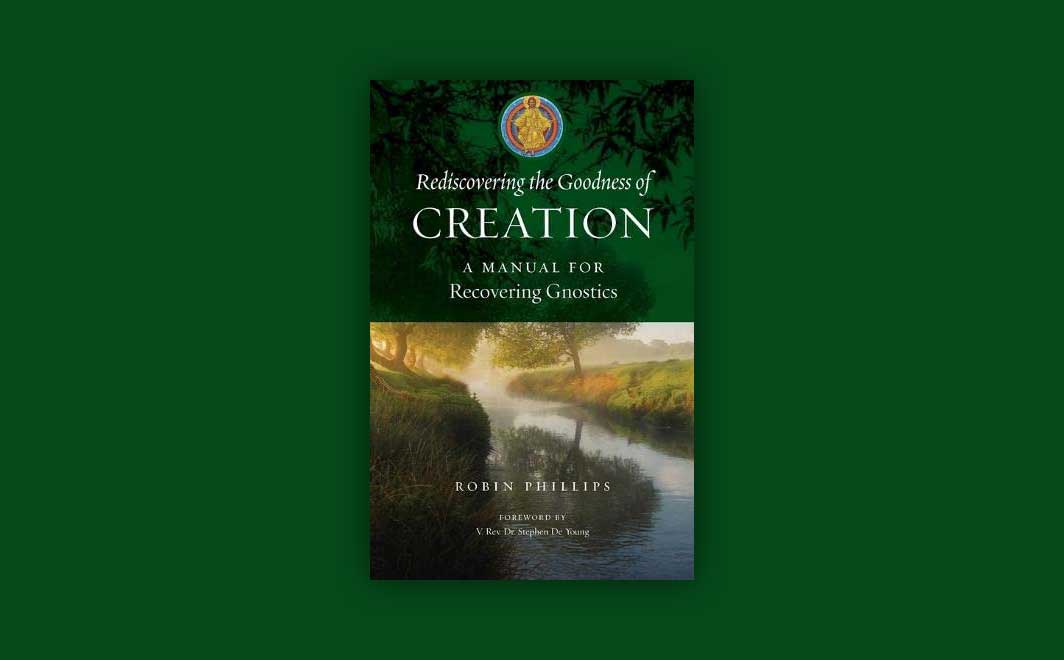
Rediscovering the Goodness of Creation: A Manual for Recovering Gnostics by Robin Phillips
Ancient Faith Publishing, 2023
(365 pages, $22.95, paperback)
In Rediscovering the Goodness of Creation, Robin Phillips recounts his spiritual biography from anti-institutional evangelicalism to the seeker-sensitive movement; from a fundamentalist Bible school to a cult in the United Kingdom; and finally, from Reformed theology to Eastern Orthodoxy. A fascinating, roundabout journey, to say the least. But the book is much more than a personal memoir. Phillips incorporates his story into a fuller discussion of the historical, philosophical, and theological questions surrounding the church’s perennial temptation towards Gnosticism. In doing so, he paints a picture of life as grounded in the goodness of creation, centered on the Incarnation of Christ, and fixed on the promise of an embodied kingdom that is both now existent and still to come.
Christians of all stripes will benefit from the book’s core insights, since they are drawn from Scripture, the creeds, and the church fathers—common wells from which all branches of Christianity draw much water. In the battle against Gnosticism, Phillips provides a much-needed update to such works as Philip Lee’s Against the Protestant Gnostics and Michael Horton’s In the Face of God, both from the 1990s.
Recognizing Gnostic Christianity
From both his own life and the landscape of contemporary Christianity, Phillips documents numerous Gnostic tendencies that affect us all. He exposes the common misconceptions that heaven is a disembodied realm and that the universe will be completely destroyed. He also takes on more subtle Gnostic elements: the sacred/secular dichotomy of modern society and the misguided dismissal of any art, literature, and music that isn’t explicitly “Christian.”
Perhaps most importantly, Phillips tackles the widespread misunderstanding of Christian worship as primarily a disembodied act that takes place intellectually in one’s head or emotionally in one’s heart. Such a view excises God from the material realm and over-spiritualizes Christian faith and practice. Phillips reminds us that worship includes bodily participation and “thick” practices centered on Christ, the Word made flesh, who comes to us through word and sacrament—all of which situate our intellects, emotions, and bodies in their proper ordering, according to God’s design.
Resisting Gnostic Christianity
After establishing how Gnosticism’s tentacles have wrapped themselves around daily life and Christian practice, Phillips spends significant time recounting the flow of redemptive history, which helps us “better understand God’s plan for the earth” (83). Here we find the grand story of Creation and the Fall; Israel’s exodus, deliverance, and eventual exile; Christ’s inauguration of the New Creation through his life, death, and Resurrection; and the final consummation in a renewed kingdom. A clear understanding of God’s work of redemption and renewal in the physical world counters Gnosticism and establishes the cosmic dimensions of salvation. Here we find a salvation that is much more than Jesus simply making “it possible for believers to go to heaven when they die,” which collapses the entire Christian hope “into fire insurance” (140, 195).
With redemptive history framing our thoughts, questions about our daily vocations (Is my work meaningful?) and of life in the body (Should I get married?) can be more accurately addressed. Phillips paints a compelling picture of what I’ll call embodied Christianity, which intentionally incorporates and values the body, the world, and other people. He lays out eight helpful principles to form new habits in this regard, among them:
Step 1: Get very comfortable with God working through means.
Step 5: Observe the church year.
Step 7: Reject sacred-secular dualism.
Step 8: Embrace art and beauty. (269–311)
All the practices Phillips suggests can be implemented in daily life and in the life of the church. He writes that “as we await the fulfillment of our salvation—both for our own lives and for the earth itself—the Church provides us with practices that embody this hope as tangible ways of affirming the goodness of creation and reaching toward the coming reality wherein God becomes all in all” (288–289). He reminds us that belief and practice go together, and that there is clearly a telos, a goal toward which we are headed. Understanding that everything has a telos—our bodies, our homes, our world, our churches—brings meaning to the mundane and hope in the resurrection and the life of the (embodied) world to come.
Further Exploration
Three decades after Philip Lee’s stinging book, Against the Protestant Gnostics, Robin Phillips makes it clear that Gnosticism is still tempting us, and he offers a variety of compelling antidotes. His message is vitally needed today, as digital disembodiment adds another dimension to the Gnostic allure.
I do wonder if the project was a bit too ambitious for one book. Some of the topics could have used further unpacking and sourcing, but that might have made the book too unwieldy. Tracing the intricacies of Neoplatonism, nominalism, redemptive history, and different denominational traditions all in one book is a tall order. It is a testament to Phillips’s academic breadth and hard work that his book reads as seamlessly as it does. And his personal experience in a variety of denominational traditions makes him a credible writer for the task.
It would have been enlightening to see a fuller treatment of the nature/grace and Creator/creature distinctions that are debated within the various strains of Christianity, since they centrally relate to Phillips’s points about the sacramentality of nature. What really is the relationship between nature and grace, and how sacramental is nature?
Phillips’s criticism of the Reformed tradition might have been strengthened by reference to one of its central philosophical axioms regarding the sacraments and Christology: finitum non capax infiniti (the finite is not capable of the infinite). This issue figured prominently in the major Reformation-era debates between Lutherans and Calvinists, and a discussion of it would have further buttressed Phillips’s argument about the spiritualizing tendencies of the Reformed regarding the sacraments.
While reading the book, I often found myself resonating with several aspects of Phillips’s personal narrative. I had a solid Baptist/evangelical upbringing but ended up in some fringe charismatic groups with Gnostic leanings in college, all of which eventually led me to reconsider doctrinal matters. I found the Reformed tradition and attended a Reformed seminary, and then discovered the historic church’s rich heritage of sacraments and liturgy, which landed me in confessional Lutheranism, with its high views of baptism, the Eucharist, and the liturgical and creedal inheritance of the church.
But there too, Gnosticism still lies crouching at the door. At a recent denominational event, I asked a small group of adolescents if we would have our bodies in heaven. About half shook their heads no. I also wonder how many funerals in my denomination unintentionally project an anti-body, Gnostic outlook in what is proclaimed or practiced regarding the dead? And what about how we steward the earth? These are just three questions among many that we should all be asking. All branches of Christianity have their own Gnostic temptations, which remain perennial and pervasive. Phillips’s book exposes the fault lines, helps us resist our Gnostic tendencies, and presents more robust ways of thinking and living in our anti-body age.
Joshua Pauling taught high-school history for thirteen years and is now a classical educator. He is head elder at All Saints Lutheran Church (LCMS) in North Carolina, has studied at Messiah College, Reformed Theological Seminary, and Winthrop University, and has written for Areo, FORMA, Front Porch Republic, Mere Orthodoxy, Modern Reformation, Public Discourse, Salvo, Quillette, and The Imaginative Conservative.
Share this article with non-subscribers:
https://www.touchstonemag.com/archives/article.php?id=36-05-045-b&readcode=10980
A Journal of Mere Christianity—Delivered to Your Door with Full Online Access
- Essays on theology, culture, and the Church
- Contributors from across the Christian traditions
- Six print issues per year
- Full digital archive access
 Subscribe (Print + Online)
Get six issues (one year) of Touchstone PLUS full online access including pdf downloads for only $39.95.
 Subscribe (Online Only)
Get a one-year full-access subscription to the Touchstone online archives for only $19.95.
bulk subscriptions
Order Touchstone subscriptions in bulk and save $10 per sub! Each subscription includes 6 issues of Touchstone plus full online access to touchstonemag.com—including archives, videos, and pdf downloads of recent issues for only $29.95 each! Great for churches or study groups.
Transactions will be processed on a secure server.
more from the online archives

27.5—Sept/Oct 2014
on Growing Vegetables as a Primer in Moral Philosophy by Rachel Lu

37.5—Sept/Oct 2024
Why Law Schools Can't Teach Law
A sidebar to How Law Lost Its Way by Adam MacLeod

24.4—July/August 2011
The Cultural Marxists’ Strategic Assault on Religion, Life & Family by Patrick F. Fagan
calling all readers
Please Donate
"There are magazines worth reading but few worth saving . . . Touchstone is just such a magazine."
—Alice von Hildebrand
"Here we do not concede one square millimeter of territory to falsehood, folly, contemporary sentimentality, or fashion. We speak the truth, and let God be our judge. . . . Touchstone is the one committedly Christian conservative journal."
—Anthony Esolen, Touchstone senior editor
