




Mandelbrot Set
The Cascading Beauty of Fractals in C. S. Lewis, Scripture & Art
A classic four-frame Peanuts comic strip from 1960 begins with a panel showing the character Lucy van Pelt looking off to the side and saying, "That's really kind of disillusioning." In the second frame, Charlie Brown walks up to her and asks, "What's the matter?" In the third frame, as Lucy and Charlie both look at something off-screen, Lucy replies, "Snoopy isn't as smart as I thought he was." In the final panel, Snoopy, in the foreground, is looking down with pursed lips at a book lying open on the floor. In the background, Lucy says to Charlie Brown, "He moves his lips when he reads!"
The wry disconnect between Lucy's notion of intelligence and reading ability, given Snoopy's canine status, is palpable. She seems to discern only one level of awareness. But I would suggest that this sort of disconnect is wide-ranging in real life, and ironically even can be found among scientists and mathematicians, whose goal, almost by definition, is to "step back" in order to see multiple levels from "outside" the confines of a particular level. All of us can at times be as seemingly clueless and unaware of different levels as Lucy is in the comic strip.
Another Lucy, one of the four Pevensie children and a primary character in several of C. S. Lewis's Narnian books, expresses, in contrast, actual recognition of levels in a different context. In a scene near the end of the final book, The Last Battle, the protagonists are thrust, seemingly to their death, into a small stable in Narnia, only to discover a whole world within. Lord Digory then observes, "Its inside is bigger than its outside," and Lucy replies, "Yes, in our world too, a stable once had something inside it that was bigger than our whole world."
Lucy Pevensie's prescient recognition of levels of awareness about the situation she and her friends were thrust into is also palpable—in the opposite direction from Lucy van Pelt's. That single line was enough to be—with prodding by the Holy Spirit, certainly—one of the primary factors in my own dark-night conversion to Christianity during my college years. It was something that my courses as a college mathematics major somehow hadn't led me to notice before.
Three Primary Qualities
I once saw a charming container sitting on top of a business office desk. It was shaped like a giant, silver-foil-wrapped Hershey's chocolate Kiss. The pointy tip of the container formed the lid. Removing the lid revealed the container to be a candy dish filled, as one might guess, with little silver-foil-wrapped Hershey's chocolate Kisses. The first thought of my inner mathematician child upon seeing the contents was, "Huh—a two-level fractal!" In lighthearted fashion, I immediately imagined the chocolate Kisses to be conscious chocolate beings clothed in tin-foil hats, completely unaware that they were the lower part of a two-level chocolate Kiss fractal (whether the inner mathematician child recognized itself as the lower part of a two-level fractal of personalities with me is another question).
The word fractal, coined by Benoit Mandelbrot in 1975 for shapes described as self-similar, originally had a technical and complex mathematical definition, and there was a precise method for determining the "fractional dimension" of "self-similar" shapes. But the meaning and understanding of the term was later expanded to include a variety of artistic and visual images, along with an aesthetic, that portray a broader sense of self-similarity in general. (Mandelbrot himself eventually described the term simply as "a shape made of parts similar to the whole in some way.")
I have often described fractals as objects that exhibit three primary qualities—complexity, variety, and structure (or composition)—each and all of which are embedded at different levels of magnification. In theoretical mathematical models, such as the Mandelbrot Set, the levels of complexity can literally reach infinitely deep within the set, but there are myriad physical examples whose multiple levels of similarity are finite.
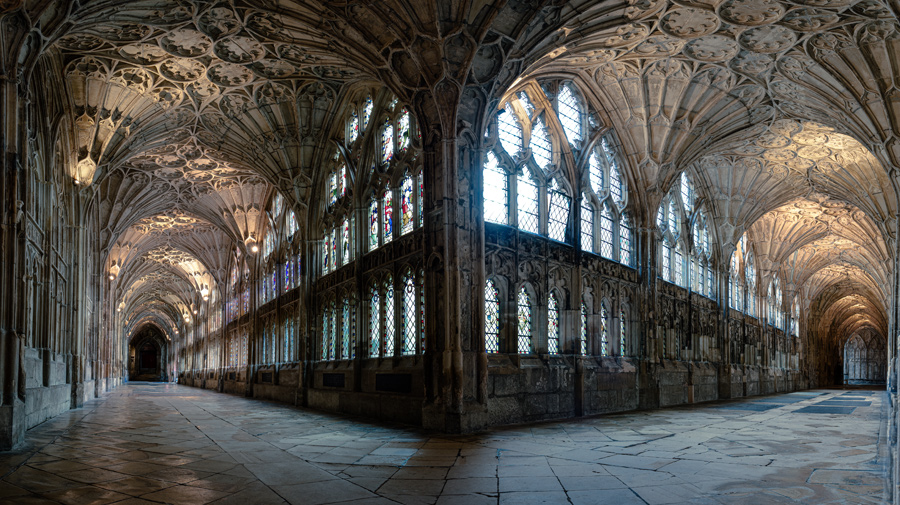
Three of my favorite concrete examples, in different branches of art, display a satisfyingly fractal nature several layers deep: the complex architectural designs of arches-within-arches-within-arches in a medieval cathedral; the variety and invention of musical themes-within-themes-within-themes of a Beethoven symphony (the Seventh, followed closely by the Fifth, are my favorite musical examples of this fractal quality); and the composition and structure seen in virtually any portion, tiny or large, of Jan van Eyck's painting The Arnolfini Wedding. In fact, I have suggested that the degree to which "great art" is great is largely (but not exclusively) dependent on how "deep" the levels of this fractal quality go.
A Larger Notion of Fractalness
I have long found the subject of fractals (of the expanded definition) fascinating and have come to see it as increasingly important philosophically. But I have also come to see the term "fractal" as unnecessarily limiting in its strictly technical and mathematical sense. To be sure, one of the primary purposes of mathematics is to "simplify" or compartmentalize or organize phenomena and ideas into recognizable and useable formulae and processes for application (as well as for simply appreciating their abstract organization for contemplation—a type of appreciation that, as will be described later, can be seen in a fractal-like manner itself).
But even the popular "expanded" view of the idea of "fractal" into a more general appreciation of its aesthetic aspects often seems still to focus primarily on its property of self-similarity and repetition at different magnifications. To me, that emphasis is like reducing the beauty of the colors in a display of the visible spectrum to a mere steady progression that compares the size of different colors' frequencies and wavelengths by their linear position on a line or graph that ranges from the low-frequency/long-wavelength of red on one end to the high-frequency/short-wavelength of violet on the other.
Such a graph would seem not to account for, even to ignore, the purely aesthetic and category-defying visual differences and delights between colors themselves and our conscious impressions of them. Is there a linear scale that ranks the alarm of red as "higher or lower" than the calm of green, or the expanse of blue as "greater or lesser" than the depths of violet? Can any other such size comparisons be made between the wide variety of color blends or the assortment of interactions between pairs or groups of colors? (Note that this illustration of a linear color spectrum is not particularly fractal-like in nature, its purpose here being only to emphasize a nonlinear and category-defying variety of beauty). Likewise with the rather linear analysis of fractals when defined primarily by their "self-similarity" and repetition—it seems to miss important—nay, vital—parts of what the recognition of a fractal object can convey in its fullness.
Nearly four decades before Mandelbrot formally coined and defined the word "fractal," C. S. Lewis, in his novel Out of the Silent Planet, stunningly captured the essence of this larger notion of fractal-ness (while also noting Mandelbrotian branches of self-similarity and repetition) that seems to be missing from Mandelbrot's description. Late in the book, the protagonist, Dr. Ransom, having been transported to Malacandra (Mars), comes upon a richly decorated stone gong and hammer hung on a pillar of stone. He examines the ornamentation of the stone:
It was partly pictorial, partly pure decoration. What chiefly struck him was a certain balance of packed and empty surfaces. Pure line drawings, as bare as the prehistoric pictures of reindeer on Earth, alternated with patches of design as close and intricate as Norse or Celtic jewelry; and then, as you looked at it, these empty and crowded areas turned out to be themselves arranged in larger designs. He was struck by the fact that the pictorial work was not confined to the emptier spaces; quite often large arabesques included as a subordinate detail intricate pictures. Elsewhere the opposite plan had been followed—and this alternation, too, had a rhythmical or patterned element in it. He was just beginning to find out that these pictures, though stylized, were obviously intended to tell a story, when Augray interrupted him.
This description of the stone's design, aside from its particular medium of "pure line drawings," could be a nearly perfect description of a studied gaze at the Arnolfini Wedding painting.
Additionally, near the end of Lewis's follow-up novel, Perelandra, there is an extended dialogue (five exotic pages' worth in full) between the angelic Oyeresu of Mars and Venus and the Earthling Ransom describing "The Great Dance," which has similar "fractal" imagery. In this Dance, things great and small, complex and simple, detailed and overarching interweave, so that
Each grain is at the centre. The Dust is at the centre. The Worlds are at the centre. The beasts are at the centre. The ancient peoples are there. . . . In the plan of the Great Dance plans without number interlock, and each movement becomes in its season the breaking into flower of the whole design to which all else had been directed. Thus each is equally at the centre and none are there by being equals, but some by giving place and some by receiving it, the small things by their smallness and the great by their greatness, and all the patterns linked and looped together by the unions of a kneeling with a sceptered love, Blessed be He!
In light of these descriptions, I would now choose to add, in addition to the three fractal qualities of complexity, variety, and structure/composition, a fourth fractal quality of harmony (or perhaps correlation), to emphasize that the other three aspects are not just "collections" of random shapes or concepts thrown together, but have an integral purpose and function in the overall design and
intention.
Examples of the Fourth Quality
As a representative example of this fourth quality, from a fourth branch of art, I might choose Lewis's novel That Hideous Strength. This literary work has a very fractal nature, which is to say, it exhibits an incredible and pervasive chessboard-like quality of parallel and opposing "black and white pieces" in nearly every aspect of the book, large or small, e.g., characters, settings, atmosphere, story elements, and themes, from minor events to the overarching plot.
This multi-level literary chessboard extends even to the grand, climactic, opposing deus ex machina devices of the two "sides" on the chessboard: in the chapter "Descent of the Gods," the planetary angelic "gods" arrive "from above" at St. Anne's-on-the-Hill to overwhelm the members of Logres in joyful communion, contrasting almost directly "piece-by-piece" with the chapter "Banquet at Belbury," where a sending of wild animals "from below" into a banquet room creates frightening havoc among the diners.
An additional intention for this fourth fractal quality might admit more intangible categories of fractal-ness, such as ideas in abstract thought processes and in the qualities of awareness itself. An example on the purely abstract side to contrast with the more concrete examples already described might be the "self-referential" method of proof used by Kurt Gödel in his famous Incompleteness Theorems, which demonstrate the inadequacy of mathematical systems to prove truth about all possible theorems within the system. The method concocts meta-theorems within the constructs of the system itself that demonstrate its own incompleteness in a self-internal and self-referential manner.
A possible "in-between the concrete and the abstract" example of such a fractal might be the philosophical divisions of life and soul that C. S. Lewis describes in his introduction to Medieval and Renaissance literature, The Discarded Image. At one end of the spectrum, he places the category of non-life or no-soul (as with stones), after which come the Vegetable Soul level, characterized by nutrition, growth, and propagation; the Sensitive Soul level (as with animals), which has the qualities of Vegetable Soul but adds sentience; and finally, the Rational Soul level, which includes the qualities of the Vegetable and Animal Souls but adds reason (the Sensitive Soul versus the Rational Soul levels are the point of Lucy van Pelt's confusion over, and blindness about, Snoopy's "level" of awareness as lightheartedly depicted in the Peanuts comic strip).
Cascading Beauty Exuding from Lewis
My discomfort with the seemingly narrow focus on self-similarity, in both popular view and modern mathematical analysis, as the primary aspect of fractal recognition, gave me the desire to come up with a different term or phrase for the elusive qualities I have looked for in an expanded view of fractal-ness. After some contemplation, I decided that the phrase cascading beauty captures the vital substance of that desire, encompassing all four qualities: complexity, variety, structure/composition, and harmony/correlation.
One of my reasons for desiring a different term or phrase is simply that this four-pronged quality has been around and recognized throughout history—though not in a narrow, explicitly described and named fashion, as Mandelbrot did with the term fractal in the 1970s. I have already mentioned some specific examples in which C. S. Lewis, writing decades before Mandelbrot's explication, employed a sense of this cascading beauty in his Space Trilogy novels. And in fact, this quality fairly permeates virtually every one of his literary works, both fiction and non-fiction. It is perhaps most clearly seen and recognized in that line in The Last Battle about the stable whose "inside is bigger than its outside."
But we see this quality again, amplified soon after, when the children discover walled gardens within walled gardens within the outermost Narnian walled garden, prompting them to say, "further up and further in." Each further "inside" garden contains a larger and richer and fuller Narnia than the outer garden "surrounding" it. Again, written decades before, this is nearly the definition of Mandelbrot's term "fractal," and yet the primary aspect of this cascading image is its beauty and
harmony.
This imagery of cascading beauty occurs in so many places in Lewis's works, large and small, explicit and implicit, concrete and abstract, that it is as if it exudes willy-nilly out of his very being as a writer, whether he consciously recognized it or not. One might even say that this cascading beauty is very nearly a spiritual component of his being (and ours, in the very act of recognizing it as such). Examples of cascading beauty are spread throughout the Narnian books alone.
An example in the large sense is the wardrobe itself in the first book, a "container" that holds within its interior the whole of Narnia. And the wardrobe, too, is in coordination and harmony with the walled gardens in the last book, forming a kind of meta-cascading beauty between the pair of them. Ironically, a kind of seemingly circular, infinite loop is created by the wardrobe's construction out of the felled boughs of a tree grown from the seed of a fruit that came from Narnia in the first place.
This (unstated and humanly incomprehensible) "creation" resonates beautifully with the metaphorical "something" inside a stable described by Lucy Pevensie in Narnia that was "bigger than our whole world." For that world (and our own) was equally ironically and humanly incomprehensibly created by that very "Something" (i.e., Christ, the Word of God), who was nevertheless born inside a stable in our world. One might even also see these two images of cascading beauty, themselves paired, like the Hershey's Kisses within the "larger" Kiss-shaped container, as a two-level example of cascading beauty. Levels within levels within levels . . .
A Narnian example in a smaller sense is the gift to King Caspian of a magical map in the third book, The Voyage of the Dawn Treader, that shows details about Narnia and its surrounding lands and waters at any level of magnification at which he and his crew choose to view it.
These are just two examples of many that could be cited, not just in the Narnian tales, but in all of Lewis's various works of fiction. And even in his scholarly, non-fiction works, Lewis not only often describes qualities of literary works that portray a sense of cascading beauty, but his method of describing them can have that quality, too.
The pervasive fractal imagery in Lewis's writing is, however, only one source of historical and pre-Mandelbrotian displays of cascading beauty. The appeal of cascading beauty is apparent throughout history (typically unstated in any explicit manner), the artistic examples mentioned here being but four of innumerable possible examples.
Transfer RNA & the Divine Metaphor
A more important purpose, however, for my offering the phrase cascading beauty is that I believe this quality conveys a recognition or signature, if you will, of the Divine. In the very large scale of such cascade, the immensity of the heavens, as we are told in the Psalm, declares the glory of God, while in a lesser scale, Elijah hears him as a still, small voice. In both cases, large and small, it is not just a part of God and his glory that are present, but their entirety, their wholeness—that is, the "size" or magnification level does not seem to make one more important than the other.
These two seeming extremes, along with examples of every "level" in between (and beyond), can be seen and appreciated throughout Scripture, almost as though this is one of Holy Writ's primary purposes. Jesus himself uses many different worldly or physical examples as analogies or parables of theological concepts in fractal-like fashion.
In modern scientific explorations of the physical world, even down to the molecular world of microbiology, wonders of this seemingly divine metaphor can be seen. For example, a brief description of "transfer RNA" in genetics can neatly convey a magnificent theological metaphor (though a lengthy and complex description would be required for a full appreciation). RNA in cells essentially forms a kind of "cheat sheet" copy of the abstract, linear coded "instructions" in DNA. It transfers this information to a complex biological machine called a "ribosome" (itself a veritable and fantastically organized fractal domain of complexity and order). The ribosome machine then translates, literally, the abstract coded information into proteins, the "flesh and blood" components that build and power our physical bodies.
Two types of RNA work together to effect this translation. One type, called messenger RNA (abbreviated "mRNA") is the long strand of information that is coded with abstract three-letter "words," while the second type, called transfer RNA units (abbreviated "tRNA"), "translates" the abstract three-letter words into actual amino acids that finally get strung together to form proteins.
It is the tRNA units that are of particular interest in the metaphor here. The molecular structure of a tRNA unit is typically displayed schematically in the vague shape of a cross. The "top" of the cross holds a three-letter code associated with a particular amino acid. That "flesh-and-blood" amino acid is "attached" at the bottom of the tRNA cross. The ribosome biological machine "reads" the mRNA string, word by word, and uses tRNA units, each one containing a needed three-letter word at the top, to "translate" the current word into a particular amino acid at the bottom. The ribosome then attaches the amino acid to a developing protein molecule.
The seemingly profound metaphor is that Christ on the Cross, who "translates" God the Father's spiritual will in heaven above into the physical flesh-and-blood of our salvation and redemption here on earth below, is "reflected" in every cell in a human body with the cross-shaped tRNA unit. That unit "translates" the abstract master DNA code at the top of its cross into flesh-and-blood proteins at the bottom of the cross. It is perhaps only unintended but happy serendipity that the lower-case English letter t in "tRNA" has itself the appearance of a cross.
Looking Beyond Visible Reality
Some might well look upon this metaphor as stretching the RNA strand a bit too far—to the breaking point, they might suggest. Perhaps. But, reasonable or not, the mere mental recognition of the use and power of metaphors and analogies can itself be seen as an abstract form of cascading beauty akin to the "more intangible categories" available for fractal consideration mentioned above. And of course, analogies and metaphors are something Jesus himself used quite often in a variety of ways in the Gospels.
In any case, Scripture seems to be replete with different purposes for the inclusion of cascading beauty in its structure. In the Old Testament, God wants—nay, demands—that his people look beyond the visible reality; the speaker in Psalm 51 declares, "For thou desirest not sacrifice; else would I give it: thou delightest not in burnt offering. The sacrifices of God are a broken spirit; a broken and a contrite heart, O God, thou wilt not despise." In the Gospels, Jesus seems incessantly to call attention to other, "higher" levels of understanding, as when he says, for example, "Very truly I tell you, you are looking for me, not because you saw the signs I performed but because you ate the loaves and had your fill."
Seemingly, the thing right in front of us is not what God wants us to focus on exclusively. Rather, he wants us to "back up" and see that thing as a lower level "pointing" to higher levels. And this is something God nearly continuously insists upon throughout the Bible. If C. S. Lewis's works are permeated by cascading beauty, Holy Scripture would seem to be flooded by it in comparison.
One reason for this flooding would seem to be that man, in his fallen state, is so adept at missing (or perhaps intentionally ignoring) the cascading portion of this aspect of beauty. In another part of Lewis's description of the Great Dance in Perelandra, one of the angelic creatures says, "All that is made seems planless to the darkened mind, because there are more plans than it looked for. . . . There seems no plan because it is all plan: there seems no centre because it is all centre. Blessed be He!"
Fallen Man's Deficiency
Interestingly (and perhaps another result of the Fall), the very act of recognizing cascading beauty—even the ability to do so—is apparently rarely seen as an act of "stepping outside" itself; that is, as a different "level" of the quality of awareness itself. For in order to recognize "other levels" in the first place, one must somehow, even if only mentally, step outside of his "comfortable" and "default" awareness, as it were, a step that is often untaken without us noticing that we have not taken it—we may see levels of cascading beauty "out there," yet we fail to notice that our very act of seeing them is itself a case of cascading beauty. Fallen man, with this deficiency, is perhaps not so different after all from the candy-dish-unaware yet conscious tin-foil-hat-covered chocolate Kisses residing in the candy dish (or the clueless inner mathematician child I described earlier) in this regard.
I have in fact wondered if this ability to "see different levels" is one of the aspects of man becoming "like us" that God refers to in Genesis—that is, a quality of the "divine" that mankind, unfortunately in the Fall, acquired "out of order" and in corrupt fashion. And that may be why it also is in need of redemption, despite its divine mirroring.
So, too, with the danger of "living forever" by eating of the tree of life in the Garden out of order, after having eaten the forbidden fruit of the tree of knowledge of good and evil. For one of the aspects of this corrupted version of "seeing levels" seems to be, ironically, the willful dissolution of the ability itself. It is as if, upon now seeing different levels (at all, or perhaps to a fuller extent), yet still not seeing them completely, fallen man is content simply to put new blinders on, to limit his recognition to "a few" levels, perhaps feeling as though he is now, finally, "like God."
I would suggest that the temptation to sin itself is a kind of desire to close off or "flatten" those levels and to ignore the cascading beauty of what the things around us, temporal or physical, point to as higher and deeper levels. I might even say that evil itself is enacted when we succumb to that temptation and actually do "reduce" the reality of cascading beauty to a single level of only-dim beauty (if even that), with an implied declaration that "this is all there is."
A great part of Scripture can be seen almost as a compendium of both encouragements and admonitions to fallen man to look for and embrace cascading beauty—to look beyond the physical "level" (or limited levels) one is gazing at directly, which tends to limit one's attention to a "this is all there is" view.
The idea of cascading beauty is implicit in Psalm 27, in which the writer declares, "One thing have I desired of the Lord, that will I seek after; that I may dwell in the house of the Lord all the days of my life, to behold the beauty of the Lord." The writer also indicates that he is not visibly "in" that blessed situation, and yet he writes in the next verse that in the midst of "the time of trouble he shall hide me in his pavilion; in the secret of his tabernacle shall he hide me; he shall set me up upon a rock."
So one might say that God is telling us over and over in Scripture, in both the Old and New Testaments, not to be like the level-arid Lucy van Pelt in Peanuts, who sees Snoopy as a poor reader because he moves his lips, but, alternatively, to be like Lucy Pevensie in Narnia, who sees the reality of cascading beauty "beyond" what our fallen eyes can only see directly "in front of us."
The Lord's Prayer as God's Signature
And yet, at least as often, Scripture simply speaks to us in another manner that seems to acknowledge, as a given, the state of cascading beauty that we find ourselves immersed in. There are, to be sure, explicit fractal-like aspects in Scripture, such as the four-level Sabbath Day (seventh day)/Shavuot (fiftieth day, Pentecost, after seven weeks)/Sabbatical Year (seventh year)/Jubilee Year (fiftieth year after seven Sabbatical years), as well as countless examples of more expansive passages of cascading beauty. And though it may be unwise to venture too far into potentially interesting theological parallels with the grand, ultimate mystery of the Trinity, the Three Persons of God, it would seem to be the source of a veritable fountain of cascading beauty in the concept
itself.
But for me perhaps the most startling and unexpected instance of being immersed in such a state "as a given" in Scripture was my sudden realization a while back of cascading beauty in a most familiar passage in the Gospels (a real, "how did I not notice this before?" moment). In the Lord's Prayer, Jesus, in a series of pair-like, two-layer fractal images or implied references, begins by addressing God the Father in heaven. We implicitly recognize and understand our earthly fathers as a lower-level reflection of that highest divine level. He then hallows the Father's name, which recalls an implied and fractal-like association with the commandment to honor our earthly father (and mother).
Jesus goes on to pair a summoning of the Father's kingdom, along with the same for the doing of his will, onto this lower level of earth, as they already exist in the higher level of heaven. Then follows a similarly paired request for, specifically on the smaller level of today, the bread that he already continuously provides, in a larger level, for us every day.
The next cascading pairing, again as a higher level followed by a fractal-like lower level, asks the Father's forgiveness of our sins in like manner to the forgiveness we are to confer upon those who trespass against us. Finally, in recognition of the hypothesis about temptation and actual evil, we (since Christ is giving this prayer to us, his followers, to pray) beg to be prevented from even entertaining the temptation to flatten cascading levels, paired with an appeal to be delivered from the potential flattened lower level of the evil that actually succumbs to that temptation.
Curiously, in additional cascading-beauty fashion, these pairs of cascading beauty interact with each other in correlation, from the highest level of God the Father himself and his will, to the earthly levels of daily bread and forgiveness, and finally to a request for deliverance from the lowest levels (if such they can be called) of temptation and evil.
Jesus Christ is the Word of God. By giving his followers that supreme model of prayer with its lovely and multi-tiered embodiment of cascading beauty, we might therefore literally say that the Lord's Prayer is the Divine Signature of God.
Stanley E. Anderson holds a degree in mathematics and has worked in data analysis, IT, and quality assurance in the aerospace industry. He and his wife are converts from Anglicanism to the Catholic Church.
A Journal of Mere Christianity—Delivered to Your Door
- Essays on theology, culture, and the Church
- Contributors from across the Christian traditions

Six print issues (one year) of Touchstone, plus full online access and PDF downloads for only $39.95.

Get a one-year full-access subscription to the Touchstone online archives for only $19.95.
bulk subscriptions
Order Touchstone subscriptions in bulk and save $10 per sub! Each subscription includes 6 issues of Touchstone plus full online access to touchstonemag.com—including archives, videos, and pdf downloads of recent issues for only $29.95 each! Great for churches or study groups.
Transactions will be processed on a secure server.
more on C. S. Lewis from the online archives
33.2—March/April 2020
Lewis, Chesterton, et al. Against the Frauds, Experts & Revisionists by Vigen Guroian

19.6—July/August 2006
The Three-Fold Cord of Imagination, Reason & Will in C. S. Lewis by Michael Ward

more from the online archives
24.2—March/April 2011
Certain Death & the Last Lectures of Socrates & Jesus by Randall B. Smith
calling all readers
Please Donate
"There are magazines worth reading but few worth saving . . . Touchstone is just such a magazine."
—Alice von Hildebrand
"Here we do not concede one square millimeter of territory to falsehood, folly, contemporary sentimentality, or fashion. We speak the truth, and let God be our judge. . . . Touchstone is the one committedly Christian conservative journal."
—Anthony Esolen, Touchstone senior editor
