





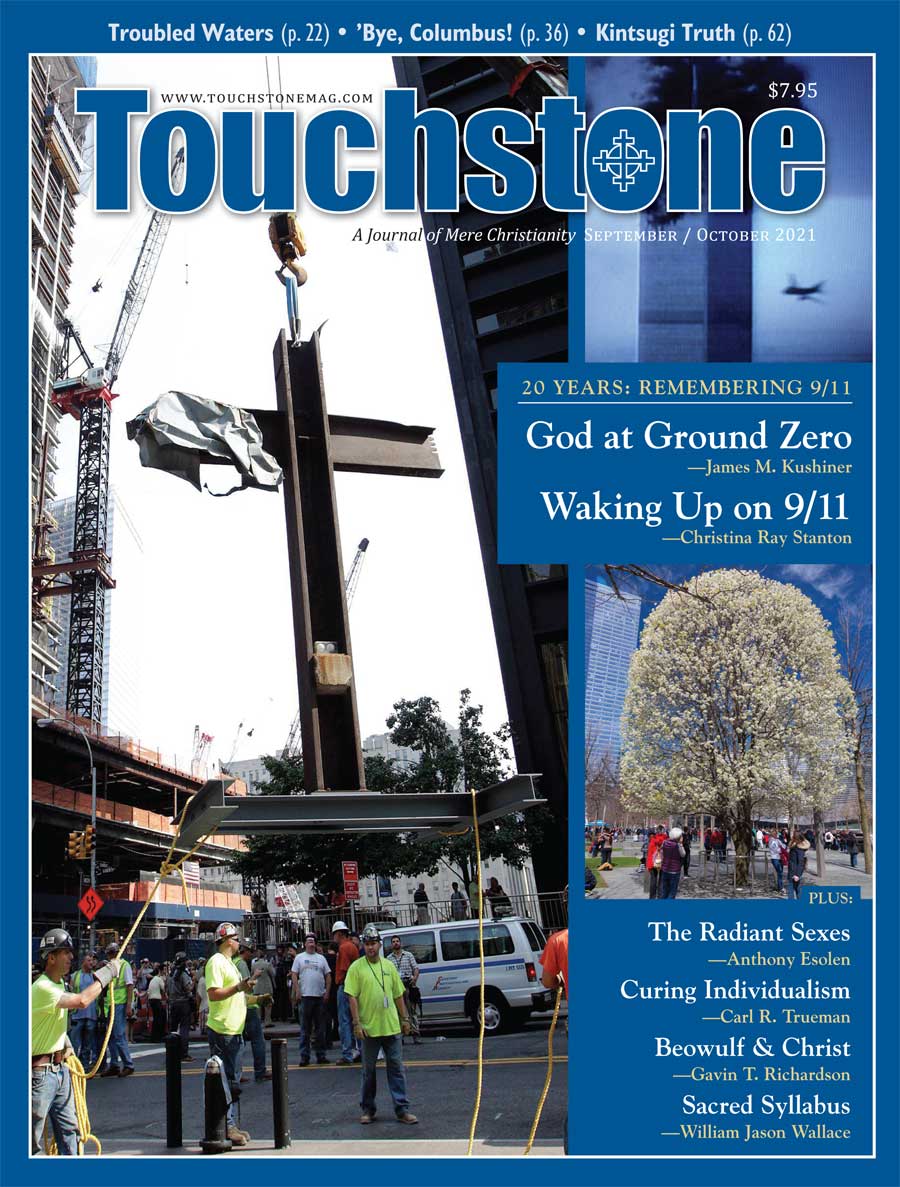
Columbus Overboard
His Recent Voyage Off the Flat Earth of Revisionist Historians
In fourteen hundred ninety-two
Columbus sailed the ocean blue.
So began a poem familiar to any baby-boomer who attended public elementary school in America in the middle of the twentieth century. By 2021, however, Christopher Columbus's legacy has clearly fallen off the flat earth of radical historical revisionism.
Reasonable, knowledgeable U.S. citizens were stunned last summer when raging mobs of mostly young adults tore down, vandalized, or forced the removal of statues of Christopher Columbus, along with those of various Confederate generals, Francis Scott Key, President Andrew Jackson, Union general and President Ulysses S. Grant, nineteenth-century abolitionists, including Frederick Douglass, Kit Carson, Junipero Serra (the Franciscan missionary to Spanish California and Roman Catholic saint), President Theodore Roosevelt, President Abraham Lincoln, American founding fathers George Washington, Thomas Jefferson, Caesar Rodney, and George Mason, and even the Virgin Mary and Jesus Christ. Those young iconoclasts had imbibed the dominant ideology of radical revisionist historians and history teachers in their secondary school and college classrooms.
Just as the American story began with Christopher Columbus, the radical revision of history began with Columbus. His legacy has become a prism for the entire iconoclastic "revisioning" movement sweeping our society today. When and why did the traditional American reverence for Columbus, an Italian explorer and adventurer and devout Roman Catholic, turn into contempt, and how is that dramatic shift reflected in the teaching about Columbus in the U.S. public school system?
Going Off Course
The decisive turning point in the burgeoning movement to knock Christopher Columbus literally off his pedestal occurred in 1990 with two discrete events.
First, on the second Monday in October 1990, the state of South Dakota began to celebrate "Native American Day" on the same day as the traditional U.S. federal holiday known as Columbus Day. Two years later the city of Berkeley, California, followed suit, and in 1994 neighboring Santa Cruz did the same. The trend revived in 2015, and by the end of 2019, ten U.S. states and another 135 cities and towns had begun to celebrate "Indigenous Peoples' Day" in lieu of Columbus Day. The most recent spate of unlawful toppling of statues of Columbus in 2020 merely added injury to insult.
Second, five months earlier in 1990, the National Council of Churches (NCC) provided the ideological justification for the ceremonial acts of local and state government authorities and helped to shape the pedagogy pertaining to Columbus in American public education. In a resolution adopted on May 17, 1990, the NCC Governing Board, with my fellow Orthodox priest, Leonid Kishkovsky, presiding, decided to anticipate the 500th anniversary of Christopher Columbus's arrival in the Western Hemisphere by denouncing the mariner and his legacy: "For the descendants of the survivors of the subsequent invasion, genocide, slavery, 'ecocide,' and exploitation of the wealth of the land, a celebration is not an appropriate observation of this anniversary." The three-page document includes a litany of grievances against that legacy. Among the most egregious claims and misrepresentations of the complex historical record were these:
• That "the Church, with few exceptions, accompanied and legitimized" the European "conquest and exploitation."
• That "the missionary efforts" during the subsequent "period of colonization and subjugation . . . resulted in crimes against the spirituality of indigenous peoples."
• That "what some historians have termed a 'discovery' in reality was an invasion" prompted by "a deep level of institutional racism and moral decadence," a phrase that leftist critics now apply routinely to the United States even after the remarkable success of the civil rights movement in the twentieth century.
Alexander F. C. Webster (Archpriest), Ph.D., is Dean & Professor of Moral Theology Emeritus at Holy Trinity Orthodox Seminary in Jordanville, New York, and Adjunct Professor of Religious Studies at George Mason University in Fairfax, Virginia.
A Journal of Mere Christianity—Delivered to Your Door
- Essays on theology, culture, and the Church
- Contributors from across the Christian traditions

Six print issues (one year) of Touchstone, plus full online access and PDF downloads for only $39.95.

Get a one-year full-access subscription to the Touchstone online archives for only $19.95.
bulk subscriptions
Order Touchstone subscriptions in bulk and save $10 per sub! Each subscription includes 6 issues of Touchstone plus full online access to touchstonemag.com—including archives, videos, and pdf downloads of recent issues for only $29.95 each! Great for churches or study groups.
Transactions will be processed on a secure server.
more on history from the online archives
15.6—July/August 2002
Things Hidden Since the Beginning of the World
The Shape of Divine Providence & Human History by James Hitchcock
31.1—January/February 2018
on Ragnarök, an Extreme Weather Event & the Paths to Conversion by Timothy J. Burbery
14.6—July/August 2001
The Transformed Relics of the Fall
on the Fulfillment of History in Christ by Patrick Henry Reardon
more from the online archives
22.3—April 2009
Neil Postman's Amusing Ourselves to Death: Public Discourse in the Age of Show Business by J. Daryl Charles

37.5—Sept/Oct 2024
Why Law Schools Can't Teach Law
A sidebar to How Law Lost Its Way by Adam MacLeod
calling all readers
Please Donate
"There are magazines worth reading but few worth saving . . . Touchstone is just such a magazine."
—Alice von Hildebrand
"Here we do not concede one square millimeter of territory to falsehood, folly, contemporary sentimentality, or fashion. We speak the truth, and let God be our judge. . . . Touchstone is the one committedly Christian conservative journal."
—Anthony Esolen, Touchstone senior editor
