




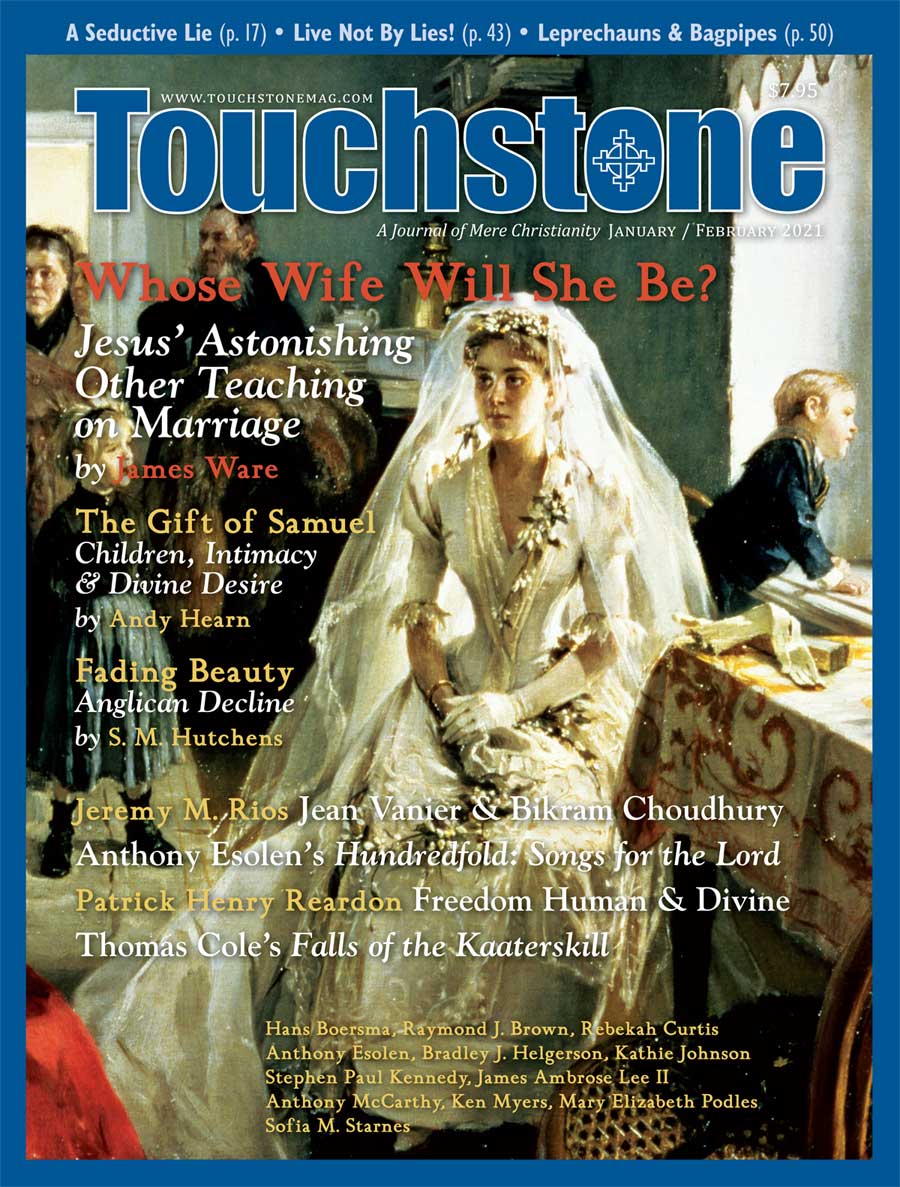
Poetic Fidelity
The Hundredfold: Songs for the Lord
by Anthony Esolen
In a fortuitous and fruitful coincidence, I found myself reading Dom Aelred Watkin's Resurrection Is Now at the same time that I became aware of Anthony Esolen's most recent book, The Hundredfold: Songs for the Lord. Allow me to quote from Watkin's work:
The essence of creativity is that what is achieved is something much more than the materials which go to its making. A masterpiece of prose or poetry is immeasurably more than the words of which it is constructed. . . . In a mysterious way the prison-house of the present has been broken open and we experience something that partakes of the universal . . . [something] that has achieved independence of time and place.
Sadly, in our current cultural milieu, Watkin's words are more aspirational than actual. When deprived of musicality, much of modern poetry struggles to exceed the limitations of its medium. The prison house of the present is not to be broken with broken-up prose; there is little if any partaking of the universal.
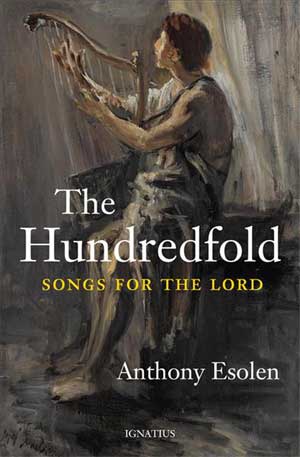
Into this diminished state of affairs comes Esolen's intense, deeply compelling, and artistically erudite poetry book, a work he describes as "a first salvo in the Christian reclamation of the land of imagination and song" (46). Indeed, the volume contains not only the poem, but also an eloquent apologia of formal poetry, focused on English forms. And yet, The Hundredfold requires no such defense. The poem stands on its own; it is its best argument.
A Clothed Numerical Scaffolding
Having made a case for formal poetry in his introduction, Esolen then offers the reader a structural description of his work, which, he explains, is essentially a single poem comprising twelve long dramatic poems, two of which are dialogues; 67 lyric poems inspired by scriptural verses; and 21 hymns based on traditional melodies and also founded on Scripture, adding up to 100 poems. The twelve dramatic poems and 21 hymns add up to 33 and are designated with Roman numerals; together they contain 3,333 lines; these are meaningful numbers given the 33 years of our Lord's earthly life.
Other numerical details complete the picture, which reveals an analytical approach to writing—or constructing—poetry that may seem at odds with those heart impulses often ascribed to the creative process, a case of the left brain imposing its will on the right brain. Yet nothing of this sort occurs in Esolen's work. The author's profound devotion to his subject, his attunement to the Spirit, and his surrender to a muse pulsing both human and divine are more than enough to animate—and clothe—the numerical scaffolding of the poem. However, only by immersing ourselves in The Hundredfold can we appreciate how successfully the verses array the poem's structure, both embracing and fulfilling it.
The following excerpt from "The Boy Who Brought Some Food," one of the monologues, offers an initial inkling:
Because I lay under the weight of earth
And the dust was a pillow to my cheek—
The dust and blood that swaddled me at birth,
When I first wailed as if my heart would break—
I could but hear and speak
Faintly, and in confusion of the sound;
And all my fellow men who dwelt in tombs,
Where never a call of clarion trumpet comes,
Spoke and heard as if muffled by the ground
And by the crowds of buried men around.
So was the conversation in our rooms.
So is it still, where the word is half-drowned;
And after a moment's silence it resumes. (96–97)
From the particular "I first wailed" to the universal "my fellow men who dwelt in tombs," from the proximate "pillow to my cheek" to the all-encompassing "crowds of buried men around," from the near-lifelessness of a "word . . . half-drowned" to life being restored when "after a moment's silence it resumes"—thus does Esolen transport us from matter to spirit, from grain to grandeur. There is no unbridgeable chasm between the particular and the universal. To dwell in God's providence is to dwell in a unified created and creative realm.
Unequivocally Christocentric
The Hundredfold opens with four lyric poems set in Eden, a prelude to the first dramatic monologue, "The Mother," which features Mary watching over her sleeping Son. The granular specificity of the descriptions in this dramatic narrative takes us deep into those might-have-been moments of the Messiah's hidden years. We read:
Look at that knuckle on his right hand, crushed
Under a beam that slipped out of its harness
When they were hoisting it to be a lintel
For the old desert fox we call our king. . . .
When he came home that night
And cleaned away the clots of dust and blood,
The vein opened again, and for one moment
I thought—this is the suffering, this, no more! (56)
The longing and pathos of these verses invite the reader to dig into the narrative further. Who is this Mother? Who her anointed Son?
Mary's monologue is unequivocally Christocentric (hence the probability of these questions), as is the rest of The Hundredfold. The settings and characters vary from poem to poem, yet each is an invitation to contemplate some aspect of the Savior's life and to appropriate a question here, a statement there, from both high and hidden points in Salvation history.
For instance, in the poem "The Centurion to His Woman," the centurion's question, "Aren't we aimed like arrows to our end?" (75), could easily be ours. After all, do we not wonder, too, about the trajectory of our lives? In the poem "Saint Peter," we hear the apostle sigh, "but when I shut my eyes / I see his burning eyes as the cock crows, / Searching the little puddle of my soul" (130–131). Are we not betrayers as well? Upon reading "The Demoniac from Gadara," for whom the defeat of demons is the defeat of death, who among us would not be inclined to seek, as the demoniac did, "deeds of great love that echo in my heart" (151)?
The Dramatic Backbone
The twelve dramatic poems form the backbone of The Hundredfold. They tell stories and transcend them, reminding us of their timeless relevance. Each comprises a conflict, a crisis, and a denouement; all bear a tension that demands response. One of my favorites is "Bartimaeus," a monologue in the voice of the man, blind from birth, whose sight Jesus restores. Esolen combines this miraculous event with the miracle of creation, so that praise and longing intertwine, as do death and discovery, nothingness and existence. He invites us to wonder about the emergence from total, lifelong blindness—"a night bird gliding on silent wings / Over the sleeping world" (115)—to full, unadulterated sight:
I was clothed in nothing
But the immortal innocence of God,
And I replied, as if my heart would burst,
"Lord, I was blind, and now I see your face." (119)
To see creation in all its newness is to see the face of God.
In another monologue, "The Blacksmith to Saint Luke," we read, "The corn in ear waved like a golden sea / Rippling under the haze of summer noon" (103). From the particular "corn in ear" to the universal "golden sea," from the minute and proximate "rippling under the haze" to the zenith of "summer noon"—here, too, Esolen transports us from the unique to the universal. What's more, he does so by rescuing a first-century moment and giving it a contemporary voice. Old utterances resurface as our utterances, and—unsurprisingly—we no longer distance what happened then from what happens now. The moment Christ entered history, time and space began to partake of God's eternal present, a reality that The Hundredfold reflects.
This timelessness, as well as the momentous blessedness of sight, which we encountered in "Bartimaeus," is reaffirmed one final time in the last dramatic monologue, "Two Disciples of Saint John in Patmos." Here we read:
Come, let me touch you, let me bless your eyes.
Things hid from the foundation of the world
Will come to light. . . .
The terrible apocalypse of love. (218)
We've come full circle from the first poem, Mary watching over her dormant son, to this scene of two disciples watching over their old master, the evangelist, while he sleeps. How fitting! After all, was John not Mary's adopted son?
The Lyric Poems & Hymns
I have focused on the dramatic poems in this review, because—as I indicated above—I believe they form the backbone of the book. Yet, I would be remiss if I did not consider the lyric poems, so integral to the work's significance. Socrates famously asserted, "The unexamined life is not worth living," and the lyric poems ensure that we pause before and after each dramatic narrative, in order to ponder the why, the what-for, and the what else of every occurrence. In addition, as preludes and postludes to the long poems, they offer crucial meditative spaces. And they ensure that the heart—where pulse and rhythm reside—retains its integral place.
Here are a few such instances. Immediately before the monologue titled "Saint Peter" we find lyric poem 32, set along the shore of Galilee, where Jesus is feeding his friends:
They sat and ate with Him, and no one spoke,
But Peter's shoulders—oxen at the yoke—
Trembled under the weight of so much love. (125)
The juxtaposition of two scenes—that of the apostles eating, seemingly at ease, without much to say, and that of Peter sitting close to Jesus ("oxen at the yoke"), his shoulders trembling (one sees him unavoidably in tears, burdened by love)—fulfills the scene as no straightforward narrative could do.
In another instance, lyric poems 42 and 43, which come before and after "Saint Paul to Gamaliel," together give this sober epistolary poem a fiery dimension, befitting the fervent Apostle to the Gentiles. First, from poem 42: "Give me a heart fit for the hero's wreath / Of golden thorns, when I shall stand with Thee" (168). And then, after the dramatic monologue, these exuberant lines from poem 43: "At the ninth height of being, eyes are bright / With what is now, what was, what is to be. . . . the intimate wellspring where the blessed are" (178). The scene is complete, fulfilled, triumphant.
Such is the vital role played by the lyric poems. But there is more. Interspersed amid the lyric and the dramatic poems are 21 hymns. Their task, Esolen explains, is to enter into a dialogue with the dramatic poems, to give them further meaning. Bis orat qui bene cantat, I would add. Esolen yearns for good liturgical music, and he reaches into the trove of English church music from the last 400 years to compose these hymns. It is thus not unexpected that we should find them both consolingly familiar, as if we'd heard them before, and bracingly fresh, because we really haven't. Listen to these lines from the hymn designated as poem XXV:
What can I give the Lord that is my own?
When I was empty, I was filled with pride;
I reckoned sand and called it diamond-stone;
My blind heart was my guide. (169)
This appeal to the familiar connects us to our spiritual inheritance, which is renewed in us that we might recognize our own longing in a future uncharted land.
The Faithful Soldier
Anthony Esolen's first foray into the world of poetry has produced a work of tender, robust beauty, one that offers further and fonder treasures with successive readings. The closing poem, written in terza rima, brings the entire enterprise tellingly home:
The old recruit must swing the sword, not yield,
for should he be cut down like a dead tree,
the red heart of his love shall be revealed. (223)
We recognize in Esolen that faithful soldier, battling in the armies of the Lord, wielding language in the service of the Word, whose Beauty is Truth, and whose Goodness lasts forever.
Sofia M. Starnes is a poet and editor of Philippine-Spanish heritage, an American citizen since 1989. The author of six poetry collections, she served as the poet laureate of Virginia from 2012 to 2014. She offers editing services to writers of various genres through Creative Writing Critiques, and serves as a translator of art essays and articles for Galería Cayón (Madrid, Spain) and the Ayala Foundation (Manila, Philippines). She lives in Williamsburg, Virginia, with her husband Bill.
A Journal of Mere Christianity—Delivered to Your Door
- Essays on theology, culture, and the Church
- Contributors from across the Christian traditions

Six print issues (one year) of Touchstone, plus full online access and PDF downloads for only $39.95.

Get a one-year full-access subscription to the Touchstone online archives for only $19.95.
bulk subscriptions
Order Touchstone subscriptions in bulk and save $10 per sub! Each subscription includes 6 issues of Touchstone plus full online access to touchstonemag.com—including archives, videos, and pdf downloads of recent issues for only $29.95 each! Great for churches or study groups.
Transactions will be processed on a secure server.
more on poetry from the online archives
37.5—Sept/Oct 2024
A Battle Plan for Peace While Growing Old by Anthony Esolen
more from the online archives
28.3—May/June 2015
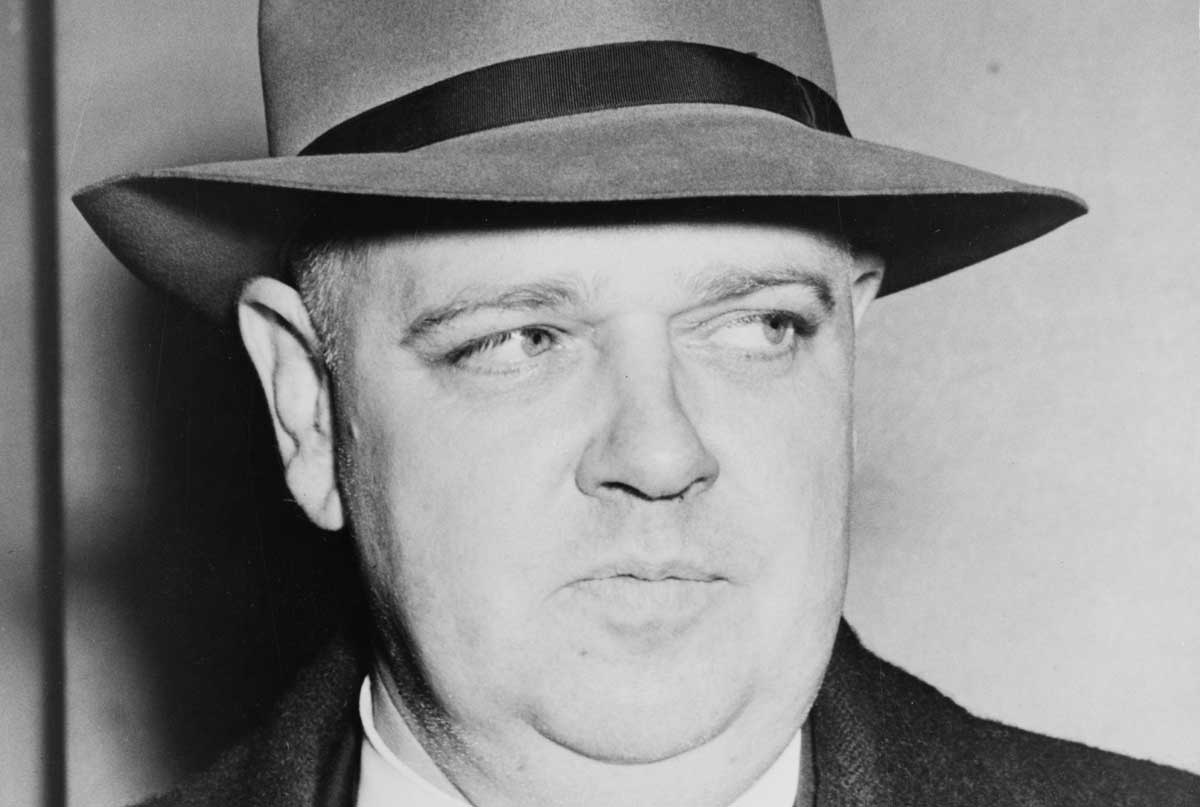
Whittaker Chambers's Lonely War Against Godless Collectivism by Hunter Baker
24.1—January/February 2011
How Planned Parenthood's Founder Played the Christians, and Won by Allan C. Carlson
29.2—March/April 2016
The History of Family Strength in America May Reveal Good News by Allan C. Carlson
calling all readers
Please Donate
"There are magazines worth reading but few worth saving . . . Touchstone is just such a magazine."
—Alice von Hildebrand
"Here we do not concede one square millimeter of territory to falsehood, folly, contemporary sentimentality, or fashion. We speak the truth, and let God be our judge. . . . Touchstone is the one committedly Christian conservative journal."
—Anthony Esolen, Touchstone senior editor
