




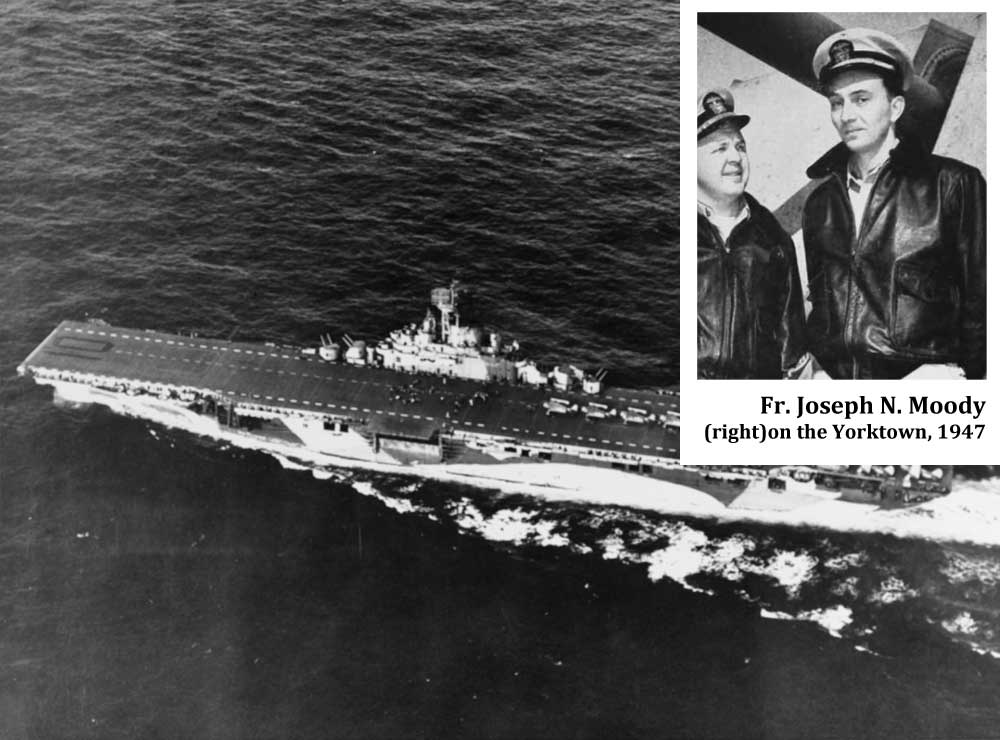

That Great Man
Remembering Chaplain Moody, Who Was Always There for His Men
Let us now praise famous men . . . but I'll just remember a faithful servant who once went to war against powers and principalities, both seen and unseen.
On Easter Sunday, April 1, 1945, more than 1,300 ships, four Army divisions, and three Marine divisions would invade the Japanese home islands in a brutal 82-day campaign. But getting to Okinawa for the amphibious landings and desperate engagement with the Divine Wind (Japan's kamikaze pilots) was no simple task.
Two weeks earlier, on March 18, the aircraft carrier USS Yorktown—The Fighting Lady—was proceeding toward Okinawa. Though aircraft carriers were surrounded by battleships, cruisers, and destroyers afloat, and Combat Air Patrol aloft, the protective screen was not impenetrable. On that Sunday, the 18th, Japanese aircraft did break through and attacked York-town. A 500-pound bomb exploded in the air just off the port side of the carrier. That fifth Sunday of Lent was promptly renamed "Bomb Sunday" by the ship's company.
Yorktown kept maneuvering to confuse the inbound targeting aircraft and to launch and land her own. The gun crews kept firing rapid continuous. And the damage control teams worked feverishly to put out fires, free compartments of gas, and de-smoke the black air. There were 23 casualties, both sailors and Marines, in three locations—one area topside in a gun mount, and two spaces just inside the skin of the ship and on different decks—not to mention damaged aircraft.
Running immediately toward the explosion from Repair Locker 3 and arriving on the scene, without orders, was Lieutenant Commander Joe Moody, a Catholic priest and senior chaplain. Two men had been blinded, another man's entrails were spread out on the deck about him, and two other shipmates were now without their legs. Amid blood flowing on deck and flames over-heating the spaces, Fr. Moody organized stretcher teams, himself first assisting a wounded sailor to safety. Barking orders like a line officer, he gave clear direction to the Protestant chaplain, Lieutenant George Wright, on where and how they would split responsibilities.
The assigned Hospital Corpsmen and stretcher bearers, some drafted by Moody, responded well. Order was restored on mayhem. The makeshift stretcher teams transported the wounded to battle dressing stations and then up deck via ladders to sick bay, laboriously opening and dogging Quick Acting Watertight Doors and advising Damage Control Central of routes. All the while the sprinkler system annoyingly hosed the sailors down. There was triage knowingly ignored, last rites administered, and even a deathbed conversion. It was a hard day and a long night of prayer and action.
No medal was ever conferred on Joe Moody. But his shipmates knew what he had done that day and never forgot it. And the historian Dr. Clark G. Reynolds, in his otherwise even-handed, warts-and-all account of Yorktown 1943–1945 (published in 1968), would refer to him as "that great man." But the crew had known that reality long before Bomb Sunday. And long after.
An Epoch Fast Fading
I am a baby boomer, one of that voluminous tribe born between 1946 and 1962. In my suburban boyhood there existed a vague and ill-informed neighborhood hierarchy concerning fathers and their roles in wartime. But rightly atop that local pyramid was my own father, Jake. He was a once-a-Marine-always-a-Marine for sure—14 battle stars, a ship sunk from under him, shrapnel in his head, and malaria three times. Dad served in the Marine Detachment of USS Yorktown, in both the first ship of that name, sunk at Midway, and the second one, bound and victorious on namesake retribution. He also made two amphibious landings.
I have lived most of my life in the giant shadow of that Greatest Generation, perhaps the more so as I chose a career in uniform. Abiding in that giant shadow was all I had ever known, and it seemed normal. Now that the bastions of that generation have almost all passed on, I realize that having been in their long-enduring presence was a privilege. Their like we will not see again.
Raymond J. Brown is Secretary of the American Lutheran Publicity Bureau, a retired U.S. Coast Guard captain, and a security consultant living in New Hampshire. He and his wife Susan, a librarian, have three grown children.
A Journal of Mere Christianity—Delivered to Your Door
- Essays on theology, culture, and the Church
- Contributors from across the Christian traditions

Six print issues (one year) of Touchstone, plus full online access and PDF downloads for only $39.95.

Get a one-year full-access subscription to the Touchstone online archives for only $19.95.
bulk subscriptions
Order Touchstone subscriptions in bulk and save $10 per sub! Each subscription includes 6 issues of Touchstone plus full online access to touchstonemag.com—including archives, videos, and pdf downloads of recent issues for only $29.95 each! Great for churches or study groups.
Transactions will be processed on a secure server.
more on biography from the online archives
more from the online archives

32.2—March/April 2019
Flight from the Absolute: Cynical Observations on the Postmodern West, Volume II by Paul Gosselin by Louis Markos
19.10—December 2006
Workers of Another World United
A Personal Commemoration of Poland’s Solidarity 25 Years Later by John Harmon McElroy
calling all readers
Please Donate
"There are magazines worth reading but few worth saving . . . Touchstone is just such a magazine."
—Alice von Hildebrand
"Here we do not concede one square millimeter of territory to falsehood, folly, contemporary sentimentality, or fashion. We speak the truth, and let God be our judge. . . . Touchstone is the one committedly Christian conservative journal."
—Anthony Esolen, Touchstone senior editor
