




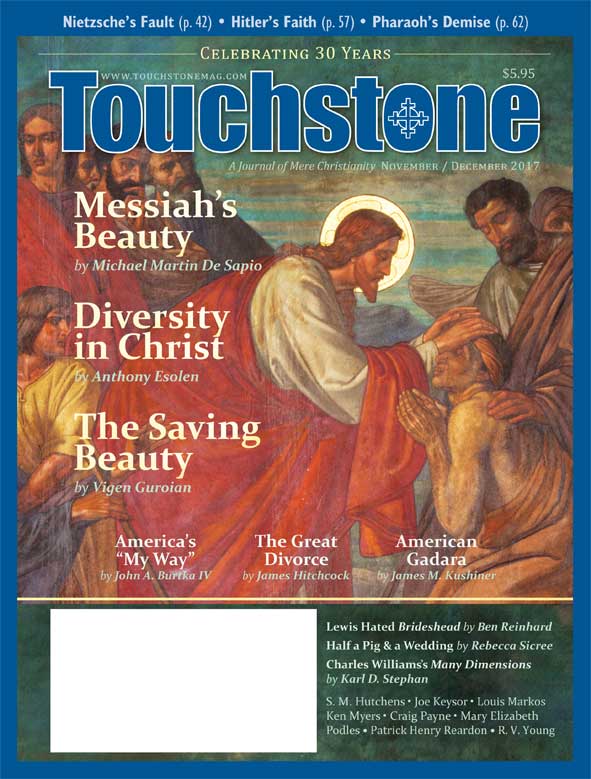
View
A Peculiar Sickness
John A. Burtka IV on Individualism in America & Its Cure
While reclining at my desk after a day's work, I caught myself singing along to Frank Sinatra's 1969 sensation, "My Way." As I mouthed each line of the song, I realized that many of our contemporary woes—spiritual isolation, social alienation, and cultural fragmentation—have their root, not exclusively in technology, social media, or the millennial generation, but much farther back in our American tradition.
The song, which, I admit, conjures up a sense of mutual triumph in Sinatra's rugged individualism and worldly success, memorializes an egotistical creed:
For what is a man, what has he got?
If not himself, then he has naught;
To say the things he truly feels
And not the words of one who kneels;
The record shows I took the blows
And did it my way.
The story of self-referential individuals, refusing to bow to earthly or heavenly authority, has been a hallmark of our American tradition going back from Sinatra to Twain to Emerson, and it reflects two vices prominent in democratic societies: individualism and materialism.
When Alexis de Tocqueville toured the United States in the 1830s, cataloguing the virtues and vices of American democracy, he warned that "individualism is a sickness peculiar to the human heart in democratic times" (Democracy in America [Liberty Fund, Inc., 2010], p. 881). What's wrong with individualism? According to Tocqueville, it begins as a rather harmless form of isolation and withdrawal rooted in self-interest, but rapidly grows, choking out public and private virtue along the way.
Due to equality of conditions in democratic societies, individuals lose the cultural glue that binds them to their ancestors, descendants, and land. Furthermore, the bonds that united the classes together in an aristocracy and provided for mutual support and shared responsibilities no longer exist. While the benefits of democracy and equality are well known, their vices are subtle and destructive.
The independence of the individual and nuclear family in democratic times creates a state of perpetual agitation and restlessness. In the course of eighty years, each person is responsible for earning an education, finding a spouse, starting a career, saving for a home, rearing children, paying for the children's college tuition and weddings, preparing for retirement, and then rolling the dice on whether he or she will have enough money in the bank to make it to the grave.
Tocqueville calls this movement and worry inquiétude, and it has the effect of turning each person's gaze inward, and consequentially towards "excessive material enjoyments" (745). This "dangerous sickness," materialism, "must be particularly feared among a democratic people because it combines with the vice of the heart most familiar to these people" (957). And when combined with individualism, the pursuit of material well-being unleashes animal-like passions that can degrade mankind and the environment if they are not checked by religious faith and piety. For Tocqueville, Christianity in America serves as the primary instrument capable of lifting people's eyes beyond individualism and materialism, towards eternity and virtue.
The Fearful Seek Order
Before explaining why faith plays such an indispensable role in Democracy in America, I will elaborate on why Tocqueville fears unbelief in a democracy. Virtue is hard and requires that people sacrifice hundreds of fleeting pleasures each day. To be virtuous is to take the long view that restraint in the present will lead to happiness in the future. With few exceptions, people require the eternal rewards and punishments of religion to inspire them toward virtuous action. When the masses abandon religious faith and authority, however, they "are soon frightened by the sight of limitless independence" (745).
People in this state of fear and agitation of spirit seek order. And most often, they desire order in the material aspects of their lives. They long for stability and turn to replacement "masters" who offer meaning and promise political tranquility. The great risk, however, is that in this search for a new master, they will unite themselves to a tyrant who might take away their freedoms and threaten the existence of the democratic system. Tocqueville summarizes this fear by stating, "For me, I doubt that man can ever bear complete religious independence and full political liberty at the same time; and I am led to think that, if he does not have faith, he must serve, and if he is free, he must believe" (745).
How does religious belief practically impact the life of democratic peoples prone to individualism and materialism? Tocqueville observes, "However animated the Americans are in the pursuit of well-being, there are moments when they stop and turn away for a moment to think about God and about the other life" (954). This happens (or did in the time of Tocqueville) on a weekly basis when Americans observe the Sabbath day and take their whole family to church. Due to the perpetual agitation of democratic life, Americans don't often make time for contemplation and reflection. Because remembrance of the Sabbath day is commanded by God, however, many Americans set aside this day every week to implement habits that are contrary to their nature, but that help them focus on eternal aims and long-term goals. This is why Tocqueville praises religion as the "only general, simple, and practical means to teach men the immortality of the soul. That is the greatest advantage that a democratic people draws from belief, and what makes these beliefs more necessary for such a people than for all others" (958).
An Antidote with Shortcomings
Tocqueville saw the Protestant faith that dominated America in his day as offering an antidote for the vices of individualism and materialism, but he was also aware of some of its counterproductive tendencies. What are the shortcomings of Protestantism? Tocqueville states that "most of English America was populated by men who, after escaping from the authority of the Pope, submitted to no religious supremacy; so they brought to the New World a Christianity that I cannot portray better than by calling it democratic and republican" (467). This democratic and republican faith, while helpful in subduing the passions, also contains the same destructive, self-referential qualities found in our system of government. Protestantism, at its root, represents a rejection of the visible nature of the Church and its authority. It replaces the pope with the sovereignty of the individual, guided by the Holy Spirit, to interpret and apply the doctrines and moral commands of the Christian faith. The risk in this approach to the faith is that it severs the individual's ties to tradition, authority, and liturgical form. In doing so, it mimics the vices of -democracy and contributes to the overall sense of inquiétude by leaving man responsible not only for carrying out his myriad duties, but also for defining and implementing the very means of his salvation.
In light of these challenges, Tocqueville predicted a revival of Catholicism in America that could offer a more holistic remedy to the problems of individualism and materialism. Why would democrats be attracted to such a hierarchical faith? For Tocqueville, the answer lies in its uniformity. For those willing to submit to religious authority, "they at least want it to be unitary and uniform" (754). Catholicism offers a faith that is consistent in doctrine and worship for Christians across all continents—and even for most of time. Furthermore, Catholicism better combats individualism and materialism by re-linking democratic man to his ancestors and posterity. Catholic piety offers all the benefits of familial, aristocratic bonds, with none of the vices. The Catholic's bond with the saints is spiritual and immaterial. He or she develops a sense of piety for the dead through the prayers of the church and personal devotions that serve the pedagogical purpose of teaching one how to love his neighbor. Finally, in the Eucharist, Catholics share fellowship with all Christians from all places in all times. This communion of saints anchors democratic man in a spiritual tradition that has greater resources to conquer individualism and materialism than has Protestantism.
Similar things might also be said about my own spiritual tradition, Eastern Orthodoxy, yet its presence would have been sparse on the continental United States at the time of Tocqueville's visit (Orthodox missionaries did, however, settle in Alaska in 1794). For example, the tradition of icons in the Eastern Church and the practice of venerating them during services serve not only to remind the faithful of their forbearers, but also to invite participation in their story. Traditionally, Orthodox families place icons in the corners of rooms in their homes so that the saints can watch over their actions throughout the day. These practices remind Orthodox of the importance of persevering in the faith until death so they can join the greater communion of saints that have accompanied them throughout their lives.
Urgent Need
Despite the vibrancy of religious belief in America compared to Europe, the need for religion in our democratic society has never been more urgent. Technology and social media have accelerated the growth of the vices of -individualism and materialism, and have also opened new avenues for increased isolation and social fragmentation. Our American polity will not survive its current political and cultural divisions unless we see a revival of traditional religious piety that both encourages long-term (i.e., eternal) thinking and planning in the present, and instills the habits of virtue for the future.
There has been a resurgence of liturgical practice, especially among millennials, in the last decade. This revival crosses denominational lines and is surprisingly common among Evangelicals. In communities with an Evangelical university, such as Wheaton, Grove City, or Baylor, there are vibrant Anglican parishes teaching students to follow the liturgical calendar and adopt ancient spiritual disciplines. This trend should be encouraged. Even late-night television host Jimmy Fallon, in a recent interview on NPR's Fresh Air, cites the loss of traditional practices—incense, monasticism, hymnography—for his departure from Catholicism. All around, Americans hunger for community, order, and form to impart meaning to them and direct their lives towards eternal aims.
Across Europe and the U.S., populist politicians have gained momentum as they challenge establishment elites on both sides of the aisle. They promise a journey to either an extinguished past or utopian future, or perhaps somewhere in between. While these political changes certainly present opportunities, such as reaffirming the importance of national borders or resisting supra-national administrative states, there's also the danger that these politicians may become the tyrants Tocqueville warned about. If so, their sirens can only be resisted by a robust religious piety that does not "trust in princes, in a son of man, in whom there is no salvation" (Ps. 146:3).
When Sinatra popularized "My Way" in 1969, it looked as though individualism had triumphed. The social homogenization and prosperity of the fifties led to a firestorm in the sixties, when radical students and elites revolted against the cultural consensus of the time. While progress for African-Americans must be applauded, the accompanying destruction of social mores and religious institutions has left America directionless.
Sinatra's song commemorated the triumph of individuality and autonomy at a time when our society was satiated with "liberation" but oblivious of the consequences to come. Having been freed from the chains of custom, creed, and shared cultural aspirations, Americans were left, according to the Supreme Court, with the "right to define [their] own concept of existence, of meaning, of the universe, and of the mystery of human life" (Planned Parenthood v. Casey, 1992). While certain avant-garde individuals, like Twain or Emerson, may have tried this in the past, their experiments were done against the backdrop of a homogenous culture with shared customs and moral norms. Today, however, these mores no longer exist, and the risks posed by individualism are even greater. If our democratic republic is to survive and thrive for years to come, it will be through a resurgence of traditional religious piety that tames the passions of individualism and materialism so pernicious to a free society.
A Journal of Mere Christianity—Delivered to Your Door
- Essays on theology, culture, and the Church
- Contributors from across the Christian traditions

Six print issues (one year) of Touchstone, plus full online access and PDF downloads for only $39.95.

Get a one-year full-access subscription to the Touchstone online archives for only $19.95.
bulk subscriptions
Order Touchstone subscriptions in bulk and save $10 per sub! Each subscription includes 6 issues of Touchstone plus full online access to touchstonemag.com—including archives, videos, and pdf downloads of recent issues for only $29.95 each! Great for churches or study groups.
Transactions will be processed on a secure server.
more on america from the online archives
29.4—July/August 2016
Russell Kirk: American Conservative by Bradley J. Birzer by Hunter Baker
30.5—Sept/Oct 2017
The Christian Cure for What Ails Modern Politics by David Bradshaw
29.2—March/April 2016
The History of Family Strength in America May Reveal Good News by Allan C. Carlson
more from the online archives



37.5—Sept/Oct 2024
Why Law Schools Can't Teach Law
A sidebar to How Law Lost Its Way by Adam MacLeod
calling all readers
Please Donate
"There are magazines worth reading but few worth saving . . . Touchstone is just such a magazine."
—Alice von Hildebrand
"Here we do not concede one square millimeter of territory to falsehood, folly, contemporary sentimentality, or fashion. We speak the truth, and let God be our judge. . . . Touchstone is the one committedly Christian conservative journal."
—Anthony Esolen, Touchstone senior editor
