




Table Graces
Gary A. Fritz on the Blessings of Serving Communion to the Saints
Although my father wasn't a pastor, I grew up with the ever-present knowledge that I was a "PK" of sorts. For me, that meant that dad was a principal, in this case, of a Lutheran school. Though that didn't carry the moral burden of being a parson's child, I certainly was raised and grew up under the scrutiny of our entire congregation, a large parish of nearly 2,000 souls. Consequently, going to church was non-negotiable, an unspoken duty that was fulfilled without question, argument, or any form of dissent. And being a compliant child, it never even crossed my mind to consider otherwise.
Thus, I attended church. A lot. By the time I was confirmed, I had undoubtedly sat through over 800 services, with roughly half of them culminating with the Sacrament of the Altar. Though I was a believer and cannot recall being without faith at any time during my growing years, I was never a fan of Communion Sundays. Inevitably, we would sing at least three extra hymns or slog our way through all fifteen stanzas of "I Come, O Savior, to Thy Table" (#315 in The Lutheran Hymnal). I suspect that "Lord, may Thy body and Thy blood / Be for my soul the highest good" just might be my deathbed mantra as I breathe my last. All told, not a bad final thought with which to enter glory.
But I digress. Of course, in a congregation our size, with pastors who would not shorten their Communion Sunday sermons to accommodate the fidgets of ten-year-old boys, these services could easily last an extra fifteen to twenty minutes. Consequently, I would usually groan when I saw the Communion "hardware" dominating the altar at Trinity Lutheran Church.
An Awe-Filled & Humbling Ministry
Fortunately for my faith-life, one's perspective has a way of changing. Now, having reached my fifties, the sacrament is dear to my heart, a part of worship that I look forward to and greatly desire. Moreover, the entire experience has grown from perfunctory to near-mystical. The very notion of the "communion of saints" permeates my sacramental imagination as I envision the worldwide body of Christ gathering, in homes and in churches, in secret and in the open, under plain thatched roofs and under grand cathedral domes, to celebrate this sacred meal. I see black and white folks, city and country dwellers, variously standing, sitting, or kneeling as the bread and wine are tasted. And in my mind's eye I reach back into history and see the whole Church, stretching down through the centuries, gathered together around this sacred table.
Thus, several years ago, when my congregation sought laity to assist with Communion, I jumped at the opportunity. Now, I would not only be a communicant but would also participate in the holy and humbling act of giving to my fellow believers the very same nourishment Jesus gave to his disciples so very long ago in the upper room.
I still recall my first Sunday as a Communion assistant. Having donned the requisite white robe, I stepped to the front of the church, the lay minister at my side. After receiving the wafer and wine, it was up to me, in turn, to administer the elements to my pastor. In moments such as these, unsolicited thoughts often rear up in my mind, and I suddenly saw that horrific scene in the film Luther when the young monk is saying his first Mass and spills a chalice of wine on the altar, right there in front of family members and congregants. I trembled then, and to varying degrees still do so today whenever this role is mine, not because I fear doing as Luther did in that scene, but simply because the sacrament is so profoundly powerful, so holy, and so filled with the depths and riches of God's mercy, grace, and love. And there I am, chief of sinners, providing this tangible message of forgiveness and life to fellow travelers on this journey of faith. What a truly "awe-ful" ministerium.
But that which is so profoundly disturbing remains equally invigorating. When called to serve in this manner, I get to speak words of comfort and to provide assurance of God's love and eternal salvation to the broken, the hurting, and the hopeful. It is not unusual then, to consider these things while at the altar.
The layout of our sanctuary and the size of our congregation are such that, when I stand at the front, every face in attendance is clearly visible. Often I have been moved by compassion as I gaze out at my fellows, whose faces I know so well, and yet . . . Do they understand? Do they recognize the power, the significance, the promise? I, who so often battle the demon of pharisaical pride, find myself longing for these parishioners to recognize and embrace the bounty that God is laying before them. And strains of that old, lengthy hymn once again come to mind:
Thy heart is filled with fervent yearning
That sinners may salvation see,
Who, Lord, to Thee in faith are turning;
So I, a sinner, come to Thee.
A Journal of Mere Christianity—Delivered to Your Door
- Essays on theology, culture, and the Church
- Contributors from across the Christian traditions

Six print issues (one year) of Touchstone, plus full online access and PDF downloads for only $39.95.

Get a one-year full-access subscription to the Touchstone online archives for only $19.95.
bulk subscriptions
Order Touchstone subscriptions in bulk and save $10 per sub! Each subscription includes 6 issues of Touchstone plus full online access to touchstonemag.com—including archives, videos, and pdf downloads of recent issues for only $29.95 each! Great for churches or study groups.
Transactions will be processed on a secure server.
more from the online archives

36.4—Jul/Aug 2023
Our Political Void & the Disintegration of Truth by Michael Hanby

29.5—Sept/Oct 2016
on Past & Present Atheism & the Invention of Happiness by Jordan Bissell
19.10—December 2006
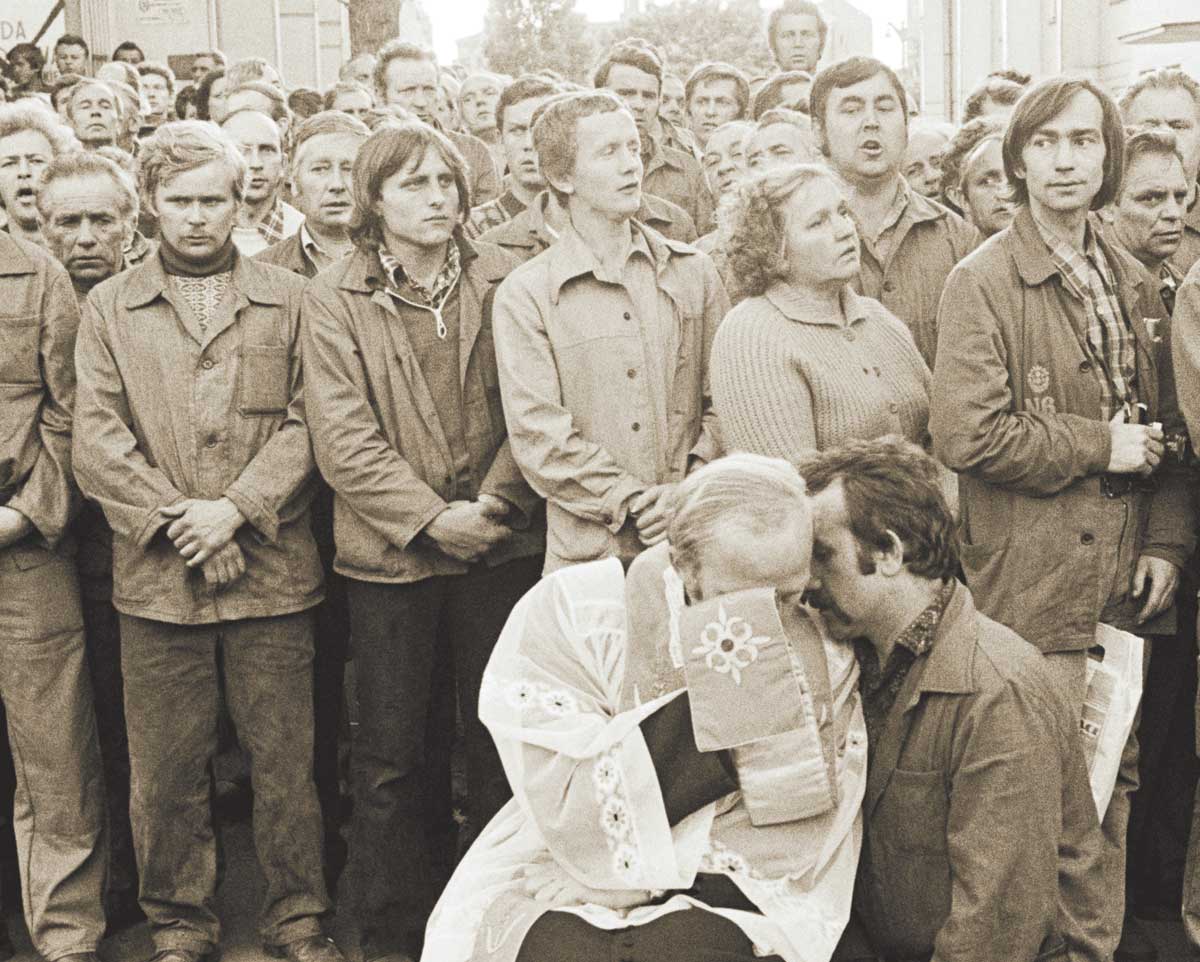
Workers of Another World United
A Personal Commemoration of Poland’s Solidarity 25 Years Later by John Harmon McElroy
calling all readers
Please Donate
"There are magazines worth reading but few worth saving . . . Touchstone is just such a magazine."
—Alice von Hildebrand
"Here we do not concede one square millimeter of territory to falsehood, folly, contemporary sentimentality, or fashion. We speak the truth, and let God be our judge. . . . Touchstone is the one committedly Christian conservative journal."
—Anthony Esolen, Touchstone senior editor
