




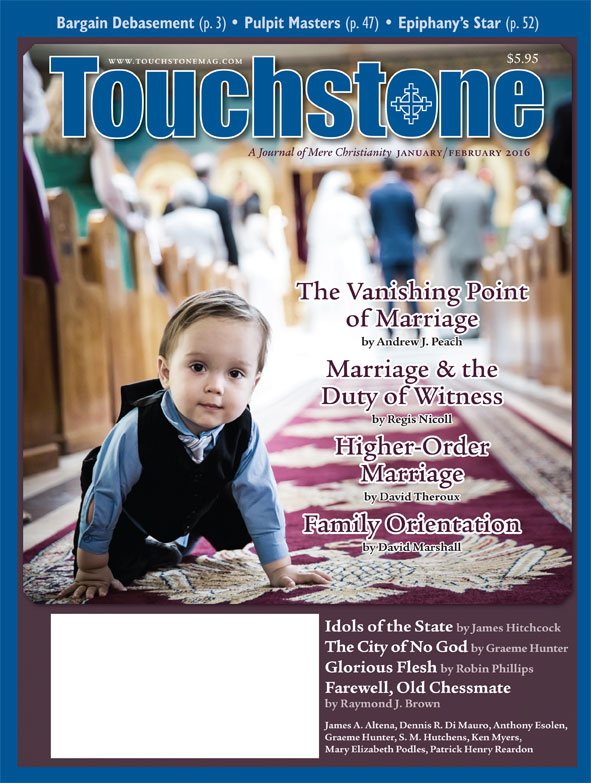
Feature
Farewell,
Old Chessmate
John Mortimer's Rumpole of the Bailey
& the New Rules of the Game
"It is good to know that both the faithful
and the faithless can still be playing from
the same chessboard."
So wrote the late John Mortimer—barrister, author, dramatist, screenwriter, bon vivant, and a charming name-dropper—in his Where There's a Will, shortly before his death. He was referring to the fact that, over the course of his life, he, as a non-believer, had been able to share similar values and intellectual pursuits with contemporaries who were Christians. Probably he was right for much of his twentieth-century life in the English-speaking West, but I rather doubt that his dictum is still true or can own any veracity much longer. As a cultural norm for all, Christendom's historical influence is dissipating. Sir John lived his life (1923–2009) when true faith in the West was diminishing, just as was the British Empire, but that faith yet held a tenuous grip and residual fragrance, and could infuse corporate memory and personal behavior.
Mortimer left behind some good writing, disagreeable though I might find his political views. He thought Margaret Thatcher's economic freedom policies were a terrible blight on the commonweal. A disdaining Mortimer wrote Paradise Postponed, novel and screenplay, decrying Thatcherism as the Decline of the West proof-positive. But let us consider first things, or at least work toward them.

Literary Stress Relief
In times of my life when the stresses of work have been acute, I have found my release in prayer, exercise, and reading humorous short stories. For the literary contribution to my mental health (escapism), I have three default positions: the McAuslan trilogy of George MacDonald Fraser, the corpus of P. G. Wodehouse, and John Mortimer's many Rumpole of the Bailey journeys into legal comedy. The first laugh-out-loud collection concerns small-unit soldiering as it really is in the English-speaking armed forces. The second library—well, if you need to be introduced to Jeeves, Wooster, Psmith, Aunt Agatha, Uncle Fred, Mr. Mulliner or Lord Emsworth, you have not yet lived. The last aggregate, the misadventures of -Horace Rumpole, Esq., has been made quite popular as a British television series. Mortimer himself was an accomplished Queens' Counsel, as well as varied scribe, quondam playwright, and even an actor. Let us speak of him—and Rumpole. First, Rumpole.
Horace Rumpole is a self-described "Old Bailey hack." Sarcastic, given to cheap wine and cheap cigars, dismissive of the establishment, self-destructively hostile to powerful poseurs, and in fear of his overbearing wife Hilda, he is nonetheless a most capable, if somewhat unorthodox, defense attorney. Always the defense. And a rapier wit to every phony, quack, overweening ambition, cheat, and outsize ego within his purview. Horace Rumpole wants Lady Justice not only blind, but also with a bag over her head. One senses that there is a good deal of the author in Rumpole but that Mortimer's breeding was a bit of a stay for the author in real courtroom environs.
A Learned Man of His Time
Sir John Mortimer himself was a convinced man of the left (though quite void of any obnoxious political correctness or faddish sensitivities). His life on this earth was a full one in both the law and the arts. He died as an octogenarian nine years after the turn of the century. He was ever an atheist. Never baptized and never believing, he was yet comfortable in Christendom and among the believers he knew. He spoke fondly of Evelyn Waugh, Malcolm Muggeridge, and Graham Greene and of his discussions of faith with them. Mortimer's doubts might have been shaken a bit, but never did they crumble. He also admired P. D. James and agreed with her criticism of new Bible translations and revisionist alterations to the Book of Common Prayer.
Sir John, like his Rumpole, did revere the British system of justice, however he might skewer some of its practitioners. It is a shame, and perhaps a blind spot in him, that he never articulated that this venerable system came from tradents who followed the teachings of God as made known in Jesus Christ.
As Mortimer neared the final enemy, he penned Where There's a Will. The book is a series of essays, generally quite light-hearted. He intended this work to be something of his last thoughts bequeathed. One of his chapters is "The Great Perhaps." I suppose one cannot approach the end of life on earth without at least a nod to the concept of God and a living eternity, if only because most of humanity has always assumed such and has believed that the earth is not enough.
In that chapter, Mortimer goes through the usual reasons nonbelievers put forth for their stand—supposed contradictions, which Christians regard as mysteries; a dogged refusal to accept that which the human mind cannot fully comprehend; the Holocaust; good atheists and bad Christians; and the limits of both free will and Calvinism.
Then, of course, there was Mortimer's youthful foundation, something none of us can ever fully escape. His blind and brilliant barrister father dogmatically believed (or unbelieved) that "Huxley was to Darwin as St. Paul was to Christ." His artist mother simply assumed atheism, and, as G. K. Chesterton opined, a person's assumptions are more powerfully held than any stated doctrine.
An Appreciative Nonbeliever
But for all this, Mortimer never displayed any of the anti-theism à la Christopher Hitchens and Richard Dawkins and others of late grown more militant and, indeed, religious in their own perverted way. He could never have been simpatico with Gore Vidal and bluster about a heterosexual dictatorship. Rather, Mortimer displayed an indebtedness to the faith that was all about him, and was, in fact, the established church of his country:
Yet no one can deny that the Christian belief in the supreme importance of each individual soul was a great advance on the faith which thought of slaves as soulless. The King James Bible is of extraordinary power and beauty. . . . Much of the literature I've valued, the art I've most enjoyed, has been produced by unquestioning Christians. Whether I'm a believer or not, I'm a part of Christian civilization.
John Mortimer, nonbeliever, could write that. I have no confidence that someone born in the English-speaking West at the time of Mortimer's death, and growing up to be a lifelong atheist, will be able to pen a similar thought when he is an octogenarian.
Mortimer was born and formed in Christendom, a subset and residue of true Christianity, an atmosphere. The world about Mortimer may not have been committedly Christian. But Christianity was accepted culturally. Most people considered themselves and their beliefs Christian. Those of doubt or unbelief or lazy discipline (the most preponderant category) tended not to flaunt it. Societal standards were Christian, and so, usually, were the laws and manners based upon them. Not always understood and certainly not lived up to, the teachings of Jesus Christ were widely accepted in the society as true. Or at least good.
John Mortimer did not accept the articles of faith of the Christian credenda. But he did largely accept the morals of that credenda. Therefore, there could be a somewhat shared worldly agenda between him and those who were religious.
Certainly Mortimer saw the foibles of certain Christians—I think of Rumpole's erstwhile Head of Chambers, Soapy Sam Ballard, and laugh out loud—but Mortimer owned the honest acumen to differentiate between the faltering believer and the faith that was allegedly saving. We Christians sometimes speak of hating the sin but loving the sinner. The irreligious Mortimer could respect the belief while castigating the goofy believer.
Yet I doubt that toward the end of our current century, Mortimer, supposing his return to this mortal coil, would be able to play from the same chessboard with a Christian. I wonder if the chessboard itself will exist. At least if current trends continue unabated.
What people are saying about Touchstone:

The Times Have Been A-Changin'
The chessboard will likely not be playable, because the same rules, courtesies, limits, traditions, and possibilities will not be recognized by both players, much less understood. There will be no common ground between the believer and the unbeliever—not because militant atheists will have intentionally sabotaged the match, but because Western Christians will have allowed too much accommodation to the world, the flesh, and the devil. One could cite (and many do) the numerous signs of this accommodation, which increasingly seem to require no explanation by the believer or justification by the nonbeliever. Consider the following jeremiad on current circumstances:
• Apatheism practiced by many alleged Christians
• Widespread acceptance of abortion
• The number of millennials choosing no religion
• The descent of the Mainline churches into left-wing politics (and the corresponding decline in adherents)
• The decline of marriage and rise of cohabitation
• Loss of transcendence
• Recreational sex and multiple partners as a given
• Normalization of homosexuality and homosexuals becoming a protected class
• Degradation in entertainment on a never-before-seen scale and volume (nothing is new, but no longer is anything hidden for shame)
• Widespread biblical illiteracy
• Cafeteria Catholicism
• The refusal to judge a belief or a behavior—however un-Christian, misguided, or ridiculous it may be
• The mainstreaming of divorce
• The increasing acceptance of medical personnel assisting in suicides
• The creeping ambition of the state to direct the church, and societal willingness to acquiesce
• The exploitation of women on an unprecedented scale (in spite of women's alleged liberation, and even with women cooperating)
• Manhood seen as an outmoded, laughable concept
As belief has consequences, so does unbelief. I will refrain from trotting out the usual gee-whiz statistics from Google and other sources, but I think the following passage from Thomas Howard in The Achievement of C. S. Lewis succinctly portrays the gradual loss of Christendom's strength, numbers, quality, and value among the citizenry of our era:
I have sometimes given a class the following list of words: majesty, magnanimity, valor, courtesy, grace, chastity, virginity, nobility, splendor, ceremony, taboo, mystery, purity. The reaction is quite predictable: either a total blank, embarrassed snickers, or incredulity. . . . They don't know what to do with them. They have never encountered them. . . . Majesty? The man must be mad. Courtesy? What a bore. Virginity? Ho-ho—there's one for you!
There is little to add to this, except perhaps to note that this exchange took place at a Christian college. I half wonder if a similar episode at Berkeley would have resulted in a student boycott and investigation of the professor.
Let me also note that when Mortimer acted for the defense in obscenity cases, he spoke of his "allegedly testing the limits of tolerance." The things he tested in the sixties are far surpassed by what is on television during prime time these days.
A Personal Testimony
I am a baby boomer, a member of that voluminous tribe born between 1946 and 1964. My roots are lower middle class and immigrant. My mother grew up in a bilingual family, Swedish and English. My father had been a World War II Marine (he had PTSD, but it was not called that back then). All the dads of the neighborhood had been in the war somehow, and some of the moms, too. Every adult on my block was hard-working and either from some "old country" or not too far removed. Most were churchgoers. The antics of us kids were never really bad—loud noise (my two brothers and I were the worst culprits) and baseballs busting windows. And the other parents could correct us as though we were their own.
Was it idyllic? No. I am aware now that three of the dads were alcoholics (the ones who saw the most combat, but these guys also never missed worship). Later in my life I became aware of a predatory, but careful, teenage homosexual living down the street. Yet we all felt safe in our environs from dawn to dusk. And letters, arts, manners, and morals were pretty much the same among us all—respectable, if not genteel or sophisticated. Most of the dads smoked, and occasionally one of them would yell "goddammit!" but would then warn all us boys never to say the same thing. Probably my neighborhood was pretty ordinary for the times.
As we got into the later sixties and the era of free love, drugs, generational mistrust, dismissal of the past, and rebellion, there was no shortage of Greatest-Generation Cassandras warning of coming accelerated degradations. They predicted things like widespread homosexuality, the abandonment of marriage, illegitimacy, and a lack of adult responsibility. These alarmist folks were not always articulate or measured in their prophecies and would often be dismissed by both the youthful boomers and the learned chattering class. However, the passage of time would prove the old fogeys quite correct in their alarmist prognostications.
No era has ever owned a corner on either righteousness or sinfulness. I don't suppose the generation before mine was any more or less sinful than my own, nor that the one after me will be. Real piety was seldom obvious among those who experienced the Great Depression and the sands of Iwo Jima. I think the difference is that, for the most part, our parents and grandparents could recognize certain things as sins that today are no longer considered sins—not just things related to sexual matters, but also concerning deeper matters of commitment and responsibility. More than anything, there is now the preponderant outlook that "I am my own." This approach has become normative custom, even gospel, for our epoch.
The Greatest Generation might have hidden their sins from others, might even have rationalized them. But they didn't deny that the sins of godlessness were real, even if they shifted the blame elsewhere. And they never considered the greatest personal sins to be things like not being judgmental when judgment was called for, lacking political correctness, preferring economic freedom over a nanny government, or smoking. Their greatest virtues were not actually little virtues like self-fulfillment, open-mindedness toward past taboos, proper diet, and acceptable gas mileage.
Today we see a more barbarian outlook. As G. K. Chesterton warned in The Ballad of the White Horse, we may recognize the return of godlessness by the "detail of the sinning and denial of the sin / by God and man dishonored / by death and life made vain." Or we might simply compare the letters published and answered in Dear Abby today to those of a generation ago.
The Disciple's Response
What may be done?
Well, the first thing always to remember of course is that the victory of Jesus Christ is already won, whatever the tribulations and purgatories of the present. The Savior promised that the gates of hell shall not prevail against his Church. So dyspepsia can be authorized, but never despair. His Church has known dark days before and has always prevailed.
Another important item to ponder is the simple concept that the world around us has changed and that we are in a battle not so much with "warships and brands," as per G. K. Chesterton, but with powers and principalities less obvious but more sinister. The abortion holocaust, for example, despite the release of the Planned Parenthood videos, still remains largely hidden from the everyday world. In any case, we all need to recognize that we are in the midst of a tough battle. As an erstwhile intelligence officer, I learned the crucial importance of recognizing and completely identifying the enemy (you might be surprised at how often this does not happen)—and of never underestimating him. "Wise as serpents and harmless as doves," as a wise Man once advised.
Third, it is helpful to bear in mind that, though it may seem paradoxical, the best way to make it easier to handle discipleship challenges in a postmodern world is to comprehend that they will be hard. Here's an illustration: As I write this, I am recovering from ankle fusion surgery. Problems with pain, mobility, sleep, and personal hygiene have all presented unwelcome challenges. The easiest thing to handle has been the pain. It is absolutely real and the single most continuous difficulty. But I was mentally and emotionally prepared for it, as I was not for the other things.
There is a certain opportunity in all this. In the early 1960s, the late Richard Halverson, who had been the pastor at the venerable Fourth Presbyterian Church in Bethesda and then Chaplain to the U.S. Senate, could write that one difficulty for evangelism in America stemmed from the fact that the mores of Christians and the mores of general society were the same. Now, however, there is a widening gulf between them, which renders the Great Commission and "the full counsel of God" more obvious on both sides of the chasm.
One thing not to do is to put our trust in princes (Psalm 146:3). Of course, matters theological and spiritual have always and should always inform the body politic. But there has been an ill-advised tendency over the last thirty-plus years to invest too much hope in elected and appointed officials to accomplish what the people of God have not been able to effect. This is always a sure formula for ultimate failure. Politics is a last resort and not usually a fruitful one.
Lastly, "Pray without ceasing" (1 Thes. 5:17). Enough said.
One Chessboard Again?
Might the same chessboard accommodate both the faithful and the faithless again one day? Perhaps. Of course, the world John Mortimer knew and loved was a by-product of the Great Commission, not the charge itself. The aim of Christians should be higher than their own codified respectability and cultural influence. Mortimer's England had to be re-evangelized once long ago. Maybe the whole West will need to be soon. But with God, nothing is impossible.
And, as a minor consolation, come what may, reading Horace Rumpole's briefs on his briefs may still provide timeless enjoyment. •
Raymond J. Brown is Secretary of the American Lutheran Publicity Bureau, a retired U.S. Coast Guard captain, and a security consultant living in New Hampshire. He and his wife Susan, a librarian, have three grown children.
A Journal of Mere Christianity—Delivered to Your Door
- Essays on theology, culture, and the Church
- Contributors from across the Christian traditions

Six print issues (one year) of Touchstone, plus full online access and PDF downloads for only $39.95.

Get a one-year full-access subscription to the Touchstone online archives for only $19.95.
bulk subscriptions
Order Touchstone subscriptions in bulk and save $10 per sub! Each subscription includes 6 issues of Touchstone plus full online access to touchstonemag.com—including archives, videos, and pdf downloads of recent issues for only $29.95 each! Great for churches or study groups.
Transactions will be processed on a secure server.
more from the online archives
25.3—May/Jun 2012
Calls for Freedom, Democracy & Secularism End Up with None of the Above by Hunter Baker

29.4—July/August 2016
on Noticing That Modern Science Has Rendered Atheism Irrational by Harry Biltz

14.6—July/August 2001
Three Bad Ideas for Women & What to Do About Them by Frederica Mathewes-Green
calling all readers
Please Donate
"There are magazines worth reading but few worth saving . . . Touchstone is just such a magazine."
—Alice von Hildebrand
"Here we do not concede one square millimeter of territory to falsehood, folly, contemporary sentimentality, or fashion. We speak the truth, and let God be our judge. . . . Touchstone is the one committedly Christian conservative journal."
—Anthony Esolen, Touchstone senior editor
