




Feature
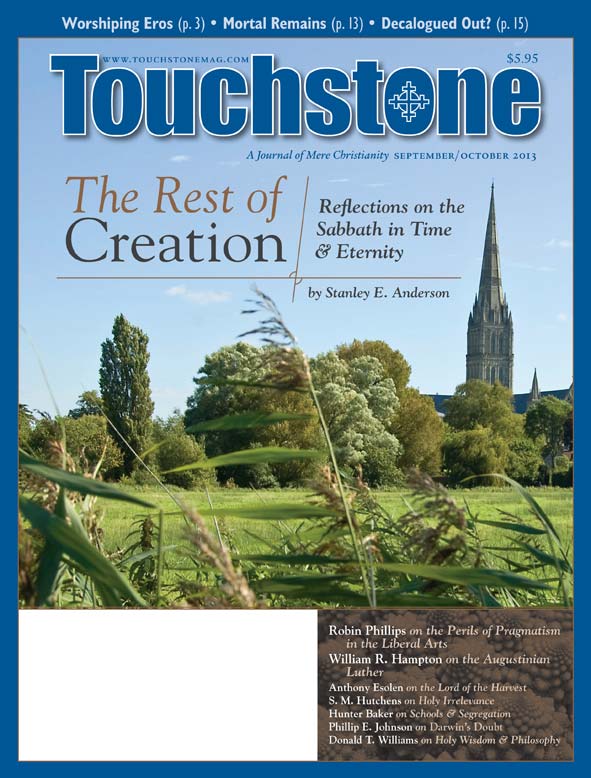
The Rest of Creation
Reflections on the Sabbath in Time & Eternity
In Dirty Harry, detective Harry Callahan (Clint Eastwood) apprehends a criminal and begins his famous monologue, "I know what you're thinking. Did he fire six bullets or only five?" If Harry had instead been a pastor confronting one of his parishioners caught doing unnecessary work on Sunday, he might have begun, "I know what you're thinking. Did God create the heavens and the earth in seven days or only six?"
The Genesis account of God's creation of the world is described as six days of "work" plus a seventh day of "rest." I have often wondered how that lonely seventh day fits in with the other six and whether it actually "counts" as part of God's creation of the world.
Unity in Rest
While listening to a homily one Sunday at Mass, an image from chemistry came to my mind (as C. S. Lewis once noted when mentioning that the inspiration for The Screwtape Letters came to him during a church service, "one could wish these things came more seasonably"). I pictured six water molecules bound together in a hexagonal shape of solid ice as representing the six days of creation. Water molecules in a liquid or gaseous state exhibit chaotic, independent motion as separate "things," but in solid form they act in unity. In scientific terminology, they are said to be in a lower energy state, or, more loosely, "at rest."
It occurred to me that this might illustrate the connection between the seemingly estranged seventh day and the other six days of creation. The emphasis would not be so much on rest as the absence of work (though that contrast is not lost, certainly), but on the formation of unity and wholeness in creation. So the seventh day, far from being the "odd man out," might be better seen as the capstone of the entire creation process.
The Catechism of the Catholic Church says, "The sabbath is for the Lord, holy and set apart for the praise of God, his work of creation, and his saving actions on behalf of Israel" (2171). When creation is seen as a series of separate works, like so many Dirty Harry bullets, it can divert our gaze away from God toward a kind of materialistic idolatry. But the Catechism's use of the singular "work" brings our attention back to God's glory. The opening of Psalm 19 says, "The heavens declare the glory of God; and the firmament shows his handiwork." We may partially glean God's glory in individual things, but we see it manifested more fully in their integration and wholeness and unity. This recognition was, for me, a way of seeing God's day of rest in a new light.
Healing & Growth in Rest
The Sabbath as a day of rest for man also reflects this unifying aspect of creation. In the very act of resting from it, our work becomes sanctified in the worship of God. But our proper spiritual rest is not simply a matter of "shutting down," the way we might shut down a computer or turn off a car engine. Jesus says that the Sabbath was made for man and not man for the Sabbath, and the Church allows for and blesses "good works" (acts of mercy and charity) on this day, reflecting Jesus' acts of healing on the Sabbath that were so frowned upon by the Pharisees. Healing goes hand in hand with wholeness and unity as an aspect of the day of rest, just as physical rest facilitates medical healing. But God intends his healing in rest to go beyond mere restoration.
The image of chaotic water molecules settling into solid ice conveys unity in rest, but it also suggests stasis or lifelessness. A richer metaphor might be seen in the making of bread or wine: dough is first kneaded, then set aside to rise; and grapes are first crushed, then allowed to ferment. In both cases, the period of "rest" helps bring the work of bread-making or wine-making to fruition.
This combination of rest and growth is also seen in sleep. Though not fully understood, such phenomena as dreams and REM states indicate that sleep is not simply a cessation of brain activity. Though in one sense at rest, the brain apparently also uses sleep time to clear out distracting elements and to bring together, sort, and integrate otherwise chaotic activity and information gathered during the day. This enables a person to wake up refreshed and ready for continued growth.
This property of sleep is especially apparent in infancy and early childhood, when the brain's most intense period of growth is accompanied by a high proportion of sleep time. Human gestation itself might be seen as nine months of sleep while the human body and brain develop.
Sleep is also associated with growth and fulfillment in Scripture. When God first creates man, Adam is alone; he is shown all the animals, but none of them is meet for him. God rectifies this situation by putting Adam to sleep in order to bring about Eve's creation from Adam's rib. Adam's "rest" thus blossoms into more fullness, not merely by the addition of one more creature among the many animals that already abound in Eden, but by the creation of this particular helpmeet, who is bone of his bone and flesh of his flesh that they might become as "one flesh" to grow and flourish.
Jesus speaks of death itself as "sleep" when, for example, before restoring Jairus's daughter to life, he says she is only sleeping. He says the same of Lazarus before raising him up. In many of Jesus' healings, the first thing he does after bringing someone through the "rest" of his healing is to give the person something to do—but not just random "work." For instance, he says to "take up your mat and go home," or "go show yourself to the priest," or "return home and tell how much God has done for you." In other words, Jesus bestows not only physical healing but also new life and growth and a pointing toward God. Of the ten lepers who were healed, it was the one who returned to glorify God that fulfilled the true purpose of his physical healing.
The Mystery & Necessity of Rest
Several of Jesus' parables talk of how a seed must "die" and be buried in the ground in order to rise to life and bring forth fruit a hundredfold. The parable of the sower and the seeds describes the "good ground" in which seed grows plentifully. Such ground has no obstructing elements—no pathways creating convenient access for the world to come stealing, no root-drying stones, and no choking thorns of worldly riches and concerns—to inhibit the growth of the seed. Such "good soil" is a place of pure rest, where the things planted by God can grow together and flourish.
In another seed parable, Jesus says, "So is the kingdom of God, as if a man should cast seed into the ground and should sleep, and rise night and day, and the seed should spring and grow up, he knows not how" (Mark 4:26–27). There is no explicit connection between the man's sleep and the springing up of the seed, but it is interesting that they are mentioned together.
Later "that same day" (4:35) comes the episode where Jesus gets into a boat with his disciples and falls asleep when a dangerous storm comes up. Fearful of perishing, the disciples awaken Jesus, who then orders the wind and sea to be calm. Does this episode prefigure the Lord's own three-day "sleep" of death, culminating in his Resurrection and the salvation of the world, the supreme example of "rest" bringing life, healing, unity, and growth on the Sabbath?
During his forty days on earth before his Ascension, Jesus exhibits a noticeable calm. It is apparent in his encounter with Mary Magdalene at the tomb, his meeting with the two disciples on the road to Emmaus, his mingling with the apostles in the closed room, and his cooking of the fish dinner at the lake. This refreshed calmness contrasts strongly with the agony, concern, and sorrow he expressed at various times on his way to the Cross. Our own rest on the Lord's Day should generate this same refreshment, calmness, and confidence in us, that we might more fully carry out the Lord's will in our subsequent labors.
So the answer to the question posed initially—"Did God create the heavens and the earth in seven days or only six?"—is that the work of creation required six days, but the rest of the seventh day was also required. Without it, the work of the other six days would crumble and dissolve into chaos and disorder. Psalm 127 says, "Except the Lord build the house, they labor in vain that build it."
Six water molecules come to rest in order to "build" an ice crystal. Dough kneaded and grapes crushed rest as they rise and ferment in order to "build" bread and wine. The Eucharist itself is our rest in the Body and Blood of Christ, the culmination of his work on the Cross, when he said, "Father, into your hands I commit my spirit."
It is only then, when finally "it is finished," that God's rest begins to turn even work that seems to the world like utter failure into glorious resurrection and salvation. One facet of the Psalmist's meaning must surely lie in rest. That facet might be understood thus: "Except the Lord's rest help build the house, they labor in vain that build it."
The Temporality That Imprisons
In Genesis, the days of creation are ordered such that God's six days of work come first and his rest on the seventh day comes last. Our own days of work and rest are also ordered into a weekly cycle, but, for Christians, the day of rest comes first and is followed by the six workdays of the week. As the Catechism of the Catholic Church notes, "In Christ's Passover, Sunday fulfills the spiritual truth of the Jewish Sabbath and announces man's eternal rest in God" (2175). The Catechism talks more about the symbolism involved, but I wonder if this curious reversal of rest and workdays also hints at or reveals another aspect of God's creation.
In his encyclical Spe Salvi (Saved in Hope), Pope Benedict XVI talks about a mistaken view of eternity. He writes in section 10:
. . . the question arises: do we really want this—to live eternally? Perhaps many people reject the faith today simply because they do not find the prospect of eternal life attractive. What they desire is not eternal life at all, but this present life, for which faith in eternal life seems something of an impediment. To continue living forever—endlessly—appears more like a curse than a gift. Death, admittedly, one would wish to postpone for as long as possible. But to live always, without end—this, all things considered, can only be monotonous and ultimately unbearable.
Later, in section 12 he writes:
The term "eternal life" is intended to give a name to this known "unknown." Inevitably it is an inadequate term that creates confusion. "Eternal," in fact, suggests to us the idea of something interminable, and this frightens us. . . .
To imagine ourselves outside the temporality that imprisons us and in some way to sense that eternity is not an unending succession of days in the calendar, but something more like the supreme moment of satisfaction, in which totality embraces us and we embrace totality—this we can only attempt.
I want to explore the idea that linear time, or "the temporality that imprisons us," is a result of the Fall of Man, and that the Fall may have affected our view of creation and the "rest" that accompanies it. In C. S. Lewis's Narnian story The Silver Chair, the children travelling underground come across a sleeping giant, Father Time, who, they are told, will awaken from his slumber at the end of the world. This suggests that the linear time we experience now is merely a stage of time, and a "slumbering" one at that, which limits our ability to "see" the fullness of both time and creation itself. Presumably, when Father Time awakens, we will experience a fuller sense of time.
But in our current fallen state, we are severely limited in our ability to even wonder what that might be like. Confined in a forced march, as it were, to journey relentlessly forward in time, we are unable to step "outside" and "look around" at time in its fullness. Even our language is fundamentally structured to reflect a sequential and linear-time-oriented framework, from which we cannot escape. The clock, as a device for measuring time in only one direction, is an icon of that "temporality that imprisons us."
Mathematical Analogies
Two illustrations from mathematics may help us understand our problem. First, imagine a society where people are aware only of even numbers, and where they know about addition, subtraction, and multiplication but not division. Since adding, subtracting, or multiplying any two even numbers always results in another even number, there is no way for a person in this society ever to arrive at, or discover, an odd number. Such a society would not only be unaware of odd numbers, but it would also be unaware of "even-ness" itself. The common phrase, "Does a fish know that water is wet?" captures this conundrum. Similarly, confinement to linear time perhaps makes it difficult for us to imagine what time in its fullness could be like, or even whether the concept of "fuller time" could make sense in the first place.
For the second illustration, consider the difficulties of representing a three-dimensional object, say a cube, on a flat sheet of paper. One way to do it is by drawing, but that will require that some of the cube's square sides be distorted by foreshortening, while others may be hidden from view entirely. Another way to do it is by unfolding a paper cube so that it will lie flat on a table in one piece; this will give you a configuration of six squares arranged in the shape of a cross. This representation will show all six sides undistorted, but their edges won't all meet up properly, and the whole thing won't look like a cube.
A naïve person might complain that neither representation accurately portrays a cube and demand that the distorted portions be erased or removed. But that would only make the representations more woefully inaccurate and maybe not even recognizable as a cube. A wiser person would recognize that, despite its distortions, a properly formed two-dimensional representation of a cube can still somewhat accurately convey its shape and three dimensions.
Similarly, descriptions of an unfallen state of existence might of necessity appear "distorted" to us fallen creatures, who can only understand things in a "flattened" manner.
God's Provision for Fallen Man
What if Adam and Eve experienced Eden as a special haven where the fullness of time reigned, but after their disobedience and expulsion from the garden, their experience of time was flattened or confined to linear time? After they have sinned, God says:
Behold, the man is become as one of us, to know good and evil; and now, lest he put forth his hand, and take also of the tree of life, and eat, and live forever: therefore the Lord God sent him forth from the garden of Eden, to till the ground from whence he was taken. (Gen. 3:22–23)
This suggests that the banishment from Eden was not merely punishment but also a form of protection. Notice that God does not say "lest he . . . have eternal life," but "lest he . . . live forever," that is, endure the "unbearable" and "unending succession of days" that Benedict XVI writes of.
God describes how Adam and Eve will suffer as a consequence of their disobedience: the pain and sorrow of childbirth; the sweat and wearying labor of tilling the earth for bread; and in the end, the return to dust in death. We see that suffering as punishment. But maybe the sufferings God describes—and even death itself—are simply unavoidable "distortions" or "side effects" of God's protection for fallen man? If the "linearization" of time was meant to shield man in a temporal way from the full effects of the Fall, maybe our sufferings might be seen, analogously, as the foreshortened squares in the cube drawing that look to us like narrow parallelograms, or as the unfolded squares of a cube that look to us like a cross.
And like the naïve person who wants to erase the distorted elements, we would like God simply to "erase" all our sufferings. But that might make the drawing even more inaccurate (read "more painful in the long run"), or make the flattened, cross-shaped cube much harder, if not impossible, to restore to its original three-dimensional shape. Perhaps the whole of man's existence in the fallen world is, like the slumbering Father Time in The Silver Chair, the "sleep" of linear time, wherein mankind is able to rest in God's working out of his healing and salvation.
The Flattening Fall
If this is the case, then creation must have existed in a fuller sense of time before the Fall. But being fallen creatures, it is very hard for us to "think outside the clocks" and imagine what that fuller sense might be. But, using our cube analogy, perhaps we can imagine that from an unfallen view not confined to linear time, the six days of creation fit together like an actual cube's six square faces, where one face does not come "before" or "after" another, but all six work together in solid unity—in timeless "rest," one might say.
Interestingly, the first line of Genesis, "In the beginning God created the heaven and the earth," conveys that very sense of unfallen, integrated unity. But it is then followed by a sequential depiction of creation, as if in concession to the imaginative limitations of fallen, linear-time-oriented readers.
On the other hand, the sequential telling may be more than a simple accommodation. Consider the possibility that the Fall had an actual "flattening" effect, not just on our human perception of time, but on all of creation itself. In that case, the Fall would have caused the unified creation to "unfold" so that it appeared as six separate days of "work" confined to linear time, like an unfolded cube is flattened and appears as a cross-shaped arrangement of separate squares.
There is a baffling effect in quantum physics known as the "delayed choice experiment." Though far too complicated to describe in detail here, it roughly means that a decision to measure particular quantum effects "after the fact" propagates the particular results of a "collapsed quantum wave function" backward in time, where they had otherwise been "undetermined." Analogously, we might think of the Fall as causing a "rippling backwards" effect (an "unfolding," if you will) that established a "flattened" timeline of separate sequential events where only unity and integration had existed before (again, our fallen language limitations force us to use linear-time-oriented terms like "before" and "after").
Longing for Lost Fullness
In Spe Salvi and elsewhere Benedict XVI talks of heavenly things in a manner suggesting (as indeed Scripture does, too) that they are "outside" of a linear view of time. Earlier I mentioned a possible "backwards" view of God's creation, along with the Church's curious transfer of the day of rest to the first day of the week. My intention was to suggest that the "wholeness" of creation came first but was, as a result of the Fall, "unfolded" and "flattened" into linear time. And thus, God's day of rest, coming as the seventh and last day, served as a time for restoration and integration. Perhaps the Church, in its leading by the Holy Spirit, made that audacious transfer of the day of rest to the beginning of the week to reflect the restoration of God's glory in his creation "as it was in the beginning, is now, and ever shall be."
In the same way, the weekly division of our own human labor into a repetitive pattern of one day of rest followed by six days of work may reflect the continuing "unfolding" and "flattening" of God's creation by our ongoing fallen nature. Could it be that the day of rest that God commands of us is meant as an effort to keep "re-folding" the flattened squares back up into a fully restored cube shape, week by week?
I suggest that the fallen world, being yet part of God's original creation, retains a longing for its lost fullness and in some sense wants and tries to fold itself back up. As the familiar passage from Romans 8:22 says, "the whole creation groans and travails in pain together." Picture a scroll being unrolled after a long time in storage: it will keep "trying" to roll itself back up and won't lie flat without being held down manually. In the Genesis account, after each day of God's creation, he "saw that it was good." Perhaps one of the dynamic aspects of creation's "goodness" is that, even in its post-Fall "flattened" state, it still seeks and longs for its original three-dimensional fullness.
The Wave Function Analogy
Another analogy from quantum physics can help here. Experiments demonstrate that, before being looked at, a moving particle seems to act as if it were taking all possible pathways at the same time. The collection of all potential pathways is called the particle's "probability wave function," and as long as the particle remains unobserved, the wave function continues to expand outward in all possible directions. But that "cloud" of possibilities is "collapsed" into a single path when an actual observation takes place.
Physics says, and is supported by overwhelming experimental evidence, that before an observation is made, the particle does not actually "exist" in what we call "reality." Instead, only the wave function exists as an ethereal "probability wave" of mere "non-real" possibilities. It is only when an observation is made that the wave function collapses into a single state that we call "reality."
The interpretations of this very mysterious phenomenon are the subject of much debate and countless books. But the important point for us is that, immediately after the collapse, the particle's wave function of potential pathways begins again to expand outward from that collapsed point and will continue to do so until another observation is made, re-collapsing the new manifestation of the wave function into a single path once again. This expansion and subsequent collapse of the wave function is repeated with each new observation.
In a reversal of the scientific view, the "ethereal" expanding wave function of possibilities may be seen as analogous to creation's original state, in which "all things are possible." That is, the expanding wave function may correspond to the "real" unfallen world, while the collapsed wave function, which science calls "reality," may represent the fallen and "flattened" world of a single, sinful, and insubstantial state.
To carry this imagery over into the cube analogy, we may say that it is our fallen and sinful nature that continually presses the six square faces down into a flat, cross-shaped pattern on the table, when, by virtue of God's grace in creation, their tendency would be to fold back up into a cube.
I draw this very speculative and fanciful image only to suggest a connection to our weekly days of rest and work. Our fallen and sinful nature continually and unwittingly manages to set back any progress toward that folded-up cube. Thus, God insists on the necessity of a weekly day of rest so that we, in our rest, may allow the work of our six days of labor to begin to "fold up" into its more glorious fullness and unity.
We cannot do the folding up on our own, though, because we are incapable, in our fallen and flattened state, to see or even aim for the proper direction and would simply destroy any progress. It would be like spinning a blind man around and then asking him to aim a gun at a distant target by himself. Our labors during the six days of work can become, with God's grace, something worth taking up and integrating into the cube. But it must be God's "rest" that allows those labors to be properly folded up into the cube.
God's Fractals
Let me return to the water analogy one last time. Continuous days of work without any rest will result in a state of chaos and instability, like water molecules in liquid or gaseous form. But day after day of rest without any work will result in a state of sloth, which we might picture as an accumulation of ice crystals into a huge, ponderous, lifeless block of ice.
But God, in his wisdom, has ordained the proper interplay of one day of rest with six days of work to result in something neither chaotic nor lifeless, but more like a fractal. "Fractal" is a mathematical term for a formation or structure that displays a similar basic design pattern at all levels of "magnification," like, for instance, a medieval cathedral with its interweaving patterns of "arches within arches within arches."
Such a fractal quality can be observed in the patterns of rest and work in Scripture. At the "highest" level, all of creation is described as an integrated unity of seven days (six of work and one of rest), while the "lowest" level is mankind's weekly seven-day cycle. And there are at least two levels in-between. In the Old Testament, every seventh year the land was to lie fallow, i.e., at rest. And after seven groups of seven years, the fiftieth, or Jubilee year, was celebrated.
God has used a great variety of fractal-like levels of unity and complexity in all of his creation. With respect to the cycles of work and rest, I see "weekly ice crystals" forming, not dull and heavy blocks of solid ice, but intricate and ever-growing patterns of beautiful snowflakes. •
Stanley E. Anderson holds a degree in mathematics and has worked in data analysis, IT, and quality assurance in the aerospace industry. He and his wife are converts from Anglicanism to the Catholic Church.
A Journal of Mere Christianity—Delivered to Your Door
- Essays on theology, culture, and the Church
- Contributors from across the Christian traditions

Six print issues (one year) of Touchstone, plus full online access and PDF downloads for only $39.95.

Get a one-year full-access subscription to the Touchstone online archives for only $19.95.
bulk subscriptions
Order Touchstone subscriptions in bulk and save $10 per sub! Each subscription includes 6 issues of Touchstone plus full online access to touchstonemag.com—including archives, videos, and pdf downloads of recent issues for only $29.95 each! Great for churches or study groups.
Transactions will be processed on a secure server.
more from the online archives
25.6—Nov/Dec 2012
The Loss of Aristotelian Logic & the Social, Moral & Sexual Consequences by Peter Kreeft
22.6—July/August 2009
on a Noble Defense Doomed by Darwinian Materialism by John G. West
31.4—July/August 2018
Labels & the Ecumenism of Discipleship by James M. Kushiner
calling all readers
Please Donate
"There are magazines worth reading but few worth saving . . . Touchstone is just such a magazine."
—Alice von Hildebrand
"Here we do not concede one square millimeter of territory to falsehood, folly, contemporary sentimentality, or fashion. We speak the truth, and let God be our judge. . . . Touchstone is the one committedly Christian conservative journal."
—Anthony Esolen, Touchstone senior editor
