




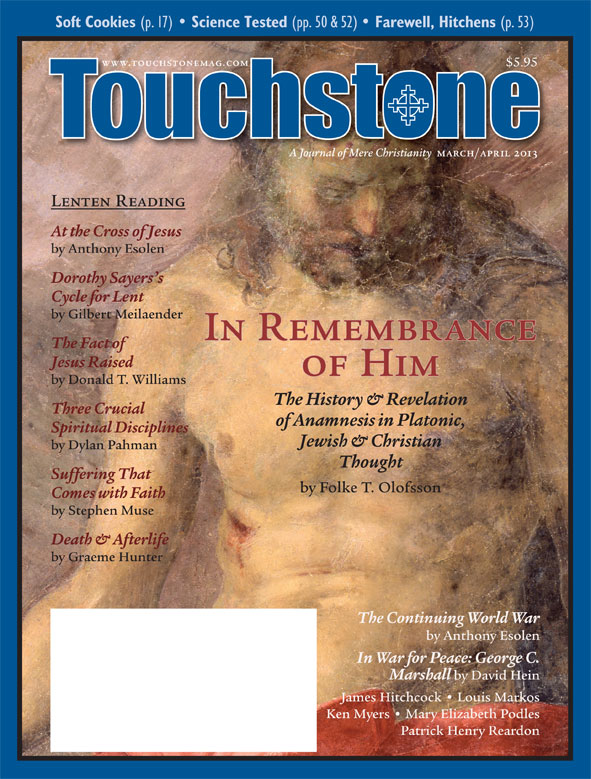
Not Lost for Words
Mortality
by Christopher Hitchens
Twelve Publishing, 2012
(119 pages, $22.99, hardcover)
Farewell Fear
by Theodore Dalrymple
New English Review Press, 2012
(238 pages, $19.95, paperback)
reviewed by Matthew Walther
"Who else feels Christopher Hitchens getting terminal throat cancer was God's revenge for him using his voice to blaspheme him?"
Dismayed. That's how I felt in June 2010 when messages like this one began to appear online following the announcement that Christopher Hitchens had been diagnosed with esophageal (not throat) cancer. Hitchens, a contributing editor at Vanity Fair and The Atlantic, the author of nearly twenty books and, for my money, one of the best popular literary critics of his generation, passed away in December 2011, but while he was with us, he was perhaps our foremost public controversialist.
Take any issue about which there seems to be, if not general, then at least widespread agreement, determine its logical or polar opposite, and you are likely to have discovered Hitchens's view. No reasonable grounds existed for war with Saddam Hussein, say Hitchens's coevals on the left. No, says Hitchens, the Iraq War was both justified and necessary. Henry Kissinger is a great statesman, say many Americans, regardless of their partisan commitments. No, says Hitchens, he is a war criminal. Mother Teresa was a heroine, says nearly everyone. No, says Hitchens, she was a fraud.
Lurking behind this last, rather bizarre judgment is, of course, the opinion for which Hitchens became most famous, namely that, to borrow from the subtitle of his 2007 bestseller, Religion Poisons Everything, Hitchens's belligerent and occasionally obnoxious atheism frustrated his many Christian admirers, who otherwise appreciated his wit and bellicosity. (Thousands of American readers of all creeds can also thank Hitchens for introducing them to neglected British novelists like Kingsley Amis, Anthony Powell, Evelyn Waugh, and P. G. Wodehouse, the author he loved best, in the pages of The Atlantic and The New York Review of Books.)
Ross Douthat saw him as "a convert in the making, whose furious broadsides against God were just the prelude to an inevitable reconciliation." But there seems to have been no such conversion, deathbed or otherwise, and Hitchens insisted that if he died sighing and making the sign of the Cross, like Lord Marchmain in his least favorite Evelyn Waugh novel, the public should understand that he had gone mad.
But to return to my dismay. Messages like the one I quoted above were not merely coarse and uncivil (as Hitchens himself was from time to time), but also presumptuous. Taking the position that any prominent atheist stricken with squamous cell carcinoma must be on the receiving end of God's wrath lands one very much in the soup, logically and theologically speaking. Hitchens himself touches upon this point in Mortality, a new collection that gathers seven essays written for Vanity Fair during the sixteen months of his illness. "Which mere primate is so damn sure he can know the mind of god?" he asks. (Biological reductionism and non-capitalization of a certain proper noun number among his less endearing stylistic crotchets.) "Devout persons," he continues, "have died young and in pain. Bertrand Russell and Voltaire, by contrast, remained spry until the end, as many psychopathic criminals and tyrants have also done." More to the point, one might add, fairly conspicuous non-believers Joseph Stalin and Mao Zedong died in their beds, aged 74 and 82 respectively, each responsible for over fifty million deaths.
A Springboard for Speculation
Mortality at first struck me as a somewhat reductive title for a book whose author is writing on literature, politics, philosophy, music, and, of course, religion. Yet death does seem to have shaken out the sands of Hitchens's glass. Longtime readers will be surprised to find his tone in this collection more morbid than mordant. (They may be even more surprised to find him expressing his gratitude toward those Christians who prayed for his recovery.) For every witty aside about those who think that Christopher Marlowe or the Earl of Oxford wrote Shakespeare's plays ("an unfailing sign of advanced intellectual and mental prostration") or quip regarding Henry James's dictation of his later novels ("among the greatest vocal achievements of all time"), there is a grim catalogue of cancer symptoms or an unflinching description of a medical procedure. Even Hitchens's moving paean to friendship and free speech at the end of the fifth essay comes in prospect of his losing the ability to speak.
A Journal of Mere Christianity—Delivered to Your Door
- Essays on theology, culture, and the Church
- Contributors from across the Christian traditions

Six print issues (one year) of Touchstone, plus full online access and PDF downloads for only $39.95.

Get a one-year full-access subscription to the Touchstone online archives for only $19.95.
bulk subscriptions
Order Touchstone subscriptions in bulk and save $10 per sub! Each subscription includes 6 issues of Touchstone plus full online access to touchstonemag.com—including archives, videos, and pdf downloads of recent issues for only $29.95 each! Great for churches or study groups.
Transactions will be processed on a secure server.
more from the online archives
34.1—January/February 2021
Jesus' Astonishing Other Teaching on Marriage by James Ware
32.6—November/December 2019
An Open Letter to Christian Readers of Jordan Peterson & Roger Scruton by James Bryson
calling all readers
Please Donate
"There are magazines worth reading but few worth saving . . . Touchstone is just such a magazine."
—Alice von Hildebrand
"Here we do not concede one square millimeter of territory to falsehood, folly, contemporary sentimentality, or fashion. We speak the truth, and let God be our judge. . . . Touchstone is the one committedly Christian conservative journal."
—Anthony Esolen, Touchstone senior editor
