




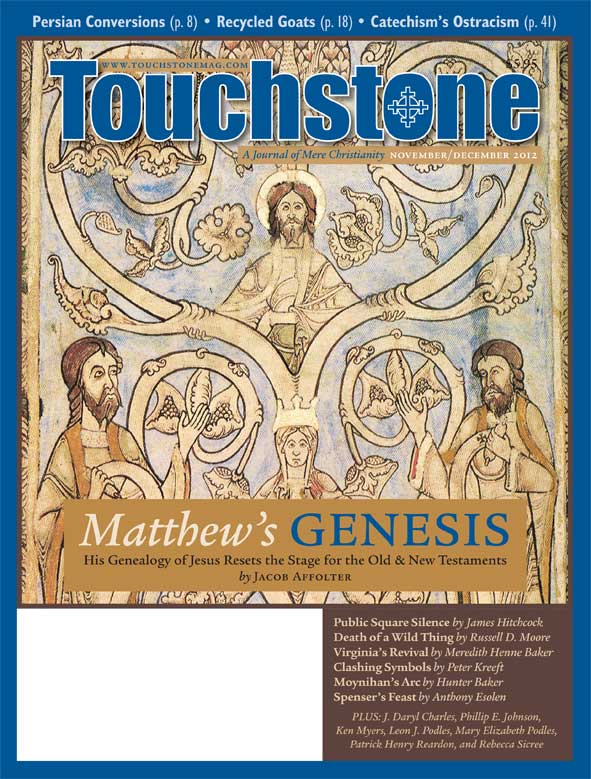
Feature
Virginia's Revival Fire
The Story of One Culture's Spiritual Rise from the Literal Ashes by Meredith Henne Baker
Today, we know the commonwealth of Virginia as a firm link in the Bible Belt, studded with Evangelical churches and Christian colleges. Driving through country routes, one sees a sign every few miles indicating a turn down a winding road to a New Fork Baptist Church, St. Luke's Episcopal, or Mt. Comfort Methodist. It is easy to assume that things have always been this way, that Christian institutions—particularly those of an Evangelical stripe— have always surrounded and engaged Virginians.
This is not, however, the case; the real history of the state and its churches proves to be more complicated—and interesting.
THIS ARTICLE ONLY AVAILABLE TO SUBSCRIBERS.
FOR QUICK ACCESS:
A Journal of Mere Christianity—Delivered to Your Door
- Essays on theology, culture, and the Church
- Contributors from across the Christian traditions

Six print issues (one year) of Touchstone, plus full online access and PDF downloads for only $39.95.

Get a one-year full-access subscription to the Touchstone online archives for only $19.95.
bulk subscriptions
Order Touchstone subscriptions in bulk and save $10 per sub! Each subscription includes 6 issues of Touchstone plus full online access to touchstonemag.com—including archives, videos, and pdf downloads of recent issues for only $29.95 each! Great for churches or study groups.
Transactions will be processed on a secure server.
more on culture from the online archives
20.7—September 2007
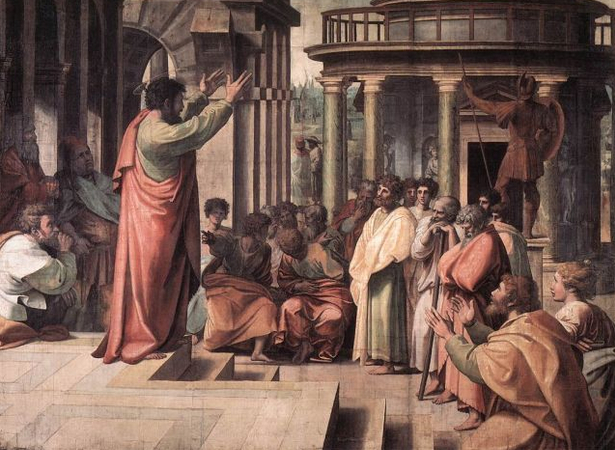
Paul Didn’t Build Bridges to Popular Culture by Russell D. Moore

32.6—November/December 2019
Historical Truth, Beguiling Stories & Three Kinds of Hearers by Anthony Esolen
more from the online archives
23.5—September/October 2010
The Loss of a Christian Understanding of Virginity Is Pure Tragedy by Eleanor Bourg Donlon
30.6—Nov/Dec 2017
Christ, Individualism & the Meaning of Cultural Diversity by Anthony Esolen

32.2—March/April 2019
Reality Shows, Even in a Popular TV Series by C. E. Smith
calling all readers
Please Donate
"There are magazines worth reading but few worth saving . . . Touchstone is just such a magazine."
—Alice von Hildebrand
"Here we do not concede one square millimeter of territory to falsehood, folly, contemporary sentimentality, or fashion. We speak the truth, and let God be our judge. . . . Touchstone is the one committedly Christian conservative journal."
—Anthony Esolen, Touchstone senior editor
