




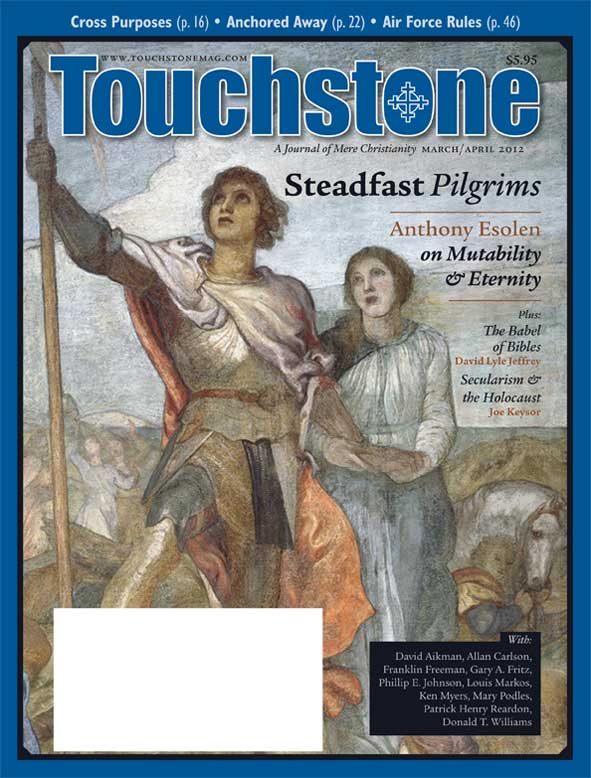
Measuring Bush
The Man in the Middle: An Inside Account of Faith and Politics in the George W. Bush Era
by Timothy S. Goeglein
B and H Publishing Group, 2011
(241 pages, $19.99, hardcover)
reviewed by David Aikman
President George W. Bush frequently told friends and interviewers that the fairest judge of his presidency would be “history.” By this he meant future historians. Many of those would-be historians, of course, have already jumped the gun, and have actively taken up writing judgments of the 2001–2009 Bush era—sometimes very unflatteringly. Several of the Bush appointees have also taken to print, ranging from Vice President Dick Cheney to Secretary of State Condoleezza Rice.
Yet when future—as opposed to present-day—historians look at the Bush era, they will almost certainly take note of one very important feature of it: More than any other recent American president, Bush was outspokenly enthusiastic about his personal Christian faith—even his conversion to faith in his adult years. He often explained his domestic policy decisions on the basis of his faith positions. Only an unpardonably ignorant future historian would ignore this component of Bush’s thinking when coming up with an assessment of his
presidency.
With that in mind, it is very helpful that one of the closest observers of Bush’s faith as it related to his character and his policies has written his own account of life in the White House during the seven years (January 2001 to February 2008) he held office there as Deputy Director of the White House Office of Public Liaison. Until his resignation following revelations—fully admitted by him—that he had plagiarized other writers in an opinion column he wrote for several years for an Indiana newspaper, Timothy Goeglein had not only conveyed opinions back and forth between the Oval Office and America’s conservative Christians (hence the book’s title, The Man in the Middle), but he had also participated in White House discussions that eventually led to important Bush administration policy decisions. Some months after his resignation from the White House staff, he was taken on by Focus on the Family as a Washington-based senior officer.
At an important level, Goeglein’s book offers insights into both Bush’s warm and generous personal Christian character and important decisions of his administration. We observe at close hand the successful battles to secure the senate confirmation of his Supreme Court nominees John Roberts and Samuel Alito, as well as the intervening misstep of nominating Harriet Miers for the same position. Goeglein is insightful and informative on the formulation of Bush’s complex policy regarding funding for stem-cell research, but he is also generous towards those American Christians (predominantly the Roman Catholic hierarchy) who were critical of the policy.
There is an interesting account of the president’s visit to Rome to meet with Pope John Paul II and later to attend his funeral. Goeglein mentions, but perhaps does not emphasize as much as he could, the remarkable breadth of the president’s ecumenical approach not only to fellow Christian believers but also to followers of other faith traditions. (I recall, for example, the glowing report by some Sikhs of the president’s praying with them when he invited them to the White House to condole over the deranged murder of an American Sikh shortly after 9/11.)
Goeglein is generous in his assessments of President Bush—one chapter is entitled “George W. Bush was right”—and deeply admiring of him as a person and a fellow Christian. He speaks warmly of Bush’s deep concern for Christian freedom internationally. Yet in his retrospective look at the 2003 invasion of Iraq, while Goeglein correctly identifies the positive results of the Iraq war—such as the overthrow of a tyrant and the establishment of a diverse, albeit flawed, political democracy—he appears to pay little or no attention to the fact that the people who probably suffered most from the new political freedoms in Iraq were the country’s Christians.
Before the American invasion of 2003, Christians constituted about ten percent of the population of Iraq, and, ironically, they had actually been protected from Muslim oppression by the iron hand of Saddam Hussein. But today, after brutal Islamic-originated pogroms against them and the involuntary flight of many to neighboring countries, they may now amount to less than half that number. The implantation of democratic freedom in Iraq did not always result in social peace and tranquility.
Goeglein is eloquent in expressing his own Christian faith and his belief in faith and freedom as essential to the continued flourishing of American society, particularly in one of the book’s last chapters. His narrative is detailed and focused. But some readers, even sympathetic ones, may be disappointed with his scanty explanation of the processes in his own life that led to his plagiarizing activities and thus to his subsequent resignation from the Bush administration.
A Journal of Mere Christianity—Delivered to Your Door
- Essays on theology, culture, and the Church
- Contributors from across the Christian traditions

Six print issues (one year) of Touchstone, plus full online access and PDF downloads for only $39.95.

Get a one-year full-access subscription to the Touchstone online archives for only $19.95.
bulk subscriptions
Order Touchstone subscriptions in bulk and save $10 per sub! Each subscription includes 6 issues of Touchstone plus full online access to touchstonemag.com—including archives, videos, and pdf downloads of recent issues for only $29.95 each! Great for churches or study groups.
Transactions will be processed on a secure server.
more from the online archives

30.2—March/April 2017
Our Path to Holiness Runs Straight Through Calvary by Robin Phillips
31.4—July/August 2018
The Difficulty of Apologetics for Dead Souls in the Real World by R. J. Snell
calling all readers
Please Donate
"There are magazines worth reading but few worth saving . . . Touchstone is just such a magazine."
—Alice von Hildebrand
"Here we do not concede one square millimeter of territory to falsehood, folly, contemporary sentimentality, or fashion. We speak the truth, and let God be our judge. . . . Touchstone is the one committedly Christian conservative journal."
—Anthony Esolen, Touchstone senior editor
