




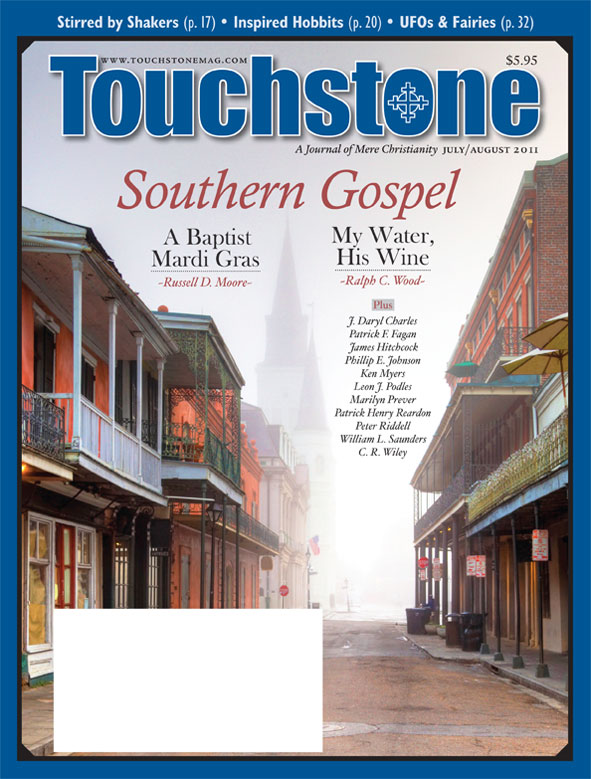
Woe Are We
Prodigal Nation: Moral Decline and Divine Punishment from New England to 9/11
by Andrew R. Murphy
Oxford University Press, 2008
(248 pages, $19.95, paperback)
reviewed by Franklin Freeman
Andrew Murphy’s Prodigal Nation brings to mind a passage in the novel The Moviegoer, by Walker Percy. Percy’s hero, Binx Bolling says, “Whenever I feel bad, I go to the library and read controversial periodicals. Though I do not know whether I am a liberal or a conservative, I am nevertheless enlivened by the hatred which one bears the other”:
Down I plunk myself with a liberal weekly at one of the massive tables, read it from cover to cover, nodding to myself whenever the writer scores a point. Damn right, old son, I say, jerking my chair in approval. Pour it on them. Then up and over to the rack for a conservative monthly and down in a fresh cool chair to join the counterattack. Oh ho, say I, and hold fast to the chair arm: that one did it: eviscerated! And then out and away into the sunlight, my neck prickling with satisfaction.
In a way that episode sums up what Prodigal Nation is about: that America is divided into two different ways of looking at itself and the world around it—which he calls the traditionalist and the progressive views—and that both sides use the jeremiad as a way to tell a story that will convince its hearers that its view is the right one.
Jeremiads from Right & Left
The Oxford English Dictionary defines jeremiad as “a lamentation; a list of woes or complaints; a doleful tirade.” Murphy identifies three things that jeremiads do: they “identify problems that show a decline vis-à-vis the past”; they “identify turning points”; and they “call for reform, repentance, or renewal.” Murphy also notes that the typical jeremiad of either party has a tension between the despair of whatever decline it is lamenting and the hope of reform and repentance, the idea that we have sinned against God, but because we are God’s chosen nation, we need not despair: if we repent, he will bless us.
For instance, a right-wing pundit might say that one problem is the religious decline in American culture, that the turning point occurred in 1963 with the Abington v. Schempp decision, which forbade prayer and Bible readings in public schools, and that we need to put prayer and Bible reading, which were never compulsory, back into the schools, the way it used to be.
But Murphy is quick to point out that such jeremiads are not limited to the likes of Increase and Cotton Mather, Jerry Falwell and Pat Robertson. He writes that
narratives of decline aren’t limited to the political right. Progressives and liberals also see declines in social connectedness, and lament the perceived retreat from such American values as egalitarianism, community, and the common good due to an ever-increasing collusion of the American government with big business. . . . Though often perceived as a “conservative” trope, especially when used by the Christian Right, the idea of American messianism has never been the sole possession of one political party. Robert Kennedy was as comfortable using the jeremiad as was Jerry Falwell.
Thus, a progressive might say that our society has still not done all it can for the equality of blacks, that the turning point was civil rights legislation in the 1960s, and that we need to return to that legislation and fully implement it. Both sides focus on the 1960s as a turning point, but with different twists: the traditionalist says that was when respect for authority and other problems began, while the progressive says that was when we had all the right legislation and ideas but we have since left the high road. One side says the 1960s were the beginning of the decline, the other that they were a beginning that has declined.
After this summarizing of various jeremiads through American history, Murphy turns to an examination of how the jeremiads have played out in American culture. Both jeremiads, he writes, present narratives that emphasize the things that will help their side. The traditionalists believe in “the past as model,” he writes, the progressive in “the past as promise.”
Plunking Down with the Progressives
Finally, and surprisingly, to me, he plunks down—unlike Binx Bolling, who did not choose one side over the other—squarely on the progressive side. This surprised me because throughout the book Murphy shows an admirable balance in moving between the two views, and he acknowledges the power of both sides’ arguments. This picking of sides occurs early in Part 2 of the book, when he begins using terms like “constraining” and “limiting” to describe the traditionalist view.
So, then, on what does Murphy base his own plunking down on the progressive side? He says that it is more inclusive of the diverse culture we are becoming and that it is in the progressive tradition of men like Lincoln and Frederick Douglass, who understood that we have to allow the principles of the past to help build a just future. Murphy speaks throughout the book of one side “valorizing” one idea over another, but he does the same thing himself at the end, with no, or almost no, explanation. There is a hidden metaphysics here that he does not acknowledge, and the only basis for his decision that I can find is a pragmatic one. He writes, “The progressive jeremiad offers a national narrative deeply grounded in the American past yet open to a dynamic and changing American future.”
When this “dynamic and changing American future” is about social equality for blacks and other minorities, well and good. When it is about the rights of illegal immigrants, we can argue about it. But when it is about such issues as homosexual marriage and abortion, orthodox Christians, and many other traditionalists, say no—and these people don’t just include the living, for tradition, as Chesterton said, gives the past a place in the conversation. In that sense, a traditionalist is more inclusive than a progressive, who jettisons the past in favor of ideas that break completely from what has always been considered wrong.
In Prodigal Nation, Andrew Murphy helpfully shows how both progressives and traditionalists use the jeremiad, and thus how they both share a certain religious framework, but he obfuscates the philosophical and ethical issues, and so diminishes the value of his book. •
Franklin Freeman is a freelance writer living in Saco, Maine, with his wife and four children.
A Journal of Mere Christianity—Delivered to Your Door
- Essays on theology, culture, and the Church
- Contributors from across the Christian traditions

Six print issues (one year) of Touchstone, plus full online access and PDF downloads for only $39.95.

Get a one-year full-access subscription to the Touchstone online archives for only $19.95.
bulk subscriptions
Order Touchstone subscriptions in bulk and save $10 per sub! Each subscription includes 6 issues of Touchstone plus full online access to touchstonemag.com—including archives, videos, and pdf downloads of recent issues for only $29.95 each! Great for churches or study groups.
Transactions will be processed on a secure server.
more from the online archives
24.6—Nov/Dec 2011
Liberty, Conscience & Autonomy
How the Culture War of the Roaring Twenties Set the Stage for Today’s Catholic & Evangelical Alliance by Barry Hankins
31.6—November/December 2018
The Slow Vindication of Leon Podles by S. M. Hutchens
calling all readers
Please Donate
"There are magazines worth reading but few worth saving . . . Touchstone is just such a magazine."
—Alice von Hildebrand
"Here we do not concede one square millimeter of territory to falsehood, folly, contemporary sentimentality, or fashion. We speak the truth, and let God be our judge. . . . Touchstone is the one committedly Christian conservative journal."
—Anthony Esolen, Touchstone senior editor
