




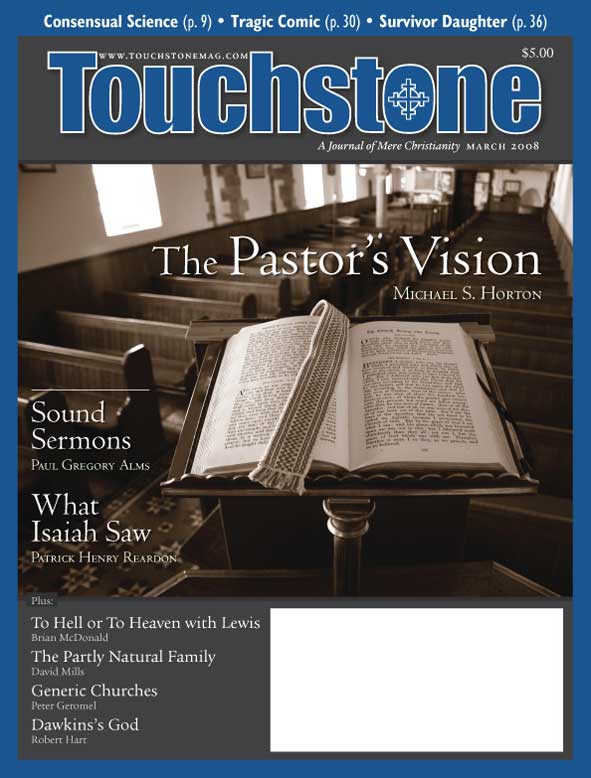
Ready, Willing, Unlabeled
Peter Geromel on Dollar Store Churches
A few months ago, I met a gentleman dressed in a motorcycle jacket and denim jeans at a coffee shop. He seemed intellectual, and we chatted about Pope Benedict’s recent statements on Islam. I thought I might have found a potential proselyte for the continuing Anglican parish I serve.
The next time I saw him was on a late night at the local diner. He didn’t remember me. He claimed that the radio towers in town were giving out radiation and told the waitress she would soon be sterile. He phoned in a citizen’s arrest on the radio tower owner.
Later I saw him at the Dollar Store. He claimed he was engaged to a helicopter pilot half his age whose father was an Anglican military chaplain. I was not surprised that he was very interested in my church. I think that if I tell him that black helicopters have been following me ever since my tiny congregation refused to join the World Council of Churches, I will have him hooked.
Another day, I met a banker whose ethnic faith tradition is Assyrian Catholic (Church of the East). He knew little of his grandparents’ faith, and as I knew more about this than most, we hit it off. His interest in my church is based on my esoteric knowledge.
Similarly, I had lunch with a banker who researches St. Bernard of Clairvaux’s influence on economics through that abbot’s method of building Cistercian monasteries. When I explained how Anglicanism is arguably closer to Benedictine and Cistercian spirituality than, say, Dominican, he became interested in my parish. Counter to expectation, he proved to be a Presbyterian and not Roman Catholic.
You see, like a dollar store, my parish and I generally draw either very dependent people or very independently minded people. The dollar store draws folks who are willing to think unconventionally and folks who simply don’t have enough money to go anywhere else. Some of us are in both categories.
It is likewise with churches like mine. Some of the people are thinking unconventionally and are ready to accept what we have to offer. Some need a great deal of pastoral attention (and are willing to admit it) and know they will never receive it at a large mainline church.
I recently surveyed the average distance traveled by the visitors to my parish. I found it to be fourteen miles. Our regular congregants hail from equally far afield. The prototypical young business man with his wife and children enthusiastically traveling just a couple of miles, I have not yet seen.
Part of the reason is that a parish outside the mainline denominations has no name recognition. It is a “hard sell.” Every effort at evangelism begins with an explanation of what you are, what your name means.
Our advertising problem is the same as the dollar store’s. The immediate questions people ask about dollar-store generic merchandise are: “What is this?” “Where does it come from?” “How old is it?” “Is it stale on the inside?” The questions people ask about the parish (those who do) are: “What is it?” “How many people do you have?” “How long has it been around?” “Is it for real once you get inside the church?”
A Generic Parish
What is the real difference between our parish and our mainline neighbors? We both have a church sign and a website for our denominations. In that we are equal. But folks will never walk into our parish with as much confidence in what they are about to receive (or not receive, as the case may be) as they will have when walking into theirs.
The mainline denominations are obviously the name brands, but in another sense they are “generic.” In television shows, the actors can be seen drinking a generic “cola.” When they go to a wedding, the minister is a generic minister. You cannot tell if he or she is Methodist, Episcopalian, Lutheran, or Presbyterian. He or she offers a generic service with a generic sermon.
This reflects the truth. Many mainline churches seem to look the same: some candles lit somewhere, some vestments with some color somewhere, some nondescript sermon that tells us that Jesus loves us but tells us nothing about man’s sin, unless it be the sin of social injustice.
They even tend to use each other’s seminaries. And everyone is in communion with everyone else despite vastly different historic theologies. As these theologies have melted away, so have the folks in the pews begun to blur ethnic and theological distinctions. They pray together and they shop in the same grocery store together (or pray together because they shop together).
The difficulty for churches outside a mainline denomination is that the people of sprawling suburbia—whether they move with their business every few years or simply stay in the area—would not think of buying anything without a price tag and a brand name they recognize from television. They would almost never think of walking into a church with a name on its sign that is not familiar to their grandparents.
They know where the grocery store, the movie theatre, the public school, and a few other places are. They know where the relevant mainline church is. They do not know where we are, and they are not likely to try to find out.
How do we reach them? The independently minded will often find us on their own. The local people already have a hometown church and will not switch unless they need more help than it can provide them. The mainline churches are also struggling to bring them in, and they have better locations, bigger, nicer buildings, more money, and far better name recognition. And they offer the twin reassurances of a name brand and a generic product.
A Hard Sell
My parish does not draw generic folks. It is not generic. Or maybe it is. Webster’s dictionary defines “generic” as meaning “of or pertaining to a whole group or class; general”; “not having proprietary status, said esp. of names for drugs”; and “ (biol.) of or like a genus.”
Like the dollar store, my parish is “generic” according to the second definition. And it is also “generic” according to the first and third definitions. In conforming to the One, Holy, Catholic, and Apostolic Church, it is of the whole group or class, which is the meaning of the word “catholic,” a word used by Aristotle to describe a group or genus in biology.
Generic Christianity of this sort is hard to sell, especially without a name brand. Fortunately, as Christians, all problems are not ours to solve. I believe we must ask ourselves: Are we willing to appear unrecognizable, irrelevant, and a bad investment of time and energy? Is our focus on quality and not quantity?
Are we willing to “waste time” helping an individual grow in Christ at the expense of filling the pews every Sunday? Do we wish to grow as a “business” yet not so much that we are willing to sell out to a larger company to get the name brand, sacrificing quality as a result? Are we willing to be generic?
A Journal of Mere Christianity—Delivered to Your Door
- Essays on theology, culture, and the Church
- Contributors from across the Christian traditions

Six print issues (one year) of Touchstone, plus full online access and PDF downloads for only $39.95.

Get a one-year full-access subscription to the Touchstone online archives for only $19.95.
bulk subscriptions
Order Touchstone subscriptions in bulk and save $10 per sub! Each subscription includes 6 issues of Touchstone plus full online access to touchstonemag.com—including archives, videos, and pdf downloads of recent issues for only $29.95 each! Great for churches or study groups.
Transactions will be processed on a secure server.
more from the online archives

26.1—Jan/Feb 2013
Manly Chastity, Hedonism & the Law of Non-contradiction by Anthony Esolen

27.4—July/August 2014
The Bible, Sacred Theology & the Mind of Christ by Patrick Henry Reardon
calling all readers
Please Donate
"There are magazines worth reading but few worth saving . . . Touchstone is just such a magazine."
—Alice von Hildebrand
"Here we do not concede one square millimeter of territory to falsehood, folly, contemporary sentimentality, or fashion. We speak the truth, and let God be our judge. . . . Touchstone is the one committedly Christian conservative journal."
—Anthony Esolen, Touchstone senior editor
