





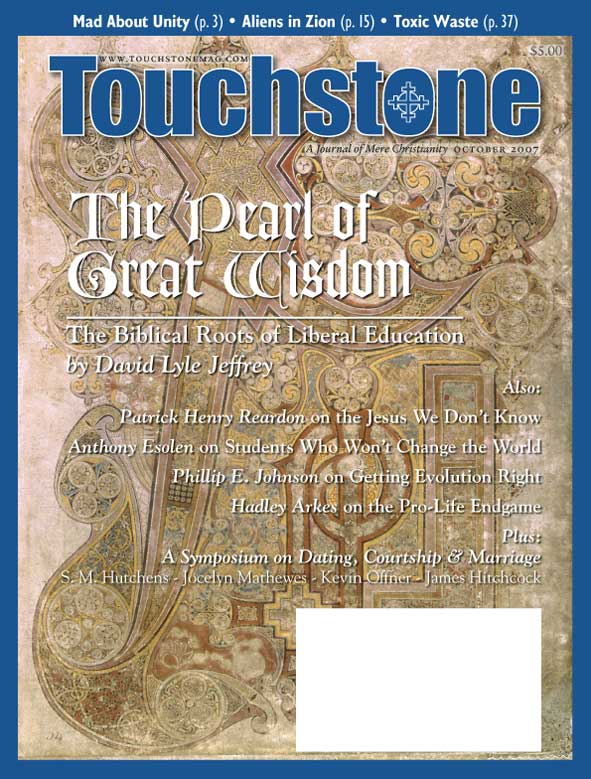
Toxic Waste
God Is Not Great: How Religion Poisons Everything
by Christopher Hitchens
Twelve Books, Hachette Book Group USA, 2007
(307 pages, $24.99, hardcover)
reviewed by Richard Kirk
Sam Harris’s The End of Faith apparently set other atheist minds to thinking, “If a Stanford graduate student can write a popular religion-bashing book, surely I can do better.” Christopher Hitchens’s recent effort in this genre employs a broader literary and cultural palate than Harris or Richard Dawkins ( The God Delusion), but philosophically, God Is Not Great is as shallow as its predecessors.
THIS ARTICLE ONLY AVAILABLE TO SUBSCRIBERS.
FOR QUICK ACCESS:
Richard Kirk is a freelance writer living in southern California whose book Moral Illiteracy: "Who's to Say?" is also available on Kindle.
A Journal of Mere Christianity—Delivered to Your Door
- Essays on theology, culture, and the Church
- Contributors from across the Christian traditions

Six print issues (one year) of Touchstone, plus full online access and PDF downloads for only $39.95.

Get a one-year full-access subscription to the Touchstone online archives for only $19.95.
bulk subscriptions
Order Touchstone subscriptions in bulk and save $10 per sub! Each subscription includes 6 issues of Touchstone plus full online access to touchstonemag.com—including archives, videos, and pdf downloads of recent issues for only $29.95 each! Great for churches or study groups.
Transactions will be processed on a secure server.
more from the online archives
37.5—Sept/Oct 2024
Why Law Schools Can't Teach Law
A sidebar to How Law Lost Its Way by Adam MacLeod
29.3—May/June 2016
A Deathbed Reflection on Catholic Social Teaching & Our Future Prospects by Karl D. Stephan
calling all readers
Please Donate
"There are magazines worth reading but few worth saving . . . Touchstone is just such a magazine."
—Alice von Hildebrand
"Here we do not concede one square millimeter of territory to falsehood, folly, contemporary sentimentality, or fashion. We speak the truth, and let God be our judge. . . . Touchstone is the one committedly Christian conservative journal."
—Anthony Esolen, Touchstone senior editor
