




Book Returns
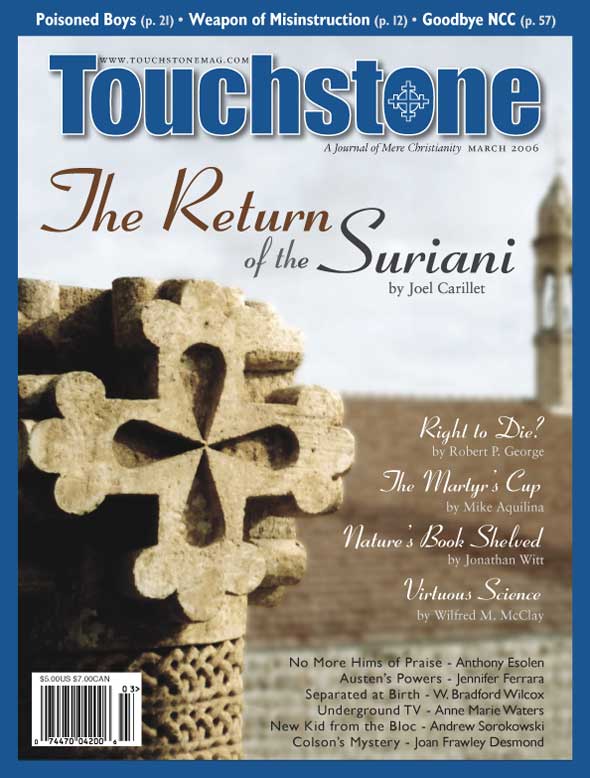
Weapon of Misinstruction
Paul Ehrlich’s The Population Bomb
by Allan Carlson
The Population Bomb, Stanford University biologist Paul Ehrlich’s Malthusian classic, appeared in May 1968, just two months before Pope Paul VI’s Humanae Vitae. The two documents seem far apart. The former argues that a mounting gap between human numbers and food “will continue to its logical conclusion: mass starvation.” The latter builds on Paul VI’s 1965 appeal to the United Nations, asking that nations “strive to multiply bread so that it suffices for the tables of mankind, and not, rather, favor an artificial control of birth . . . in order to diminish the number of guests at the table of life.”
Catholic Obsession
Yet they are closely intertwined. The prophetic message of Humanae Vitae, particularly its prescient warnings about the consequences of severing sex from reproduction, emerged when parts of Asia and Africa were evidently starving and mounting expert opinion demanded population control.
For its part, The Population Bomb is obsessed by the Roman Catholic Church, angered by the pope’s apparent intransigence, and hopeful about a potentially rebellious laity. (I wish I could report that the book’s angry obsession also extended to my corner of the Christian world, but alas, Ehrlich finds the Lutheran Church in America of that era to have “a highly enlightened policy on population.”)
Time and again, Ehrlich veers off to grapple with his Catholic problem. He takes heart that lay Catholic use of contraception appears similar to that of non-Catholics. However, “conservative elements in the Church hierarchy still resist change.” The author notes that a majority of the papal commission charged with studying the contraception question had concluded that contraceptive methods (other than abortion) were consistent with “the teaching on responsible parenthood of the Second Vatican Council.” It is “a mystery to informed Catholics” why the pope has not acted.
He labels the rhythm method “Vatican Roulette,” joking that people who practice this form of contraception “are commonly called ‘parents.’” Ehrlich mocks prominent Catholic scholars who have families of ten or more children, while concurring with his “Catholic colleague” John Thomas that existing Catholic teaching “contributes to misery and starvation for billions, and perhaps the end of civilization as we know it.”
The Population Bomb stands as one of the most effective propaganda tracts ever published in America. On every college and university campus, the specter of imminent doom caused by human numbers motivated the children of the Baby Boom to embrace Ehrlich’s “obvious first answer”: “Set an example—don’t have more than two children.”
The Baby Bust followed, with American fertility dropping to a historic low by the mid-1970s, well under a two-children-per-couple average. The drop was particularly sharp among American Catholics. As late as 1967, twenty-eight percent of young “devout” Catholics still planned to have five or more children. By 1971, less than seven percent did. The anti-natalist ethos of The Population Bomb had triumphed over the welcoming spirit of Humanae Vitae.
Poor Ehrlich
Today, it is easy to see the manifest errors of logic and prediction made in The Population Bomb. Ehrlich’s dire warnings—that “the world . . . is rapidly running out of food,” “the battle to feed humanity is already lost,” and “in 1984 the United States will quite literally be dying of thirst”— appear absurd today.
Allan C. Carlson is the author of numerous books, including Family Questions: Reflections on the American Social Crisis and The American Way: Family and Community in the Shaping of the American Identity. He attends St. Paul Lutheran Church in Rockford, Illinois. He is a senior editor of Touchstone.
A Journal of Mere Christianity—Delivered to Your Door
- Essays on theology, culture, and the Church
- Contributors from across the Christian traditions

Six print issues (one year) of Touchstone, plus full online access and PDF downloads for only $39.95.

Get a one-year full-access subscription to the Touchstone online archives for only $19.95.
bulk subscriptions
Order Touchstone subscriptions in bulk and save $10 per sub! Each subscription includes 6 issues of Touchstone plus full online access to touchstonemag.com—including archives, videos, and pdf downloads of recent issues for only $29.95 each! Great for churches or study groups.
Transactions will be processed on a secure server.
more from the online archives

34.1—January/February 2021
Jesus' Astonishing Other Teaching on Marriage by James Ware
27.2—March/April 2014
on C. S. Lewis & the New State Paganism by W. E. Knickerbocker

32.2—March/April 2019
Reality Shows, Even in a Popular TV Series by C. E. Smith
calling all readers
Please Donate
"There are magazines worth reading but few worth saving . . . Touchstone is just such a magazine."
—Alice von Hildebrand
"Here we do not concede one square millimeter of territory to falsehood, folly, contemporary sentimentality, or fashion. We speak the truth, and let God be our judge. . . . Touchstone is the one committedly Christian conservative journal."
—Anthony Esolen, Touchstone senior editor
