The Dust of Adam
David Mills on the Rite of Ash Wednesday
“When you fast,” Jesus says to us in the Sermon on the Mount, “do not be like the hypocrites, with a sad countenance. For they disfigure their faces, that they may appear to men to be fasting. Truly, I say unto you, they have their reward. But you, when you fast, anoint your head and wash your face; that you appear not to men to be fasting, but to your Father who is in the secret place.”
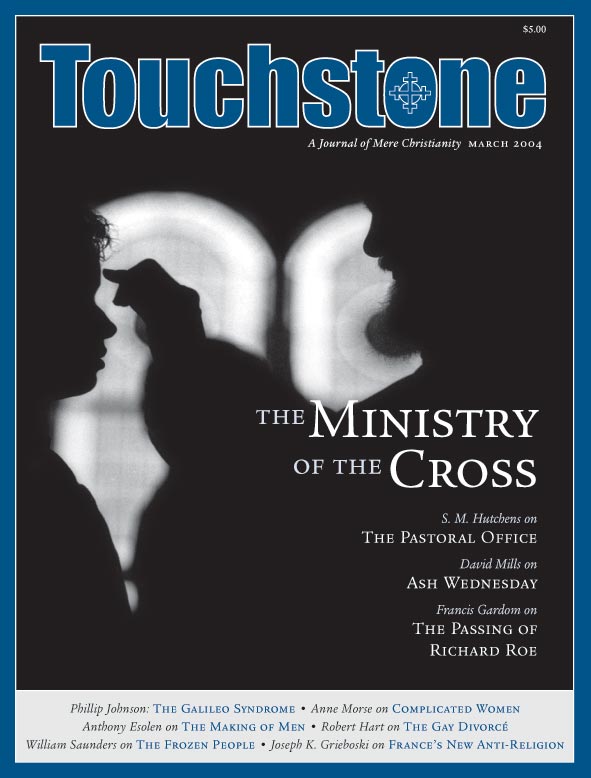
So much, you might think, for the traditional imposition of ashes on Ash Wednesday, as practiced by many Western Christians since the early Middle Ages. In liturgical churches, the priest or pastor marks a small cross on your forehead with ashes, traditionally made by burning the palms from the previous year’s Palm Sunday. As he does so, he tells you that you are dust, and to dust you shall return.
This seems to be exactly the sort of thing Jesus rejected. After all, the point of smearing ashes on your forehead is to disfigure it in a way everyone else is bound to notice. But Jesus is referring to a private fast made public so that people would applaud. He is not referring to a public ritual, which by definition cannot be observed in secret and for observing which you earn no applause. Jesus himself observed the public feasts and fasts of his day.
Valued Disciplines
A great value of liturgical disciplines is that you can do the things you ought to do without worrying about whether you are doing them for the right reasons. You win no fame or favor for doing what everyone is supposed to do. As a simple test, grab someone at church the Sunday after Ash Wednesday and say, “Hey, I had ashes put on my forehead last Wednesday.” The answer you will get will be some variation of “Big whoop.” It is like asking for approval because you didn’t sing a hymn during the sermon or came to the 11:00 service at 11:00.
And of course you may wipe off the ashes when you leave the service, so that it remains private in the sense of remaining within the gathered community. Having enacted the lesson liturgically, having the ashes smeared on your forehead, you will have ashes smeared on your heart.
But all that said, I would not ignore the usefulness of keeping the ashes as a public witness. I was, as a new Christian, deeply affected by seeing hundreds of people walking around Boston one late winter’s day with smudges on their foreheads, and finding out that evening, from a woman at a seafood restaurant, why she had that mark on her face. It had never occurred to me that people could be so confident in their religion as to wear its marks in public.
But what does the rite actually mean? What value does it have? I will try to exegete the rite for Ash Wednesday.
Exegeting liturgical rites and ceremonies is more an intuitive art than a textual science. The rites usually evolved over centuries, and the people who invented and developed them rarely if ever bothered to tell anyone what they were doing. The exegete has to intuit the logic of the rite and how it works in the lives of the worshipers. The accuracy of his conclusions depends on his sympathy and learning. He has to be able to hear the liturgy’s music. Some people, including a good many professional liturgists (if not most), are, alas, liturgically tone-deaf.
I assume that the long-established liturgies mean more than they may have been intended to mean. I can think of one liberal Episcopal liturgist who gets the wrong end of the stick with stunning consistency because he thinks that when he has found the practical origin of a practice he has thereby disposed of it. Candles, for him, are just lights. It does seem to me obvious that because man is a symbol-making creature, he will inevitably and rightly make the important things he does mean as much as possible. He will make even of necessities a dramatic icon.
David Mills has been editor of Touchstone and executive editor of First Things. He edits the opinion page of the Pittsburgh Post-Gazette.
A Journal of Mere Christianity—Delivered to Your Door
- Essays on theology, culture, and the Church
- Contributors from across the Christian traditions

Six print issues (one year) of Touchstone, plus full online access and PDF downloads for only $39.95.

Get a one-year full-access subscription to the Touchstone online archives for only $19.95.
bulk subscriptions
Order Touchstone subscriptions in bulk and save $10 per sub! Each subscription includes 6 issues of Touchstone plus full online access to touchstonemag.com—including archives, videos, and pdf downloads of recent issues for only $29.95 each! Great for churches or study groups.
Transactions will be processed on a secure server.
more from the online archives

calling all readers
Please Donate
"There are magazines worth reading but few worth saving . . . Touchstone is just such a magazine."
—Alice von Hildebrand
"Here we do not concede one square millimeter of territory to falsehood, folly, contemporary sentimentality, or fashion. We speak the truth, and let God be our judge. . . . Touchstone is the one committedly Christian conservative journal."
—Anthony Esolen, Touchstone senior editor