




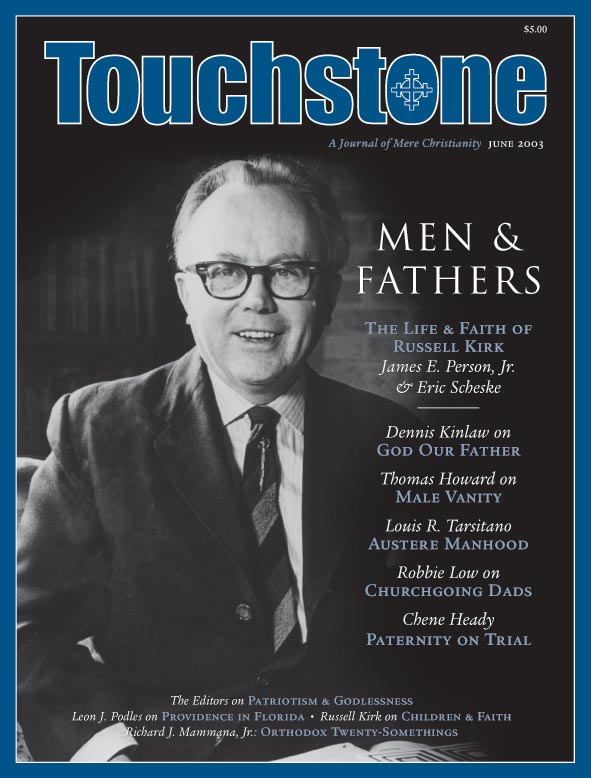
The Holy Fool as Bohemian Tory
The Wise Faith of Russell Kirk
by James E. Person, Jr.
“I have enjoyed from my earliest years the advantage of being a Fool,” wrote Russell Kirk, that most unfoolish of men, in 1987. In explanation of this odd remark, he cited his antithesis: the Wise Man—the ungrounded intellectual—in Yeats’s play The Hour-Glass, who is saved from spiritual destruction in the last moment of his life when he discovers one person who still believes in God and in the soul, Teigue the Fool.
The name of Russell Kirk and the word “fool” seldom appear in the same sentence. A distinguished conservative man of letters, author of the renowned history of ideas The Conservative Mind (1953), unofficial advisor to American presidents, practicing Roman Catholic, and self-styled “Bohemian Tory”—a writer of traditionalist outlook given to wandering in far lands and enjoying diverse cultures—Kirk nevertheless came to be considered something of a fool during his lifetime by a small number of social critics and political pundits. He could have occupied an honorary chair at any one of several universities, becoming ensconced in a lifelong position and accepting the accolades of numerous admirers and pilgrims to the great man’s school. Kirk could have set up shop in any of the myriad conservative think tanks that today dot the land. In any such scenario, he would have been financially well off, comfortably so. But instead, he chose to live out his life in simplicity at his ancestral home in Mecosta, an almost-forgotten village in the stump-country of north-central Michigan. Even so, at the end of his life, he stated in his memoir that by faith and prudent action he had realized his life’s purpose and could face the end of his earthly existence as a man blessed and fulfilled.
How so? The nature of the belief system Kirk found so fulfilling and how this faith was acted upon in his life are worth considering, if only to begin to understand how a man renowned for his wisdom found and lived out an abundant, good life.
Putting on Armor Young
Kirk had first come to believe in the existence of the immortal soul early in life, during his formative years living in his grandfather’s home beside the railroad tracks in Plymouth, Michigan, the town of his birth and upbringing. Later in life, he wrote that he came to this knowledge by the influence of his family, particularly his gentle mother and her own father, Russell’s grandfather, who by their example exempted him from the intellectual fads and follies of the early twentieth century. He spent his early years “reading good old books instead, and talking with good old people. From the moment I could form coherent sentiments, I was aware that I was a soul. During my teenage years I had my doubts about God, but I never questioned the existence of my own soul: I was not that much of a Fool.”
Interestingly, one of the authors whose works steered Kirk away from becoming a fool during his teenage years was one he seldom mentioned in his writings: Mark Twain. In an unpublished paper written in 1970, Kirk went so far as to say, “More than any other writer, Twain set me to thinking early on about ultimate questions. For me, Twain demolished the notions of Progress and Perfectibility.” He read both The Adventures of Huckleberry Finn and The Mysterious Stranger when he was 12 or 13 years old, and they moved him; he affected a precocious cynicism not uncommon among teenagers—“and yet, though I responded to Twain’s pathos, something within me protested against his nihilism.” In the long run, he claimed, he reacted energetically against Twain; but without Twain’s challenge, he might have made no sufficient response to modern disillusion—whether the disillusionment of the Great Depression (which enveloped the nation during Kirk’s teens) or the disillusionment of the postmodern era. “It is better,” he wrote, “to reject the idols of the crowd at the age of thirteen than at the age of thirty: One puts on armor young, and may go on pilgrimage, not in vain.”
Kirk underwent no religious instruction to speak of during his youth; his parents and grandparents were decent, hardworking people who, though embracing neither Christianity nor any other belief system, lived earnestly off the moral capital of their Puritan ancestors. (Kirk’s mother’s family was descended from the Separatist settlers of Plymouth Plantation, after which Plymouth, Michigan, was named.) As Kirk grew older, he gradually adopted a form of Stoicism not dissimilar to the Calvinist belief of his heritage: a belief that amid all our learning, planning, and striving, what happens to us in life is simply meant to be, and that a calm resignation to the workings of a distant, mysterious Providence is the way of wisdom. The hurts of life can be endured, he believed, by following the admonition of Marcus Aurelius: to “Live as upon a mountain,” detached and unbowed by life’s circumstances. A fuller account of Kirk’s spiritual development is given in this issue by Eric Scheske; for the purpose of this shorter account, it suffices to say that over time, Kirk sought something beyond Stoic resignation.
A Divine Intent
Kirk grew into manhood, graduated from college, obtained his master’s degree, and served in uniform during World War II. During the late 1940s and early 1950s, he spent half of each year in Scotland, studying to achieve the highest degree possible in the study of history: the coveted D.Litt. offered by St. Andrews University. His thesis, harking to the reading of “good old books” from his grandfather’s library during his youth, was to be a history of ideas, which would trace and articulate the Anglo-American conservative tradition. As part of his studies, Kirk delved into the works of Edmund Burke, in which he saw articulated the politics of prescription and convention supported by long usage, wise prejudice, and sound tradition.
James E. Person, Jr. is the author of Russell Kirk: A Critical Biography of a Conservative Mind (Madison Books), as well as Earl Hamner: From Walton's Mountain to Tomorrow (Cumberland House Publishing), and is a longtime book reviewer. He has written on Kirk and on Evelyn Waugh for Touchstone.
A Journal of Mere Christianity—Delivered to Your Door
- Essays on theology, culture, and the Church
- Contributors from across the Christian traditions

Six print issues (one year) of Touchstone, plus full online access and PDF downloads for only $39.95.

Get a one-year full-access subscription to the Touchstone online archives for only $19.95.
bulk subscriptions
Order Touchstone subscriptions in bulk and save $10 per sub! Each subscription includes 6 issues of Touchstone plus full online access to touchstonemag.com—including archives, videos, and pdf downloads of recent issues for only $29.95 each! Great for churches or study groups.
Transactions will be processed on a secure server.
more from the online archives


22.5—June 2009
C. S. Lewis on Civilization & the Natural Order by Timothy L. Hall

32.2—March/April 2019
on Preserving Physical & Spiritual Nourishment by Nathanael Devlin
calling all readers
Please Donate
"There are magazines worth reading but few worth saving . . . Touchstone is just such a magazine."
—Alice von Hildebrand
"Here we do not concede one square millimeter of territory to falsehood, folly, contemporary sentimentality, or fashion. We speak the truth, and let God be our judge. . . . Touchstone is the one committedly Christian conservative journal."
—Anthony Esolen, Touchstone senior editor
