




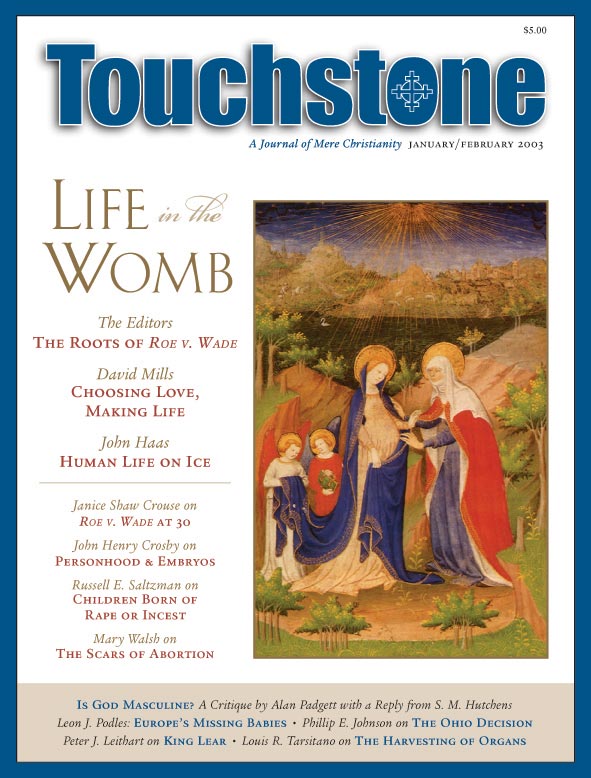
Human Life on Ice
Biotechnology, Human Dignity & the Teaching of the Church
by John M. Haas
The man across the table from me was articulate, passionate, zealous, brilliant, principled, and committed to doing good. I had sat spellbound as he delivered for my personal benefit one of the most fascinating and lucid microbiology lectures I had ever heard. He was also engaged in research that I found morally reprehensible.
His company, Advanced Cell Technology, was taking the DNA from human somatic cells, placing it in enucleated cows’ eggs, and beginning the cloning process for a human being. The organism would be allowed to grow to a mass of about 100 cells before it would be dissected to obtain human cells for research. These were cloned human beings with cow mitochondrial genetic material.
The company had no interest in producing cross-species creatures. Its activities were driven by concerns of simple research, efficiency, and cost control. For the cloning process, cows’ eggs were easier and cheaper to obtain than human ova. Also, the cows’ eggs were bigger than human ova and easier to work with. These were utilitarian concerns, pure and simple.
But as we spoke in his boardroom, in his laboratories human embryos were lying in petri dishes, subjected to experimentation, dissected, and killed; some were frozen for future use. Human embryos—embryonic human beings—it does not matter how it is put; they were beings who were human.
Divine Dignity
The poet, philosopher, and theologian within our cultural tradition all once spoke of the transcendent worth and inviolability of the human being. Legislators, jurists, warriors, and police once protected the innocent of our species, from the moment of conception. The medical profession from the time of the pagan Hippocrates swore never to kill the unborn child. In more recent times the World Medical Association adopted the Declaration of Geneva, which includes an oath for physicians to take upon beginning their medical career: “I will maintain the utmost respect for human life, from the time of conception.”
It was human life that engendered such awe, the creature before whom we stood in reverence, for in this creature we saw even more than ourselves. We could see the very image of God himself. We were not simply one species among others. As the psalmist, and later the apostle would declare: “What is man, O Lord, that you are mindful of him, the son of man that you care for him? You have made him a little lower than the angels; you have crowned him with glory and honor, subjecting all things under his feet” (Heb. 2:6–8).
The bard and playwright Shakespeare declared with equal eloquence: “What a piece of work is man, how noble in reason, how infinite in faculties . . . in action how like an angel, in apprehension how like a god: the beauty of the world, the paragon of animals” (Hamlet, act 2, scene 2).
But it was man’s godlike qualities that set him apart. His dignity was a participatory dignity, for One alone is truly good, the One in whose image we knew we had been created and by whom we have been redeemed.
A Journal of Mere Christianity—Delivered to Your Door
- Essays on theology, culture, and the Church
- Contributors from across the Christian traditions

Six print issues (one year) of Touchstone, plus full online access and PDF downloads for only $39.95.

Get a one-year full-access subscription to the Touchstone online archives for only $19.95.
bulk subscriptions
Order Touchstone subscriptions in bulk and save $10 per sub! Each subscription includes 6 issues of Touchstone plus full online access to touchstonemag.com—including archives, videos, and pdf downloads of recent issues for only $29.95 each! Great for churches or study groups.
Transactions will be processed on a secure server.
more from the online archives
23.5—September/October 2010
The Loss of a Christian Understanding of Virginity Is Pure Tragedy by Eleanor Bourg Donlon
24.3—May/June 2011
The Making & Endurance of the King James Bible, 1611-2011 by Barton Swaim
35.2—Mar/Apr 2022
on Fatigued Christians Deciding to Engage the Culture by Keith Lowery
calling all readers
Please Donate
"There are magazines worth reading but few worth saving . . . Touchstone is just such a magazine."
—Alice von Hildebrand
"Here we do not concede one square millimeter of territory to falsehood, folly, contemporary sentimentality, or fashion. We speak the truth, and let God be our judge. . . . Touchstone is the one committedly Christian conservative journal."
—Anthony Esolen, Touchstone senior editor
