




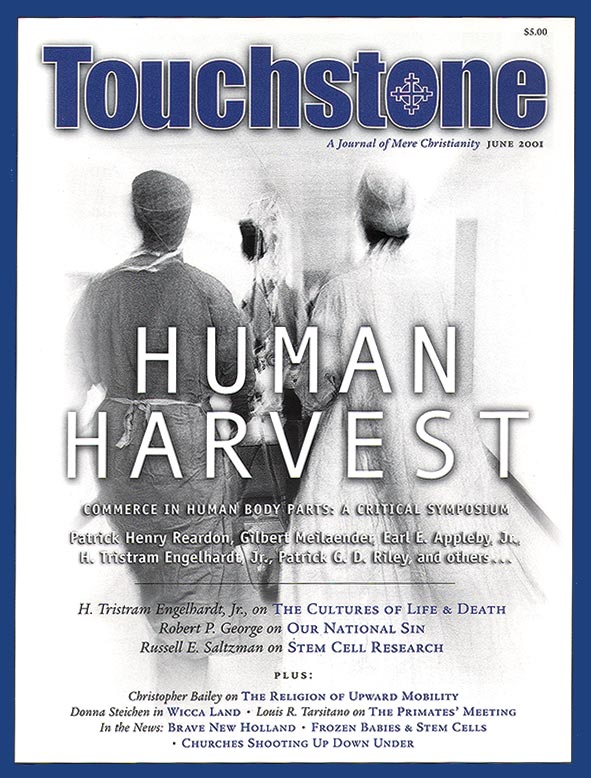
Our National Sin
Robert P. George on the Past, Present & Future of Abortion
On January 22, 1973, in Roe v. Wade and Doe v. Bolton, the Supreme Court of the United States struck down the laws of 50 states prohibiting or significantly restricting abortion. In the name of a generalized “right to privacy” allegedly implicit in the due process clause of the Constitution’s Fourteenth Amendment, seven justices (Blackmun, Burger, Douglas, Brennan, Stewart, Marshall, and Powell) created a license to kill the unborn.
These men probably had no idea that they were unleashing a struggle for the soul of the nation. Five had been appointed by Republican presidents—two by Eisenhower, three by Nixon. Four of these five were regarded as conservative, “law-and-order” judges. All no doubt believed that legal abortion was an enlightened and humane policy, one that would ease the burdens of many women and girls and relieve the enormous cost to society of a high birthrate among indigent, often unmarried, women. They seemed blithely to assume that abortion would be easily integrated into the fabric of American social and political life.
They were wrong on all counts.
A Multitude of Errors
They were wrong about the Constitution. As the two dissenting justices (White and Renquist) pointed out, it is nothing short of absurd to claim that a right to feticide follows from the constitutional injunction that “no state shall deprive any person of life, liberty, or property without due process of law.”
If the Constitution can be read to imply anything about abortion, it is that unborn human beings are, like everyone else, entitled to “the equal protection of the laws.” At a minimum, Roe and Doe were an outrageous usurpation of the constitutional authority of the people of the United States to shape law and policy through the institutions of representative government.
The Roe justices were also wrong to imagine that legal abortion would prove to be enlightened or in the slightest respect humane. On the contrary, the policy imposed by the Court has proven to be an unmitigated disaster. In the 28 years since Roe and Doe, abortion has taken the lives of more than 30 million unborn victims—each a distinct, unique, precious human being. It has done immeasurable moral, psychological, and sometimes physical harm to women who are so very often, and in so many respects, truly abortion’s “secondary victims.”
It has corrupted physicians and nurses by turning healers into killers. It has undermined the moral authority of the law by its injustice. It has abetted irresponsible—even predatory—male sexual behavior. Far from reducing the rate of out-of-wedlock births, particularly to poor women, illegitimacy has skyrocketed in the age of abortion.
The justices were wrong, moreover, to suppose that America, as a nation, would learn to live with the abortion license. A notable effect of the Court’s rulings was to energize the grassroots pro-life movement that had come into being a few years earlier to resist efforts to liberalize state abortion laws. In the beginning, the movement and its leadership were largely Roman Catholic. The mainline Protestant churches, if they concerned themselves with the issue at all, positioned themselves on the pro-abortion side.
At a decisive moment, however, the Evangelical community, prompted very significantly by the pro-life writings of the late Francis Schaeffer, became fully activated in the cause. Today, a common commitment to defending the unborn is at the heart of an unprecedented Catholic-Evangelical alliance that extends beyond abortion to issues of sexuality, marriage and family, education, welfare, crime and prison policy, international human rights, and the place of religion in American public life. It is fair to say that the most influential pro-life voices in the country today belong to Evangelical leaders such as Chuck Colson and James Dobson.
Robert P. George is McCormick Professor of Jurisprudence and Director of the James Madison Program in American Ideals and Institutions at Princeton University (web.princeton.edu/sites/jmadison). His books include In Defense of Natural Law (Oxford University Press) and Conscience and Its Enemies (ISI Books). He has served as chairman of the U.S. Commission on International Religious Freedom. He is a senior editor of Touchstone.
A Journal of Mere Christianity—Delivered to Your Door
- Essays on theology, culture, and the Church
- Contributors from across the Christian traditions

Six print issues (one year) of Touchstone, plus full online access and PDF downloads for only $39.95.

Get a one-year full-access subscription to the Touchstone online archives for only $19.95.
bulk subscriptions
Order Touchstone subscriptions in bulk and save $10 per sub! Each subscription includes 6 issues of Touchstone plus full online access to touchstonemag.com—including archives, videos, and pdf downloads of recent issues for only $29.95 each! Great for churches or study groups.
Transactions will be processed on a secure server.
more on abortion from the online archives
26.1—Jan/Feb 2013
on Abortion as a Matter of National Welfare by W. Ross Blackburn

30.3—May/June 2017
on the Misuse of Property Rights to Justify Slavery & Abortion by Robert Hart
24.1—January/February 2011
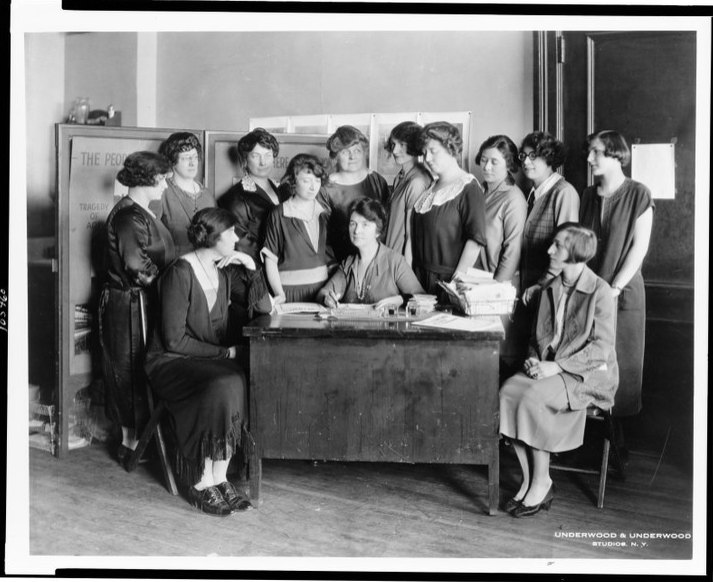
How Planned Parenthood's Founder Played the Christians, and Won by Allan C. Carlson
more from the online archives

23.1—January/February 2010
It’s Bent on Bringing Down the House on the Family & the Church by Douglas Farrow


calling all readers
Please Donate
"There are magazines worth reading but few worth saving . . . Touchstone is just such a magazine."
—Alice von Hildebrand
"Here we do not concede one square millimeter of territory to falsehood, folly, contemporary sentimentality, or fashion. We speak the truth, and let God be our judge. . . . Touchstone is the one committedly Christian conservative journal."
—Anthony Esolen, Touchstone senior editor
