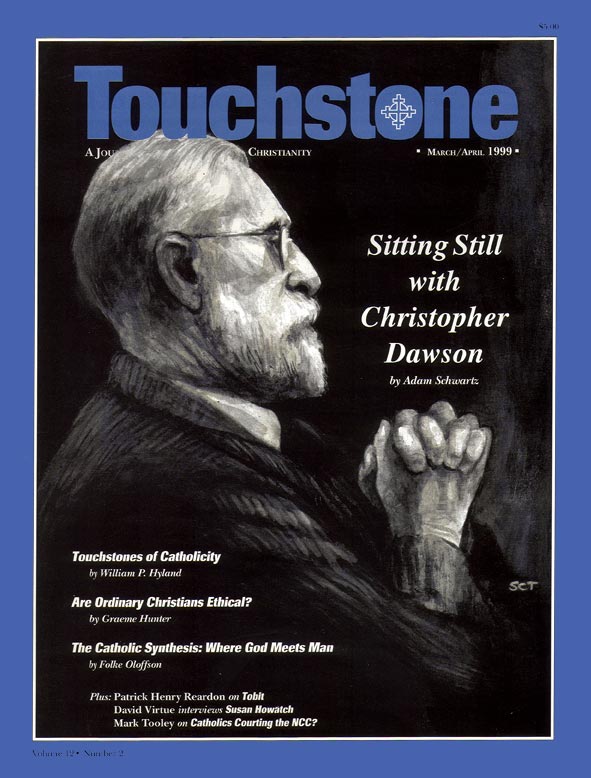
Touchstones of Catholicity by William P. Hyland

Touchstones of Catholicity

Bishop Richard Challoner & the Idea of the Primitive Church

by William P. Hyland

Bishop Richard Challoner was the indefatigable leader of the small community of English Catholics during the often difficult times of the eighteenth century. Called “Recusants” because of their refusal to attend Church of England services, Catholics were penalized by various laws and persecuted during the period that lasted from the English Reformation up to the nineteenth century. Challoner is a revered figure in the English Catholic imagination, and a symbol of the fortitude of the Catholic community in the last century of those penal days, from the aftermath of the Glorious Revolution to the days of the anti-Catholic Gordon riots, whose fury, as an elderly man, he barely escaped with his life.

Challoner was born in 1691 to Presbyterian parents, and while still a boy became a Catholic. As a teenager he went off to the English seminary at Douai, France, where he successfully studied for the priesthood, and remained there in an academic and administrative capacity until 1730, when he returned to England as a missionary priest. In 1741 he was consecrated as a coadjutor bishop for the Vicar Apostolic of London, and in 1758 he succeeded to the office of Vicar Apostolic himself, and was the most prominent leader of the English Catholics until his death in 1781.

The life and work of Bishop Challoner can speak to all who are committed to a life of contemplation and action firmly rooted in Christian orthodoxy. Although a staunch Roman Catholic in a time not given to ecumenical sentiments, Challoner’s Christocentric piety, along with his emphasis on Sacred Scripture and classical spiritual writings, has a universal appeal. Most of all, his belief that reflection upon the acts of martyrs and saints throughout history, and the life and teachings of the early Church, serves as a foundation in the formation of Christian identity, makes Richard Challoner a marvelous inspiration for all who are serious about Christian unity based upon the ancient faith of the Church.

A Writer & Compiler

Challoner’s pastoral responsibilities were extensive and exhausting, and he spent most of his time absorbed in his episcopal duties under rather difficult circumstances. His flock was an increasingly varied one, ranging from families of the old Catholic nobility in the countryside to recently arrived indigent Irish workers, and even included the Catholics scattered throughout the English possessions in the Americas.

In the midst of his extensive pastoral activities he produced many written works, and was a respected controversialist, scholar, and devotional writer. His literary production included: an updated and corrected version of the Douay Bible; devotional manuals; English translations of important Catholic spiritual writers from the Middle Ages; polemical works in defense of the Catholic faith; catechetical literature; and extensive work on the history of the early Church, and in particular, the early history of Christianity in Britain.

At the heart of Challoner’s literary endeavors was an attempt to formulate an accessible corpus of devotional and historical literature in English to buttress the identity of the British Catholics, as well as to stress the common heritage shared by the English, Scottish, and Welsh Catholics and the increasing number of poor Irish Catholic immigrants to England. One aspect of Challoner’s work that has not been studied is how he constructed this identity for British Recusants by stressing their continuity with the primitive Church and, in particular, the unbroken continuity of that primitive Church with the British and Irish churches of the Middle Ages, the Reformation era, and his own day.

Richard Challoner virtually created, or at the very least radically expanded, a devotional library for English-speaking Catholics. The basis of this was of course the Holy Scriptures, and it was his explicit desire that at the very least, the Catholic clergy and the more educated among the laity would develop a devotional life centered on the reading of Scripture.1 As a corollary to his scriptural scholarship and updated version of the Douay Bible, Challoner produced various short tracts of moral instruction based upon the Scriptures.2

Most influentially of all, perhaps, Challoner wrote and compiled The Garden of the Soul, whose first edition appeared in 1740, and which for the next century would be the standard prayer book for English-speaking Catholics. Challoner’s book of Meditations for every day in the Church year, based upon the Scriptures and the writings of St. Francis de Sales, exerted a similarly defining role in the devotional life of Catholics until at least the mid-nineteenth century.3


A Journal of Mere Christianity—Delivered to Your Door

  • Essays on theology, culture, and the Church
  • Contributors from across the Christian traditions

Subscribe (Print + Online)

Six print issues (one year) of Touchstone, plus full online access and PDF downloads for only $39.95.

Subscribe (Online Only)

Get a one-year full-access subscription to the Touchstone online archives for only $19.95.


bulk subscriptions

Order Touchstone subscriptions in bulk and save $10 per sub! Each subscription includes 6 issues of Touchstone plus full online access to touchstonemag.com—including archives, videos, and pdf downloads of recent issues for only $29.95 each! Great for churches or study groups.

Transactions will be processed on a secure server.


more from the online archives

22.8—November/December 2009

The Origin of Aesthetics

Looking for Beauty & Justice 150 Years After Darwin’s Classic by Charles Taliaferro

31.5—September/October 2018

Pastoral Realism

on the Congregation as a Wilderness by Paul Gregory Alms

17.4—May 2004

Supremely Modern Liberals

The Unhappy & Abusive Marriage of Liberalism & Modernism by James Hitchcock

calling all readers

Please Donate

"There are magazines worth reading but few worth saving . . . Touchstone is just such a magazine."
—Alice von Hildebrand

"Here we do not concede one square millimeter of territory to falsehood, folly, contemporary sentimentality, or fashion. We speak the truth, and let God be our judge. . . . Touchstone is the one committedly Christian conservative journal."
—Anthony Esolen, Touchstone senior editor

Support Touchstone

00