




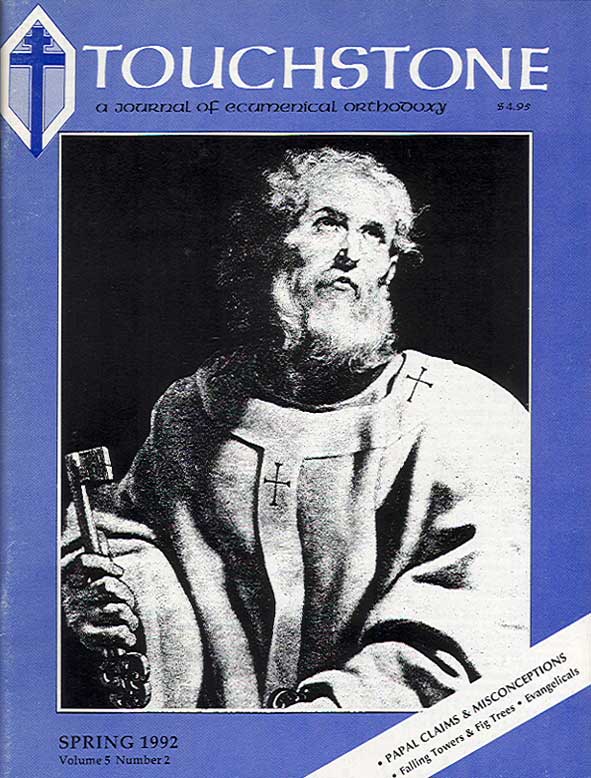
Papal Claims
Beyond the Misconceptions
by Thomas A. Baima
The editor of this journal accused me of saying a number of years ago, “Papal infallibility is a highly nuanced reality.” I honestly don’t remember saying that, but it does sound like something I might have said. For papal infallibility and, indeed, the whole Petrine ministry is a highly nuanced reality. It is as nuanced as it is important and controversial. Unfortunately for ecumenical discussion, the nuances often are not appreciated, and misconceptions abound even in learned circles to bedevil a fairer and more accurate consideration. So it is with some caution that I approach this highly nuanced and controversial subject and set myself to get beyond some of the misconceptions.
I think it is only fair to begin with a couple of disclaimers. First of all, even though I am trained as systematic theologian, my area of expertise is in the theology of the development of doctrine and not in the Petrine ministry. So, I offer this more as a survey from which I will refer the reader to the work of some theologians who have made this particular topic their life study.
Secondly, I am a committed Catholic Christian who lives within a faith community and for whom this topic is a matter of belief. I say that not as an apology but simply to clarify that I am dealing with this subject here in a different way than a scholar of comparative religions. I am only writing from a Roman Catholic perspective. Space does not permit me to go into longer explanations or alternative views on a number of important assumptions and interpretations. So to save me from having to repeat disclaimers at every controversial point, let me state at the very outset that this is intended merely as a survey to clarify a few points—important points—in the Roman understanding of papal claims.
Now I propose to do three things to uncover some of the nuancing that exists around the Petrine ministry. The first thing I would like to do is examine the structure of the communion of the Catholic Church as it is set forth in the 1983 Code of Canon Law, which puts into legal language the theology of the Second Vatican Council. There are very fine histories about the development of the papal office, but what I want to focus on in the first section is the present reality of authority and its exercise within the structure of Catholic Christianity.
Next, I would like to examine in some detail the titles that the pope wears, or said another way, the multiple offices that he holds. In this section, by relating it back to the structure of authority in the Church, I would like to sort out those functions of the papacy which are also exercised by other levels of authority within the ecclesial structure. By doing this, I believe we can narrow the scope of our discussion to those things which are absolutely unique to the Petrine ministry of the pope. The discussion of those powers which the pope exercises in common with other bishops in the Church is another subject perhaps for another time.
In the second section, I am going to pay particular attention to the office of the patriarch, which is something we share in common with Eastern Orthodoxy. I am going to dwell on that for a fair period of time, for much of what we Catholic Christians experience of the pope’s authority is actually his patriarchal rather than his Petrine authority.
In the third section, we will, having sorted out the unique Petrine functions from common episcopal functions, look more precisely at what the unique claims are and then touch upon the limits that define them. I can only hope that charitable readers as they look at the scope of this topic will forgive me for having to leave aside some very interesting tangents.
I. The Structure of the Church
If you read the documents of the Second Vatican Council and, in particular, the document Lumen Gentium, the dogmatic constitution on the church, you will find a conception of the church as a communion, as a unity of believers gathered around their bishop in a hierarchical construction.1 When you open the Code of Canon Law, the very first canon tells you a great deal about that hierarchical constitution. Canon 1 reads: “The Canons of this code affect only the Latin Church.”2
Thomas A. Baima is a Roman Catholic priest of the Archdiocese of Chicago and provost of the University of Saint Mary of the Lake in Mundelein, Illinois. He holds a doctorate from the Pontifical University of Saint Thomas Aquinas in Rome/Angelicum.
A Journal of Mere Christianity—Delivered to Your Door
- Essays on theology, culture, and the Church
- Contributors from across the Christian traditions

Six print issues (one year) of Touchstone, plus full online access and PDF downloads for only $39.95.

Get a one-year full-access subscription to the Touchstone online archives for only $19.95.
bulk subscriptions
Order Touchstone subscriptions in bulk and save $10 per sub! Each subscription includes 6 issues of Touchstone plus full online access to touchstonemag.com—including archives, videos, and pdf downloads of recent issues for only $29.95 each! Great for churches or study groups.
Transactions will be processed on a secure server.
more from the online archives
22.6—July/August 2009
on a Noble Defense Doomed by Darwinian Materialism by John G. West

25.6—Nov/Dec 2012
The Loss of Aristotelian Logic & the Social, Moral & Sexual Consequences by Peter Kreeft
calling all readers
Please Donate
"There are magazines worth reading but few worth saving . . . Touchstone is just such a magazine."
—Alice von Hildebrand
"Here we do not concede one square millimeter of territory to falsehood, folly, contemporary sentimentality, or fashion. We speak the truth, and let God be our judge. . . . Touchstone is the one committedly Christian conservative journal."
—Anthony Esolen, Touchstone senior editor
