




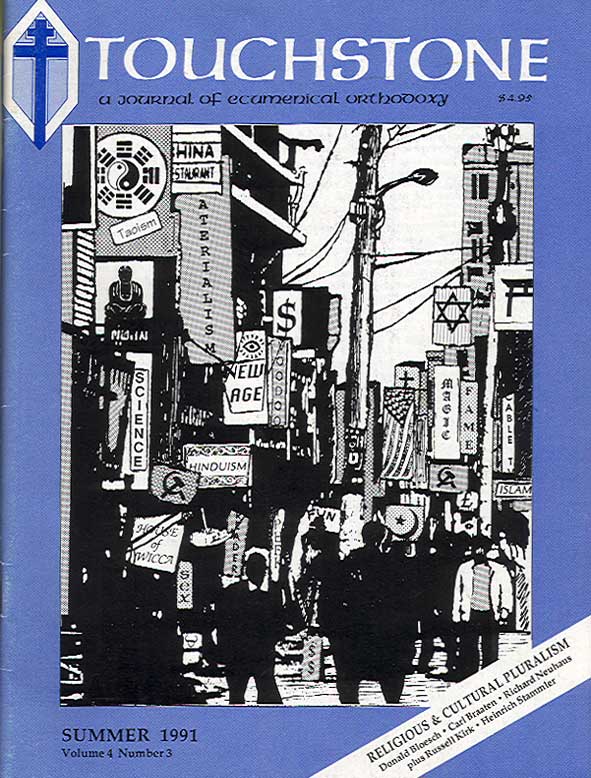
The Crisis of Modern Art
Nicholas Berdiaev's Prophetic Critique
by Heinrich Stammler
In 1931 there appeared in the Zeitschrift für Aesthetik und allgemeine Kunstwissenschaft an article entitled "The Historicity of Art." The author was a young assistant professor of Philosophy, Helmut Kuhn, who later made a name for himself as a Platonist philosopher, aesthetician, and specialist in problems of ethics. In his essay Kuhn was concerned with the question of the degree to which art is either subject to the laws of historical change or exempt by virtue of its intrinsic qualities—thus in some way transcending the perishability of all earthly things.
Paradoxically, the historicity of art becomes manifest in its very origin in a given present. This origin at a distinct point in the flux of history establishes a special relationship of the work of art to the specific situation of that moment. And so, the degree to which art is involved in the institutional life and public concerns of a given age is an indicator of the degree to which the arts are an integrated part of the life of a society. On the other hand, even the degree to which the arts are withdrawn from public concerns reflects a judgment of the time upon itself. Kuhn wished to emphasize that art cannot be regarded from a purely formal-aesthetic, phenomenological point of view; it must be seen, at least in some essential characteristics, as a sign of the times, and therefore expressive of them, either in assertion or denial.
Since the days of the Renaissance, and particularly the great age of European classicism, renewed attempts have been made to determine the specific aesthetic, moral, and even religious properties of a given period by the art forms in which it seemed to express itself. The name of Winkelmann springs to mind, who believed he could define the aesthetic and moral essence of classical antiquity on the basis of the character of its artistic creations. This was a belief that was to have a tremendous influence on the contemporary mind, being shared by authorities such as Goethe, Schiller, Keats, Pushkin and the entire neo-classicism of the age of the Empire, until toward the end of the nineteenth century, when Baudelaire, Nietzsche, Jacob Burckhard, Renan and others shattered this belief beyond all recognition.
From the Middle Ages to the age of impressionism, as long as these varied interpretations were preferred within the framework of an art, which was representational, pictorial, and objective, and for which the aesthetic values of classical antiquity and the Renaissance could be to some degree, tacitly assumed, they were not devoid of a certain plausibility—especially when formulated by ingenious, empathetic, and well-informed critics.
But in view of the jumble of confusing phenomena in the arts of our present, which seem to defy rational description, painting, sculpture, music, even writing, have appeared to break away from all established canons of taste. What began to dawn upon a startled world with cubism, fauvism, futurism, expressionism, abstractism and atonality, was tantamount to all-out iconoclasm, a nihilistic destructiveness. The artists resolutely turned their backs on the natural shapes and contours of the cosmos. All form, the human image included, was ruthlessly subjected to dissection and disintegration. The canons of beauty bequeathed by antiquity and revived and enriched by the Renaissance, were neglected or set aside. The very concept and ideal of beauty was consigned to obsolescence.
But this was not all: Art increasingly became inaccessible. It ceased to be the expression of a consensus regarding what is beautiful, harmonious, well-proportioned and pleasing to the senses. Thus, what we are accustomed to call "modern art" became "unpopular," a stigma that it has not been able to live down even to our day. It became an art for artists and trendy critics. And art criticism, where it was not dominated by purely commercial interests, tended more and more to turn into a dialogue between "experts." The general public was excluded from the lucubrations of the connoisseurs. The ordinary art lover saw himself relegated to the benches with the ignoramuses and the philistines.
It could also be said, in more philosophical terms, that art, with its centuries-old Western tradition of striving for ever regenerated visions of beauty, fell out of the platonic trinity of the True, the Beautiful, and the Good. Now, so it seemed, art had divorced itself from the world of meaning, shutting itself up in a realm of an arbitrary formalism devoid of all human content.
This was the situation which the illustrious Spanish philosopher José Ortega y Gasset came upon during the 1930s, not long after the publication of Helmut Kuhn's article, when he penned his famous essay about the "Dehumanization of the Arts." Far from chiming in with the chorus of the contemners of modern art, he tried to explain this phenomenon to his more perceptive contemporaries.
Ortega believed that he was able to discover in its line, rhythms, and spasms a new vitality, a joyous departure to new shores of expression. He saw in it a fresh reaffirmation of the character of art as, above all, an unrestrained play of the pure imagination released from all pre-established forms and conventions. He saw in it a force now gloriously emancipated from all service to the community, civic virtue, morality, religion, patriotism, social purpose, pure sentiment, and in general from all purposive edifying or exhortatory concerns and demands. With satisfaction he observed similar manifestations of modern art all over the globe, "Thereby giving ample proof that modern art is a unified and meaningful movement." And if art thus has forfeited much of its former seriousness which ultimately derived from its ties with the Platonic trinity, it has also won much in terms of a playful self-assertion of the original homo ludens (i.e., man exercising his creativity spontaneously, like a child yielding to the natural urge to play).
A Journal of Mere Christianity—Delivered to Your Door
- Essays on theology, culture, and the Church
- Contributors from across the Christian traditions

Six print issues (one year) of Touchstone, plus full online access and PDF downloads for only $39.95.

Get a one-year full-access subscription to the Touchstone online archives for only $19.95.
bulk subscriptions
Order Touchstone subscriptions in bulk and save $10 per sub! Each subscription includes 6 issues of Touchstone plus full online access to touchstonemag.com—including archives, videos, and pdf downloads of recent issues for only $29.95 each! Great for churches or study groups.
Transactions will be processed on a secure server.
more from the online archives
34.1—January/February 2021
What the World Needs Now It Hardly Knows by Anthony Esolen

22.6—July/August 2009
on a Noble Defense Doomed by Darwinian Materialism by John G. West
calling all readers
Please Donate
"There are magazines worth reading but few worth saving . . . Touchstone is just such a magazine."
—Alice von Hildebrand
"Here we do not concede one square millimeter of territory to falsehood, folly, contemporary sentimentality, or fashion. We speak the truth, and let God be our judge. . . . Touchstone is the one committedly Christian conservative journal."
—Anthony Esolen, Touchstone senior editor
