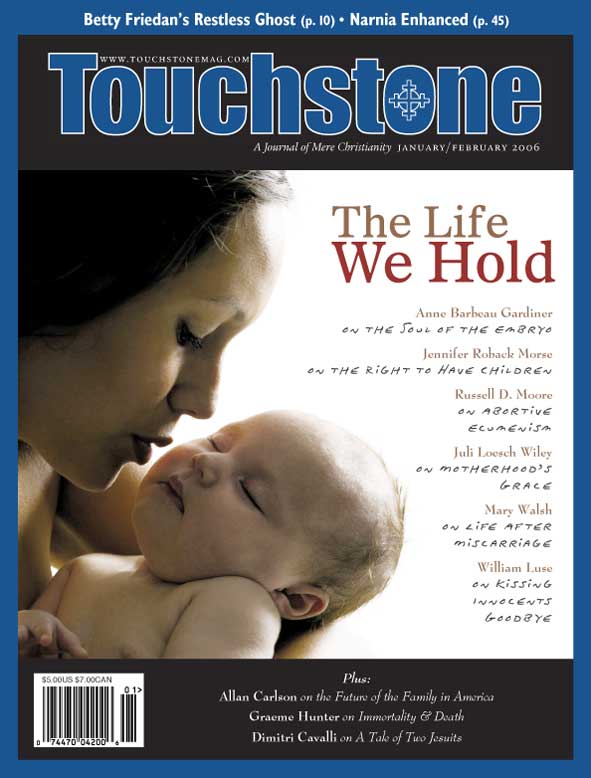
First Comes Marriage by Jennifer Roback Morse
First Comes Marriage
Jennifer Roback Morse on Why No One Has a Right to a Child
In Vista, California, an infertility clinic with a policy of artificially
inseminating only married women is being sued by a lesbian woman for sexual
orientation discrimination. In Indiana, a law was introduced and quickly withdrawn
that would have confined the use of artificial reproductive technologies to
married couples.
The superficial appeal of the lesbian’s case is that having a baby
is a right, from which no one can be excluded, no matter what their marital
status. The ill-fated Indiana law was shot down because its opponents appealed
to the same intuitive sense, widely felt by Americans, that people have a right
to have a baby.
Whose Rights?
There is some legal precedent for believing that procreation is a fundamental
right. The Supreme Court has held (in Skinner v. Oklahoma) that sterilization
cannot be used as a criminal penalty because the right to have children is
a fundamental right, but this right surely cannot mean that anyone who wants
a baby is entitled to a baby, and that someone is required to give them one.
Let me be blunt: There is no right to a child, because a child is not an
object to which other people have rights. If that were true, then parents would
be owners of their children, rather than their stewards or guardians. The well
being of the child could be, and would be, sacrificed to the “rights” of
the parents. If we are born as objects to which other people have rights, when
do we become persons with rights of our own, and why does the woman’s “right” to
have a child trump the child’s right to have a father?
The family courts do not typically use the language of rights, even for children
already born to specific and identifiable individuals. They usually do not
say, “These parents have a right to this child.” Even when they
use the term “parental rights,” these are not like property rights
to cars and refrigerators. Children are not chattels. A person cannot dispose
of his children, or write a contract to give up these rights. If anyone has
a right to anything, it is the child.
We must distinguish between “the right to have a child” in the
sense of possession and the “right to have a child” in the sense
of procreation. There is one coherent way to imagine a right to procreate.
Two people of the opposite sex can come together to conceive a child, without
permission from the state or anyone else. People do it all the time.
To put it another way: Every individual is sterile. No one can have a baby
by himself. Each human infant has two parents, one male and one female. Therefore,
any right to have a child should be held by a couple, not by an individual
who wishes to be a parent.
A Couple’s Right
This right of procreation a married couple holds is, quite literally, a natural
right. No one has to help the couple produce the child: They can do that all
by themselves. In fact, one of the great problems every society has to solve
is discouraging reproduction in certain circumstances, precisely because producing
babies is all too easy and natural to do.
Every known society has developed some social institution for defining the
appropriate types of reproductive couplings. Whatever the specific rules, formal
and informal, all societies limit the appropriate context for both sexual activity
and childbearing. As long as a couple meets a society’s criteria, as
the natural parents of the child they obtain the rights to exercise the full
complement of parental rights it grants.
This universal social institution is, of course, marriage. Nobody grants
a married couple the right to make babies; it is inherent in their marriage.
It does not follow that the natural right of a married couple to have babies
extends to random couplings of individuals. Nor does the entitlement of married
couples to procreate naturally generate a right for anyone to be artificially
inseminated. No one, married or otherwise, is entitled to the assistance of
others in becoming a parent.
The virtue of recognizing the natural right of a married couple to procreate
is that this arrangement best protects the rights of the most vulnerable, namely,
the child. What is owed to the child? The child’s most basic entitlement
is the right to be born into a home with both a mother and a father who love
him and each other. This gives the child at least the possibility of a relationship
with both parents.
In the vast majority of cases, this basic right of relationship will involve
provision for the child’s material needs because the natural parents
have the greatest incentive and opportunity to meet those needs. The right
of relationship is widely viewed as more fundamental than the right to material
support in this sense: Being poor is not ordinarily grounds for removing children
from their natural parents. The state will not remove children unless the parents
are grossly negligent or abusive.
Individuals may appear to have the same procreation rights as married couples.
The belief that they do creates the widespread sympathy for the lesbian in
the doctors’ conscience case, and the antipathy against the proposed
Indiana restriction on artificial reproductive technology. But there is no
individual right to have a child, and the state should decline to “discover” or
invent one.
Divided Parents
Unfortunately, forty years of public discussion, policy, and the courts’ decisions
about “reproductive rights” have been muddled by exactly the failure
to take this basic biological fact into account. The language of rights has
been used to divide the reproductive pair into individuals.
For instance, the feminist chant, “a woman’s body, a woman’s
choice,” not only forgets the interests of the child, it ignores the
interests of the male partner in the reproductive enterprise. While a man’s
body does not give birth to a child, his body may legally be pressed into eighteen
to twenty years of service to support the child. Public policies that support
a low-income woman and her child if she is unmarried undermine the father’s
participation. These state policies replace the male half of the reproductive
unit with a government check.
The Supreme Court disaggregated the married couple into an association of
two individuals when it asserted an individual’s right to obtain and
use contraceptives in the 1972 Eisenstadt v. Baird case. “Whatever
the rights of the individual to access to contraceptives may be, the rights
must be the same for the married and unmarried alike,” the Court declared,
defining the married couple as “an association of two individuals each
with a separate intellectual and emotional makeup.”
The Court concluded: “If the right of privacy means anything, it is
the right to be free from unwarranted government intrusions into matters so
fundamentally affecting a person as the decision whether to bear or beget a
child.”
Sexual Affront
But privacy is not the only issue at stake in childbearing. The integrity
of the couple as a mated pair is also worth protecting. Giving legal recognition
to the couple upholds the adults’ interests in parenting their jointly
conceived child, as well as the child’s interest in having a relation
with both parents.
Once we realize that the “right to have a baby” is not and cannot
be an individual right, but inherently resides in a couple, we have to ask
ourselves: what kind of couple? Surely there is a compelling social good in
attaching both biological parents to each other and to the child. This satisfies
the child’s entitlement to a relationship with both parents, and meets
the social good that the child be provided for.
Just as surely, it makes no sense to assign the parental rights to couples
who mate with each other more or less at random and who demonstrate no willingness
or ability to create a common life that they could share with a child. This
is why the Indiana law, limiting the use of sperm banks to married couples,
was on the right track.
Unfortunately, most states already support the right of unmarried women to
be artificially inseminated, and, in doing so, let them deprive their children
of a relationship with their father.
The states do this through deliberate policy. The sperm donor is a “legal
stranger” to the child, to use the cold language of the law. If men could
be called upon to provide child support, no man would make a deposit in a sperm
bank. If women could be required to allow the donor to have a relationship
with the child, no woman would make a withdrawal. It is the state’s policy
of shielding the biological parents from each other that allows anonymous sperm-donor
pregnancies to take place.
So who has a natural right to a child, a right that the state should recognize
and support? The most compelling candidate is the child’s pair of biological
parents, who have committed themselves to creating a common life together for
the sake of their child as well as themselves. In other words, married couples.
They may be said to have a right to a child (though not one that gives them
a right to the aid of others or of technologies like artificial insemination),
but no one else.
Jennifer Roback Morse is the author of the recently published Smart Sex: Finding Life-Long Love in a Hook-Up World and Love & Economics, both published by Spence Publishing. A research fellow at the Acton Institute, she is also founder of Your Coach for the Culture Wars, a business helping organizations take a stand in the culture wars. She can be contacted through her website: www.jennifer-roback-morse.com.
|