






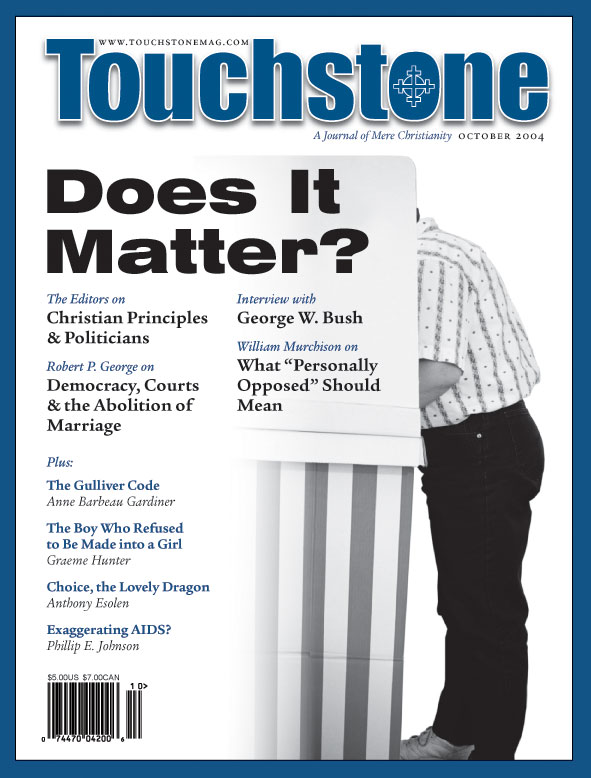
First Things First
On the Two Values that Matter Most
by James M. Kushiner
The National Council of Churches recently published “Christian Principles in an Election Year,” which identifies “ten non-partisan, biblically based guidelines” for voters in this election year. What are the ten areas of concern? War/conflict, urban decay/poverty, foreign policy, economic justice, racial justice, environmental justice, immigration, health care, and criminal justice. The non-partisan guide makes no mention of “gay marriage” or sanctity of life issues such as abortion, embryonic stem-cell research, or euthanasia.
A recent editorial in a conservative Christian magazine did a little better in this regard, but still missed an important opportunity to uphold the Christian tradition. It addressed the question of Christians voting “to communicate biblical values to their government representatives.” Offering aid to the Christian who wants to vote conscientiously in the upcoming election, the editors chose six areas of “urgent concern”: religious freedom around the world, Middle East peace, expanding access to health care, fighting AIDS wisely, pro-life Supreme Court appointees, and defending marriage—in that order.
How they failed was by neglecting to prioritize their six issues or to explain why they included those issues as opposed to other crucial issues left unmentioned, such as embryonic stem-cell research, human cloning, and euthanasia.
Do the editors believe that there is no meaningful hierarchy of issues? By presenting the issues in the way they did, they effectively advocated what could be called a democratization of values or egalitarianism in ethics. If we ask which issues should most inform our voting, the answer is, take your pick from the list.
Since no candidate is better on all the items, such an approach would seem to leave us morally free to vote for any candidate who is strong on several of them while bad on several others. Which are which doesn’t matter, since they are all offered, without prioritization, as biblical values. The Christian conscience is free to choose what it likes in this moral and ethical cafeteria.
But the Christian tradition, rooted in Holy Scripture, shows clearly that two of the six are in a class of their own: They are timeless and foundational matters. The others are not. The Christian must try to understand the others in the light of timeless and foundational principles, but the way he thinks these matters are best addressed in this world is a matter of prudence, on which Christians can disagree, and indeed disagree radically. But the sanctity of human life and the sanctity of marriage are primary and fundamental biblical “values.” Genesis teaches this and Christ confirms it.
Pillars of Life & Marriage
This is clearly true of the sanctity of human life. In Genesis, while all other life is “brought forth” by the earth, man is directly formed by God. His very flesh bears the fingerprints of the Creator, and his soul is given from the breath of God. Man is a special God-made being, in his very flesh.
Further, while all life reproduces “after its kind,” man’s procreative mandate is unique. God creates woman for man and brings the two together under his hand and blesses the union, a one-flesh union that in Christian theology is more than biological; it reflects a deeper mystery of Christ and the Church.
And there is more: Not only is the substance of man sanctified by God, it is further sanctified by the flesh of Jesus Christ, flesh conceived by the power of the Holy Spirit and born of the Virgin Mary. Further, Christ gave his body on the Cross for the redemption of fallen Man, and not just a redemption from punishment for sin.
James M. Kushiner is the Director of Publications for The Fellowship of St. James and the former Executive Editor of Touchstone.
A Journal of Mere Christianity—Delivered to Your Door with Full Online Access
- Essays on theology, culture, and the Church
- Contributors from across the Christian traditions
- Six print issues per year
- Full digital archive access
 Subscribe (Print + Online)
Get six issues (one year) of Touchstone PLUS full online access including pdf downloads for only $39.95.
 Subscribe (Online Only)
Get a one-year full-access subscription to the Touchstone online archives for only $19.95.
bulk subscriptions
Order Touchstone subscriptions in bulk and save $10 per sub! Each subscription includes 6 issues of Touchstone plus full online access to touchstonemag.com—including archives, videos, and pdf downloads of recent issues for only $29.95 each! Great for churches or study groups.
Transactions will be processed on a secure server.
more on America from the online archives
29.2—March/April 2016
The History of Family Strength in America May Reveal Good News by Allan C. Carlson

30.5—Sept/Oct 2017
The Christian Cure for What Ails Modern Politics by David Bradshaw

29.4—July/August 2016
Russell Kirk: American Conservative by Bradley J. Birzer by Hunter Baker
more from the online archives

33.1—January/February 2020
on the Consequences of One Birth Before Roe v. Wade by Craig Kellogg Galer


37.5—Sept/Oct 2024
An Abandoned Ruling Principle & How to Get It Back by Adam MacLeod
calling all readers
Please Donate
"There are magazines worth reading but few worth saving . . . Touchstone is just such a magazine."
—Alice von Hildebrand
"Here we do not concede one square millimeter of territory to falsehood, folly, contemporary sentimentality, or fashion. We speak the truth, and let God be our judge. . . . Touchstone is the one committedly Christian conservative journal."
—Anthony Esolen, Touchstone senior editor
