




Christ in China
Louis Markos on David Marshall’s Take on Chinese Religion & Tradition
As the Apostle Paul stood on Mars Hill before a coterie of educated Athenian Stoics and Epicureans, who likely thought there was little of value this babbling barbarian Jew from Asia Minor could teach them, his knees must have been shaking behind his toga. How could he build a bridge between the holy, omnipotent God who had revealed himself in the Incarnation, death, and Resurrection of Christ and the squabbling, decidedly unholy gods of Greek paganism? True, most of the philosophers who smiled condescendingly at him thought themselves above the fanciful myths believed in by the common, credulous crowd, but that would not help him to convince them that his God should also be theirs.
Perhaps he thought of something he would, a few years hence, write to the church in Rome: that though God had spoken directly only to the Jews, he had made known his power and holiness by inscribing it into the created world around us and the conscience within us (Rom. 1:20; 2:14–15). In fact, just a few years earlier, he had explained to a group of excited pagans in Turkey that God had not left himself without a witness among the Gentiles but had filled their fields with rain and their hearts with joy (Acts 14:17).
Whatever his thought process, Paul remembered, as he gazed into their serene but skeptical eyes, an altar he had seen in the marketplace inscribed to an unknown God. The God of Abraham, Isaac, and Jacob and Father of Jesus Christ had, it seems, left a faint but real witness to himself among the plethora of gods and idols that littered the streets of Athens. Paul’s job would not be to speak of a God of whom the pagans had absolutely no knowledge, but to reveal to them the true and full nature of the God they had already been worshiping, ignorantly and falsely, under a different name (Acts 17:22–23).
From that point of contact, Paul explained that the God who had created the heavens and the earth did not dwell in temples built by human hands; rather, through the creation of one man, he had created all the races of men, setting their times and places, though never being far from any of us. Then, to drive his point home, he quoted two pagan poets who, though writing about Zeus, inadvertently spoke of things that were true about the One God revealed in Christ—whose authority God confirmed by raising him from the dead (17:24–31).
As a long-time professor at Houston Christian (formerly Baptist) University, I have devoted my career to building bridges between our Greco-Roman pagan past and the truths revealed in Christ and the Bible. In such books as From Achilles to Christ and From Plato to Christ, I have sought to identify in the literature, philosophy, and mythology of ancient Greece and Rome seeds of the gospel that would only sprout and bear fruit in the light of the risen Son.
I have also challenged Christians with first-hand knowledge of non-European churches to write their own books with titles like From Confucius to Christ or From Buddha to Christ. I have learned a great deal from Don Richardson’s Eternity in their Hearts (Regal Books, 1984), which documents isolated tribes scattered across Asia, Africa, and the Americas that retain a memory of monotheism yet are held captive in fear to spirits they can never fully appease. But I was particularly hoping for some good writer to take up the vast and ancient nation of China. Had the God of the Bible left himself a witness in the Middle Kingdom?
Enter David Marshall, a prolific author and apologist who spent many years traveling across China, studying, praying, and ministering to Christians and non-Christians alike. Sensing my interest in such things, he recently sent me a copy of his True Son of Heaven: How Jesus Fulfills the Chinese Culture (Kuai Mu Press, 2002), a book I have devoured with much enthusiasm and three of whose insights I would like to share here.
I. Worshiping God Without Idols
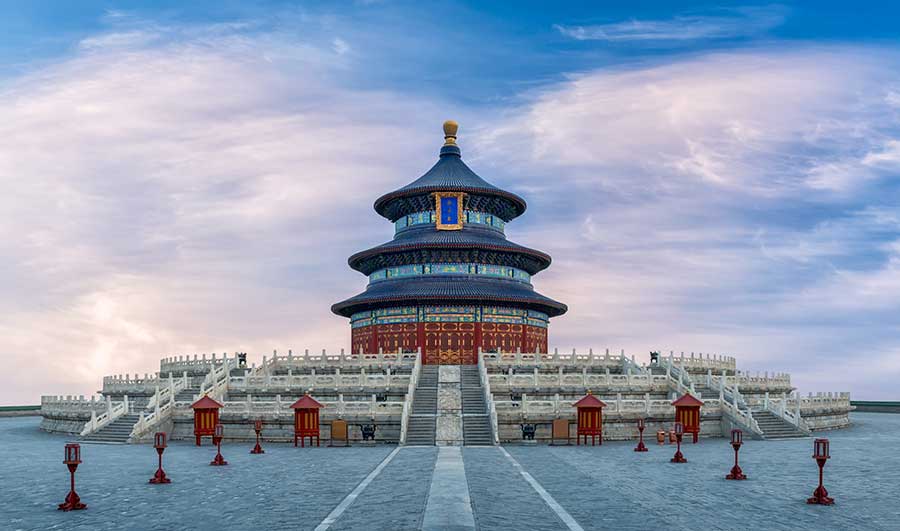
As he sought, like Paul before him, for a connection point between the gospel of Christ and a seemingly hostile culture bereft of the Scriptures, Marshall did not have to scour the country for an obscure altar to an unknown God. He did not have to look any further than at one of China’s earliest and most impressive sacred structures, the Temple of Heaven in Beijing. “The first emperors of the Ming dynasty,” he explains,
having chased Genghis Khan’s great-grandchildren out of China, built this magnificent worship hall to restore Chinese religion. In it they placed a plaque which united both names of God in one: Huang Tian Shang Di, “Awesome Heavenly Supreme Being.” And in it, they prayed to Tian as the Creator. (27)
Unlike other Chinese temples, this one did not include an idol of the God, for this God dwelled in heaven. As Creator, he was greater than the emperor, yet he was a personal God who cared about human beings and meted out rewards and punishments. The temple itself rests on four red and gold pillars (which Marshall links to the four Gospels), has a tri-level roof (which Marshall links to the Trinity), and is surrounded by two circles of twelve pillars each (which Marshall links to the twelve tribes of Israel and the twelve disciples).
Though a critic could easily accuse Marshall of reading too much into these numbers, what he reveals next about a vital ritual performed at the Temple of Heaven carries far more weight. Once a year, the emperor, who bore the title “Son of Heaven,” would enter the temple to pray and to sacrifice sheep and goats on behalf of the people:
In Israel, as in China, once a year one man approached a temple, representing all. Like the emperor, the day the Jewish high priest came to meet God [Yom Kippur] was filled with suspense, for he too came to pay the bill for the nation’s sins. As in Beijing, he offered livestock—cattle, sheep, and goats. (187)
Though the Temple of Heaven is roughly five hundred years old, it reflects ancient Chinese religious beliefs that pre-date Moses and that point to a universal yearning within the human soul for reconciliation with the Creator, with a God who cannot be contained in temples built by human hands. Even so, Melchizedek, though not a Jew, was a priest and king who worshiped God Most High without idols (see Gen. 14:18–20; Heb. 7).
II. Both Sheng Ren & Rebel
China, it seems, has her own large-scale version of the altar to the unknown God, but what of her philosophers? Did any point to Christ in a way analogous to Socrates and Plato? One did, and his name was Confucius. He lived about a century before Socrates and shared the Greek sage’s wisdom, courage, and humility. “Confucius,” Marshall writes, “believed Heaven had entrusted him with a two-fold mission: to preserve the best of China’s traditions, and to teach true benevolence” (39–40). Like Socrates, he was not afraid to ask difficult questions and to call leaders to live and rule virtuously.
And yet, also like Socrates, Confucius refused for himself the title of sheng ren (“holy man”). Instead, just as Socrates (in Republic II) imagined a perfectly just man who would yet be condemned and suffer, so Confucius looked ahead to a good man who “would even be willing to ‘accept death’ to ‘accomplish benevolence’” (42). To elaborate on this ideal sheng ren, Marshall quotes Confucian scholar Chen Jing-pan on the qualities of this hoped-for sage:
[He] would have transcended the achievements of any living being which had so far existed. He was thought of as being in the same category as the Divine Being of whom the Superior Man should always stand in awe. He has, in short, the ideal of the ideal human life, and the highest standard for human beings. (42)
Incidentally, Marshall adds, “Confucius never said the Sheng Ren would be Chinese” (42).
From Confucius, the Chinese learned the central virtue of loyal submission (xiao), most fully represented in the call to honor and respect one’s parents and to preserve the traditions of the elders. Though that has always been a strength of Chinese culture, Marshall explains, it has also led to much abuse by parents who use their children’s loyalty to fulfill their own dreams and by political leaders who use their subjects’ loyalty to quell dissent. As a result, Chinese culture has given rise to a number of rebels and bandits, the most famous, and infamous, being Mao Tse Tung.
Though Marshall in no way praises Mao’s bloody leadership, he explains that the dictator’s iconoclastic call to shatter repressive hierarchies and look to the future rather than the past appealed—and continues to appeal—to Chinese who “felt Mao was right about one thing: sometimes to rebel was justified” (61). China has never quite been able to resolve the strong dichotomy between the Confucian and the Maoist ideals. Could there be a leader who combined the humility of the former with the righteous anger of the latter? If there were, would he not fulfill the deepest, most paradoxical longing of the Chinese people?
“Jesus,” Marshall offers, “was history’s most effective revolutionary and social reformer. Yet all the while, he walked the path of xiao, showing the world a model of humility and proper loyalty like it had never seen before” (68). No leader or prophet in human history has ever shown such filial piety as Jesus did toward his Father, and yet, none has ever spoken more strongly for the outcast and the oppressed. Jesus is the sheng ren Confucius called for, but he is also the rebel who sets free the captive and preaches good news to the poor.
III. The Chinese Buddhist Dream
Jesus, whom many Church Fathers accepted as fulfilling the teachings of Socrates and Plato, may also be accepted as fulfilling the teachings of Confucius. But what of that other pillar of Chinese culture and self-identity, Buddhism? Marshall does a fine job explaining to his Western readers that China is and is not a Buddhist nation. Although the Chinese found the compassionate side of the Buddha appealing, they did not care for his strict renunciation of all earthly goods.
The Chinese have always sought after fu, which Marshall defines as “fortune, luck, happiness, and prosperity” (79). The Buddhist call to forego family and children, good food and fellowship, and financial stability did not resonate with the yearnings of the Chinese. They were happy to embrace the Buddhist creed of right thoughts, right speech, and right action—had not Confucius taught the same—but they did not believe that life was suffering and that the proper path to salvation was to empty oneself of all desire.
In the end, China domesticated Buddhism, bending it to fit her own quest for fu and her longing for divine compassion. That is why, Marshall argues, the Chinese merged one of their own myths with a chapter from the Buddhist Lotus Sutra. The myth tells of a lovely princess named Miao Shan, who was locked in a nunnery by her father when she refused to marry the man he had chosen for her. When she won the favor of the gods in the nunnery, he had her killed. But her kindly spirit and merciful nature broke the chains and dispelled the horrors of the underworld, and she was made a goddess. Later, when her father grew sick, “Miao Shan came to him and, plucking out her own eyes, cured him. Moved by her noble gesture, he repented, and she was made whole again” (111).
In a telling act of syncretism, the Chinese took their redemptive myth of Miao Shan and linked it to the “Indian Lotus Sutra [which] spoke of a god of mercy named Avalokivatta, ‘From on high looking down.’ ‘Guan Yin,’ he would later be called in China” (97). Marshall’s suggestion as to why the connection was made reveals a deep hunger in the Chinese soul for the good news of Christ’s Incarnation, Crucifixion, and Resurrection:
First, Miao Shan provided a Chinese face for the new religion. Second, her story played on the Chinese moral ideals of loyalty to parents and of self-sacrifice. . . . By putting forward the myth of Guan Yin, in all his or her guises, Buddhism tried to have it both ways: escapism for the monkly-minded, and salvation for the masses. Buddha would renounce the world and save it at the same time. . . . And so, Buddhism spread in China through myths of redemptive suffering, of the power of love to overcome hatred, and fancy footwork on the part of a few monks. But what spread was no longer a very orthodox Buddhism. It was a Pure Land [distinctively Chinese Buddhist] dream: a dream of divine heroism that would save man regardless of cost to Itself. (111–112)
The Answer for Every Culture
The pagan, pre-Christian signs that point ahead to Christ—in ancient Greece, Rome, Egypt, Scandinavia, India, and China—are evident; to discover them, we just need eyes to see and ears to hear. In the days before the Incarnation, God did not leave himself without a witness but spoke, through general revelation, to the yearnings and desires of all the nations. So it must be, or else Christ was not, as he claimed, the Light of the world. Marshall expresses it best in the closing paragraph of his book: “Jesus died for our sins and came to life again. He calls us to follow him. That is the answer to the deepest need in every culture: a way through death into life” (201). Amen and amen!
Louis Markos , Professor in English and Scholar in Residence at Houston Baptist University, holds the Robert H. Ray Chair in Humanities. His 19 books include Lewis Agonistes; Restoring Beauty: The Good, the True, and the Beautiful in the Writings of C. S. Lewis; On the Shoulders of Hobbits: The Road to Virtue with Tolkien and Lewis; and From A to Z to Narnia with C. S. Lewis.
A Journal of Mere Christianity—Delivered to Your Door
- Essays on theology, culture, and the Church
- Contributors from across the Christian traditions

Six print issues (one year) of Touchstone, plus full online access and PDF downloads for only $39.95.

Get a one-year full-access subscription to the Touchstone online archives for only $19.95.
bulk subscriptions
Order Touchstone subscriptions in bulk and save $10 per sub! Each subscription includes 6 issues of Touchstone plus full online access to touchstonemag.com—including archives, videos, and pdf downloads of recent issues for only $29.95 each! Great for churches or study groups.
Transactions will be processed on a secure server.
more on Christianity from the online archives
33.3—May/June 2020
Human & Divine Societies Require Careful Thought & Discourse by Anthony Esolen

32.4—July/August 2019
on Probability, Death & the Existence of God by Graeme Hunter

31.1—January/February 2018
on Taking the Measure of the Deserving & the Undeserving Poor by Martin Bordelon
more from the online archives


33.3—May/June 2020
Bach's Cantata BWV 106, Gottes Zeit ist die allerbesteZeit (God's time is the very best time) by Ken Myers

23.6—November/December 2010
Darwin, Design & Thomas Aquinas
The Mythical Conflict Between Thomism & Intelligent Design by Logan Paul Gage
calling all readers
Please Donate
"There are magazines worth reading but few worth saving . . . Touchstone is just such a magazine."
—Alice von Hildebrand
"Here we do not concede one square millimeter of territory to falsehood, folly, contemporary sentimentality, or fashion. We speak the truth, and let God be our judge. . . . Touchstone is the one committedly Christian conservative journal."
—Anthony Esolen, Touchstone senior editor
