




Fair to Middle Earth
Even the token conservative Catholic among the extensive stable of editorial writers employed by the New York Times enjoys only limited latitude in the opinions he is permitted to express in the pages of America's most influential organ of progressive piety. Although what Ross Douthat writes is more likely to be thoughtful, coherent, and prudent than most of what is on offer in the Times, it appears that he must still make concessions. Much as Christians in pagan Rome were permitted to worship Jesus so long as they were willing to burn an occasional pinch of incense to the divinity of the emperor; just so, writing for our nation's paper of record evidently requires everyone, even the man paid to be a conservative anomaly, to offer occasional obeisance to the gods of imperial progressivism.
A piece by Douthat in the New York Times of March 7, 2021, "Do Liberals Care If Books Disappear?", deplores the decision by the custodians of the copyright to the "Dr. Seuss" books, so popular among children, to withdraw from publication six of the books, deemed by a "panel of experts" to "portray people in ways that are hateful and wrong." Even as he inveighs against this example of "cancel culture," Douthat concedes, however, that "Western children's literature really has been influenced by imperialism and racism. The Babar books have obvious colonialist undertones." Then there is The Lord of the Rings, "with its Greco-Roman Gondorians besieged by darker races from the south and east": although it is "a work of genius," still, "Tolkien's chauvinism is a real moral and artistic flaw."
These problematic assertions seem to be Douthat's bit of incense in the sacrificial fire.
The Supposed Moral Defect
Let us begin by considering Tolkien's supposed moral flaw. If The Lord of the Rings is immoral insofar as it shows a "Greco-Roman" city overcoming against all odds an invasion by "darker races from the east and south," would the "moral flaw" be removed by making the beleaguered defenders of the city dark-skinned southeasterners and their assailants white "Greco-Roman" types? Or does proper deference to equity entail that both sides be utterly devoid of distinctive physical features or local origin?
Critical race theory, an element of the radical progressive vision that the New York Times seems to have accepted without qualification, maintains that "people of color" cannot be "racist," because white men of European extraction are historically privileged oppressors of dark-skinned victims. This would seem to favor the former alternative, since the latter implies that moral judgment can be rendered in an abstract, ahistorical vacuum.
Apparently then, the moral defect of Tolkien's great work is having depicted those "darker races from the east and south" as the villains, oppressors of the white "Greco-Romans," who not only achieve victory over an apparently invincible enemy, but who also represent the better cause. The notion that such a story is intrinsically immoral depends, however, on a view of history so occluded as to be merely risible, were its effects not so troubling. The history of the world is an account of the continual rise and fall of empires, of national groups moving out of one territory and invading and colonizing that of their neighbors, only to succumb themselves ultimately to defeat and colonization at the hands of yet other groups.
The most obvious example relevant to Tolkien's depiction of a conflict between white men from the Northwest and darker-skinned denizens of the Southeast would be the conflict between Islam and Christendom. Seven hundred years before what J. H. Parry calls The Establishment of the European Hegemony, 1415–1715 (1949, revd. 1959, 1966), Muslims, within a generation of the death of Mohammed, began to spread in all directions from the Arabian Peninsula, where Islam originated. By the time of Parry's terminus a quo for the rise of European exploration and conquest, Islamic armies in the service of a succession of caliphates and empires had invaded and subjected all of North Africa and the Middle East, and parts of Eastern Europe, formerly Christian lands, and made significant inroads in central Asia and the Indian Subcontinent.
Even after the European nations had begun to emerge as global powers, Islam was still a dominant force: in the sixteenth century, the Ottoman Turks largely controlled the Mediterranean Sea, threatening the coasts of Italy, France, and Spain; and in 1683, Turkish armies came close to overrunning Vienna—only a generation before Parry's terminus ad quem for the "establishment of the European hegemony." Muslims have hardly been perennial victims of Christian Europeans.
Imaginary yet Representative
The culmination the Turkish effort to rule the world in the name of Islam came in 1453 with the conquest of Constantinople. And this brings us back to Tolkien—and Ross Douthat.
A work of imaginative literature, like The Lord of the Rings, is a fiction: it entails the creation of a world apart from the reality that we inhabit, and the places and the characters who live in them and their actions and speeches are all imaginary. This is true even of works to some extent based on history or historical characters: Prince Hal and Hotspur in Shakespeare's I Henry IV are based on actual men about whom the playwright read in Holinshed's Chronicles and other historical sources of his time, but the speeches, actions, and even the ages he attributes to them are fictional. Unlike a historian, a playwright is under no obligation to adhere strictly to the facts concerning the men and events he depicts.
Nevertheless, fiction is still a representation of -reality—an effort to make imaginatively present an enhanced version or experience of the world in which we live. What makes great literature so valuable is that it offers, by means of vicarious participation, moral insight into human nature and the human condition. We may think of a work of literature as analogous to a laboratory experiment, which enables an investigator to comprehend aspects of the physical universe that would be impossible to discern without isolating them from the seamless continuity of natural phenomena. A literary critic will, then, attempt to draw out the connections between the representation created by the literary artist and the actual realm of which we are denizens.
The Obvious Parallel
Douthat's likening of the men of Gondor to the "Greco-Roman" civilization of the ancient world is precisely such an effort, but, regrettably, a singularly inept one. The Athens of Pericles or the Rome of Augustus hardly spring to mind in contemplating Tolkien's Gondor. The obvious historical parallel is Constantinople, the city founded by the first Christian emperor as capital of the Eastern Roman Empire—now usually thought of as Byzantium.
Long after the Western half of the empire had broken up into the feudal kingdoms and duchies that would form the basis for modern European nations, the Eastern emperors in Constantinople maintained at least a semblance of imperial grandeur. As the centuries wore on, however, Byzantium was increasingly wracked by disputed successions, palace intrigue, and corruption; the entire pattern of political decadence that we have come to call "byzantine." This occurred against a background of continual pressure from a series of aggressively expansionist Muslim rulers. Tolkien's depiction of Gondor is strikingly similar.
Byzantium provides, then, a plausible model for Tolkien's Gondor, even if the author had not thought of this; and the warriors from Rohan, the Shire, and other lands inhabited by the free peoples of Middle Earth in some respects resemble the Crusaders from Western Europe who campaigned to recover the Holy Land from Islam and provide relief from the pressure on Constantinople.
That the Crusaders ended up sacking Constantinople rather than defending it, that the city and the entire Byzantine Empire would succumb to conquest at the hands of the Ottoman Turks in 1453, are irrelevant to the resemblance between Tolkien's story and some aspects of Byzantine history. Likewise, it matters not at all that the principal warriors to come to Gondor's succor, the Riders of Rohan, have more in common with the Anglo-Saxons of the seventh and eighth centuries than with the knights of the later Middle Ages, who actually mounted the several crusades to the Holy Land.
Dr. Johnson's Reproof
If Tolkien has failed to make these bits and pieces of history and fable cohere into a plausible fiction of his own, then the shortcoming may be pointed out by critical analysis. But one of the most widely appreciated elements in The Lord of the Rings is precisely the consistency and vibrant liveliness of the imagined world of Middle Earth. Douthat himself calls it "a work of genius," and the essence of literary genius is the ability to create a convincing representation of reality.
The "flaw" in his fiction, if flaw it be, is that he has deployed the wrong characters in the wrong roles according to no literary consideration intrinsic to the story, but only according to a fashionable ideological "narrative" dear to some contemporary "activists." It is difficult not to recall Dr. Johnson's reproof of the eighteenth-century critic John Dennis's complaint that, in Coriolanus, "Menenius, a senator of Rome, should play the buffoon." Johnson's rejoinder remains instructive:
But Shakespeare always makes nature predominate over accident; and, if he preserves the essential character, is not very careful of distinctions superinduced and adventitious. His story requires Romans or kings, but he thinks only on men. He knew that Rome, like every other city, had men of all dispositions; and wanting a buffoon, he went into the senate house for that which the senate house would certainly have afforded him.
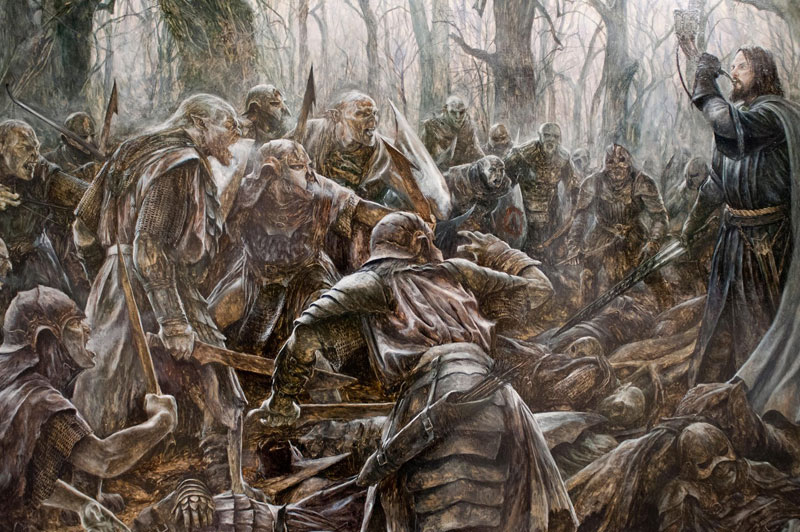
Tolkien, wanting a depiction of invading hordes besieging a beleaguered city, took from the relentless armies of the Ottoman Turks features that are a part of the reality of human history.
The Only Real Obstacle
Tolkien's perfectly legitimate literary representation thus clashes with the current notion that the "privileged" must behave with submissive, not to say groveling, deference toward their alleged victims. The implicit premise of this demand is that men and women of differing races, religions, and nations have nothing in common. Neither the colonist nor his descendants, for instance, can even begin to understand the suffering of the colonized or their descendants.
This view is both historically inaccurate and logically contradictory. Muslims generally count as victims of "Islamophobia," according to the ideology of "inclusion" and "diversity," but, as we have seen, for at least 1,100 of the 1,400 years since the founding of Islam, they have usually been on the offensive against an overmatched, retreating European Christendom.
What is more, a rudimentary knowledge of history reveals that the record of Islam is far worse than that of European Christendom regarding all the issues agitating the "woke": colonialism, slavery, inequality of women, oppression of "sexual minorities." The only reason that Christianity and the West are routinely denounced is that the progressives, quite shrewdly, take Western Christian culture seriously: they know that it poses the only real obstacle to their program of total revolutionary transformation of culture, society, and human nature itself.
Dr. Johnson regards this general human nature, which unites all men, as the principal concern of literature, and, while he may over-emphasize the focus on abstract teaching in literature, his basic proposition is certainly correct: we turn to poems, plays, and novels because they enable us, paradoxically, to experience universal realities about human nature in a concrete, particular form. Tolkien's fiction embodies both poles of this paradox: his orcs, goblins, elves, dwarfs, and hobbits; his "Southerners," Riders of Rohan, and men of Gondor represent the rich diversity of human beings who populate this earth as well as Middle Earth. We immediately understand their conflicts, their loves and loyalties, their vices and virtues, their fears and doubts. The fictional world that Tolkien creates in The Lord of the Rings is a compelling analogue to our world, although completely distinct from it.
The secular materialist elite, which has come to dominate our society, however, refuses to acknowledge the independent integrity of a work of literature: whatever is not contributing to revolutionary progress toward utopia is ipso facto evil.
Time to Stop
That most conservative Christians, along with Ross Douthat—and me!—routinely offer qualifications of our beliefs, limp apologies, ritual abasements—all the little pinches of incense that we cast into the progressive altar flame—ought to be alarming. If we have not altogether succumbed to revolutionary brainwashing, we have allowed ourselves to be browbeaten into one truckling concession after another. It is time to put a stop to it, to insist upon the virtues and achievements of our civilization, our culture, our religion. Otherwise we shall lose them.
R. V. Young is Professor of English Emeritus at North Carolina State University, a former editor of Modern Age: A Quarterly Review, and the author of Shakespeare and the Idea of Western Civilization (Catholic University of America Press, 2022). He and his wife are parishioners at St. Ignatius of Antioch Church in Tarpon Springs, Florida. They have five grown children, fifteen grandchildren, and three great-grandchildren. He is a senior editor of Touchstone.
A Journal of Mere Christianity—Delivered to Your Door
- Essays on theology, culture, and the Church
- Contributors from across the Christian traditions

Six print issues (one year) of Touchstone, plus full online access and PDF downloads for only $39.95.

Get a one-year full-access subscription to the Touchstone online archives for only $19.95.
bulk subscriptions
Order Touchstone subscriptions in bulk and save $10 per sub! Each subscription includes 6 issues of Touchstone plus full online access to touchstonemag.com—including archives, videos, and pdf downloads of recent issues for only $29.95 each! Great for churches or study groups.
Transactions will be processed on a secure server.
more on J. R. R. Tolkien from the online archives
more from the online archives

18.4—May 2005
The Idylls, Idols & Devils That Corrupt the Moral Imagination by Vigen Guroian

18.3—April 2005
on Being a Free Narnian & the Joy of Subordination by Donald T. Williams
24.5—Sept/Oct 2011
A Critical Memoir of Thomas Merton at Gethsemani Abbey by Patrick Henry Reardon
calling all readers
Please Donate
"There are magazines worth reading but few worth saving . . . Touchstone is just such a magazine."
—Alice von Hildebrand
"Here we do not concede one square millimeter of territory to falsehood, folly, contemporary sentimentality, or fashion. We speak the truth, and let God be our judge. . . . Touchstone is the one committedly Christian conservative journal."
—Anthony Esolen, Touchstone senior editor
