




Grateful for Dante
How the Great-Souled Tuscan Saved My Life
On a warm October day in Ravenna, the ancient Roman imperial capital on the Adriatic, I walked down a street that runs by the Franciscan basilica and dead-ends at a small neoclassical monument topped with a dome. This is the Tomb of Dante, erected in the city where the fourteenth-century poet spent the final years of his life, and died. I entered the shaded portico quietly and stood to the side, waiting for German tourists to finish their inspection of the sarcophagus. Then, alone at the grave of the man whom God had used to deliver me from my own dark wood, I fell to my knees and prostrated myself in gratitude.
This is not the kind of place a middle-aged man from a small Louisiana town finds himself, nor is making a full prostration the normal thing that Dante admirers do at his tomb. But I needed to do this as an act of pietas. The wandering Tuscan had saved my life. He saved me from what the Welsh call hiraeth, defined as "homesickness for a home to which you cannot return; the nostalgia, the years, the grief for the lost places of your past."
Shattered Illusions
I was born in St. Francisville, a little Mississippi River town, the only son of my father. He named me after himself—I am Ray Oliver Dreher, Jr.—because he wanted me to be just like him. What a man he was! My father, who died in 2015, was one of the most intelligent, brave, and accomplished men I have ever known. With the exception of a few years serving in the U.S. Coast Guard, he spent his entire life in West Feliciana Parish, our home. He was the master of everything there. He was an accomplished athlete in his youth, a skilled hunter all his life, the kind of man who could repair anything, and a model of physical courage. Local men looked to him for wisdom and leadership. In an earlier age, he would have been a chieftain.
I was . . . not him. Daddy sired a son who was intensely bookish and a terrible athlete. I was so tenderhearted towards animals that I forced myself to shoot them because I was so desperate not to fail my father's expectations. He was mostly kind and nurturing towards my younger sister and me, but it was clear that I was a disappointment to him. (My country-girl sister Ruthie, though, was the son he never had.) My teenage years were quite turbulent between us, and made it clear to me that I would have to live away from his disapproving gaze if I wanted to flourish.
Flourish I did. My journalism career took me to Washington, New York, and other big cities. I did well. With distance between us, my dad and I got along fine. My sister married, started a family, built a house across the gravel road from my folks, and taught in the local school system. I married, started a family, and migrated from city to city, like many people of my generation do. Then, in 2011, Ruthie died of cancer. My wife and I felt called to return to St. Francisville to serve the family. I was at the point in my career where I could live anywhere and write. We left Philadelphia in early winter, and were at home in St. Francisville in time for Christmas.
Days into the new year, I landed a big book deal to tell the story of my sister and my decision to move back to my roots. I looked forward to paying tribute to her memory and my family. I had come home in honor, and was now in a position to bring honor and glory through my writing. I was on top of the world.
Then, as I was finishing the manuscript for the book, my sister's oldest child, Hannah—whose gift and whose curse is an inability to keep her mouth shut and stay on script—explained to me why her younger sisters were keeping my wife and me at bay. They had all been raised by their sainted mother to reject us as fake, unreliable "city people"—and my father had encouraged them in this. Hannah said that there was no way any of them would accept me and my family, and that it broke her heart to watch us keep trying, not knowing the back story.
Hannah and I were standing on the Boulevard Saint-Germain in Paris when she revealed the truth to me. It was from that spot that I entered exile. Yet I had to go back home and keep living there, where we were not wanted. I confronted my father about this. His denials were weak and unconvincing. My illusions about family were shattered. I fell into a deep depression, and became ill with chronic mononucleosis, brought on by the stress. My rheumatologist said that I would never recover unless I left Louisiana. I told him I couldn't do that, because as the only child of my parents still alive, I had a duty to take care of them.
"Well," he said, "you had better find some way to get inner peace, or you're not going to make it."
Finding Dante
My wife convinced me to start seeing a therapist. After my therapy appointment in Baton Rouge one morning, I found myself in the poetry section of a Barnes & Noble in Baton Rouge—an unusual place for me to be, as I am not much of a poetry reader. There on the top shelf was the Divine Comedy of Dante Alighieri. I wish I had read that in college, I thought, but it's too late for me now. How could I possibly understand this massive poem from the fourteenth century? The Commedia would be one more unclimbed mountain for me.
But then I took the book down from the shelf, opened it to the opening verses, and read:
Midway in the journey of our life
I came to myself in a dark wood,
for the straight way was lost.
I thought: That is me! I am 46 years old, and I am hopelessly lost in a forest. I read in the supplementary material for the translation that Dante Alighieri wrote this poem from his own exile. Halfway through his successful life as a poet and statesman, he had suddenly been cast out of his native Florence, and reduced to living as a peripatetic beggar. Maybe this wandering Tuscan had something to teach me after all.
I bought the Commedia—ultimately, several different translations—and every book I could find on the poem. Then I immersed myself in Dante's work, not as a literary exercise, but as a shipwrecked soul who had found a map in a bottle on the beach, and who was deciphering it in a desperate attempt to return home.
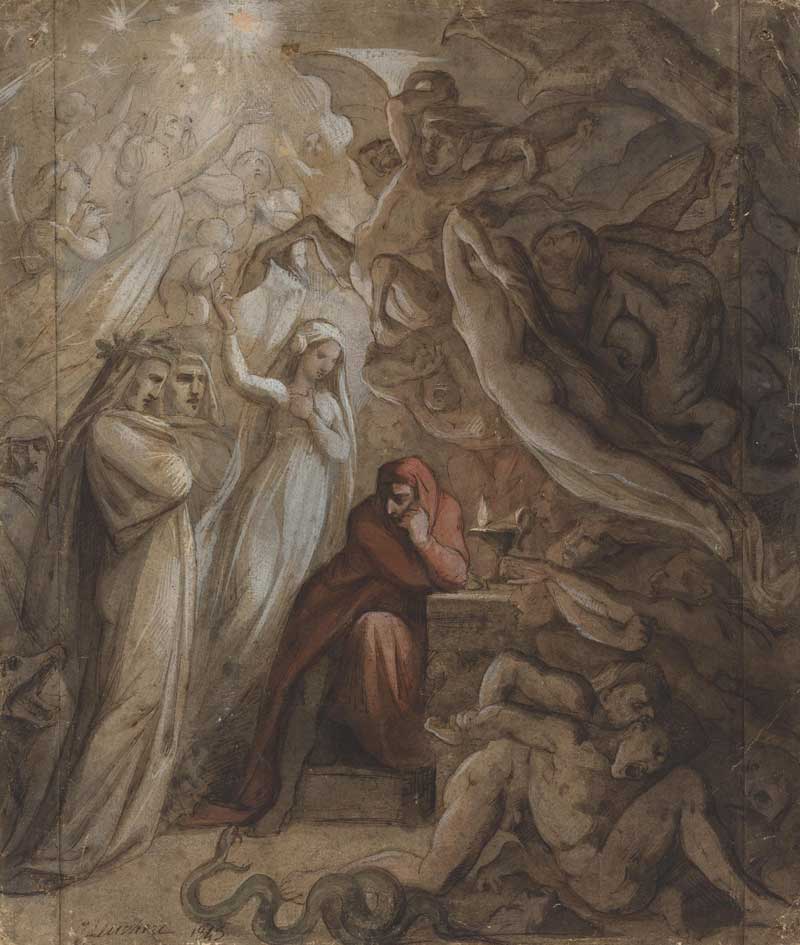
The Commedia is the pilgrimage of a lost soul named Dante through Hell, Purgatory, and Heaven, from the dark wood to the throne of God. In the first book of the trilogy, Inferno, the pilgrim Dante tracks through Hell, learning about the nature of sin. In the second, Purgatorio, the pilgrim discovers what it means to refuse sin, and to die to one's sinful self. And the third book, Paradiso, is a meditation on theosis, or what it means to be fully united to God.
For Dante, the pilgrimage is a journey of repentance and restoration. He learns that the cause of sin is disordered love: either you love the wrong things, or the right things in the wrong ways. The poem is a fictional representation of what the poet Dante learned about himself in his own painful exile from Florence. For me, accompanying Dante and Virgil on this arduous trek meant a sojourn through the dark and unexplored corners of my own heart. There I found dragons.
Disordered Love for Family & Place
Each reader will find figures and dramas within the vastness of the Commedia that resonate personally. For me, the first came in Inferno's Canto X, when Dante and Virgil enter the circle of the Heretics. Flames burst from open tombs where dwell those who believe that the body does not contain a soul. Out of one tomb rises a Florentine warlord, Farinata degli Uberti, who recognizes the pilgrim's Tuscan accent.
Dante and the older man, who is of Dante's father's generation (or perhaps grandfather's), were on opposite sides of the bitter political divide that tore Tuscany in two. They trash-talk each other about Tuscan political life. Farinata was extremely proud of his family and of all he had accomplished in the world—so much so that he gave no thought to the afterlife. As I read this, I thought, Dante, walk on—he's dead, and you won't win this argument. You have the freedom to keep moving.
Then it hit me: this is a portrait of my father and me, and our long-running battle. My dad was a professing Christian, but lived as though this world—actually, his world, of West Feliciana Parish—was all there was. He spited me for imagining that there could be a life beyond it. His disordered love for family and place had caused him and my sister (who was just like him) to train the next generation to reject me for not loving it like they did. This was my father's tragedy: to love family and place so much that he made it impossible for the family to continue in that place.
But I didn't have to be caught in that tragedy. I had the power to walk on.
The Wrong Father Enthroned
The next big turning point for me came in Canto XIII, when Dante and Virgil enter the dismal wood of the Suicides. There they speak with a man who, like the other suicides, has been condemned to spend eternity as a tree (the idea is that they must suffer eternally without the body they despised). This man, Pier della Vigna, had been a key adviser to the Holy Roman Emperor, but had fallen out of favor and been imprisoned on theft charges. Pier could not bear to live without the emperor's approval, and had killed himself in prison.
This tormented tree was I. I, too, felt that life was unbearable within the disapproving gaze of my father, and through my chronic illness was slowly killing myself.
I realized that I had thought of myself as the Prodigal Son, though I had only been prodigal in the mind of my father (for having left home in the first place). Now that I was back, I expected my father to welcome me. But neither he nor anybody else there had done so. The legacy of my dutiful younger sister and the pridefulness of my father created a barrier that could not be crossed, no matter how hard I tried. The Catholic priest Henri Nouwen, in his beautiful little book The Return of the Prodigal Son, writes, "I am the prodigal son every time I search for unconditional love where it cannot be found."
Then it became clear to me: I was looking in the wrong place for the kind of love that only God the Father can give me. I had never really believed God loved me—or rather, I knew that he loved me, but I also knew that he disapproved of me. But now, through Dante, the Holy Spirit revealed to me that I had projected my disordered relationship with my earthly father onto God the Father.
Moreover, I had enthroned family and place—and their personification, my father—in my heart in the place of God. This was the greatest sin that led me to the dark wood in the middle of the journey of my life. It was my sin, and I had to own it and repent of it. This sinful disposition, the refusal to believe that God the Father loved and affirmed me, formed an impassable barrier around my heart, one I had spent a lifetime reinforcing.
My priest, Father Matthew Harrington, was by then used to me coming to confession and starting out by recounting a passage from Dante, and the sin that reading it had uncovered for me. But this time, I began my confession with a bizarre claim: "I have been an idol-worshiper."
"You remember me telling you a while back that I have a lot of trouble believing that God loves me? That I felt like I could never make him happy enough to deserve his love? This is where it comes from. I didn't understand it until Dante made me think about it, but without meaning to, I made gods of family and place. I made them into my idols. I set them up in my heart where God ought to be."
Father Matthew looked at me, his brow creased.
"There's more," I said, then told him the story of Pier della Vigna. "Don't worry," I hastened to add; "I'm not a potential suicide. It's that there's a part of me that can't deal with life without my father's approval. Isn't that stupid?" I asked.
"It's not stupid."
"Well, I feel stupid. I'm 46 years old, and I am stuck in this damn ditch, where I have been since childhood. I couldn't take it when I was younger, and ran away. I'm tired of running. I've got to face down this dragon and kill it. I don't know what to do now, but I want to confess that I have worshiped idols, and I am sorry. I put other things before God. I want to lay those idols at the foot of the Cross and be done with them."
Father Matthew said nothing. He bowed his head again and reached down to lift his stole, which was my signal to kneel. He put his stole over my head, pronounced the words of absolution, made the Sign of the Cross over my head, then unveiled me. I kissed his right hand, stood up, and walked out of the church feeling light.
Relationship Restored
That proved to be a turning point. God's grace began to pour out on me, and I began to heal inside. There would be much more to learn from climbing the mountain in Purgatorio—especially about setting aside anger—and from gliding through Paradiso. I routinely confessed to Father Matthew my anger at my father over his refusal to love me like I wanted him to. My priest admonished me that I am bound to keep trying to love my dad even though he doesn't give me the love for which I long. After all, said Father Matthew, this is what our Lord did for us, despite our refusal to love him in the same way.
Keep loving him, Father would say regularly. This is God's will. Later, in Paradiso, the pilgrim Dante tells the nun Piccarda that he doesn't understand why God has not rewarded her as Dante believes she deserves. Piccarda waves this away, telling the puzzled pilgrim, "In His will is our peace." I kept those words at the front of my mind as I kept faith with my dad, whose health was rapidly declining.
In the spring of 2015, with death approaching, my father looked at me with tears in his eyes one morning, and said he was sorry for the way he had treated me. I did not see that coming. Of course I forgave him. I reflected later that had I known all the pain and suffering waiting for me in Louisiana, confronted by the fact of my forever exile from family, I never would have returned home. I never would have discovered Dante, and never would have gone through the agonizing pilgrimage that freed me from bondage to disordered love and restored my relationship to God the Father.
In late summer, my father entered home hospice care. I moved in to live with him in his bedroom. I read to him, prayed over him, rubbed lotion into his feet, and gave him the regular doses of morphine the doctor prescribed to ease his passage. For eight precious days, we dwelt in peace, father and son. And then, on the day he died, surrounded by family and friends, I held his hand as he breathed his last. It was golden.
Gratitude & Peace
Late that night, back in my own home for the first time in over a week, I marveled at how right everything felt. All my adult life I had dreaded this day. I had even told my wife when we married that when it came, I would shatter into a thousand pieces, and she would have to be prepared to pick me up. But the day came, and it was . . . beautiful. Holy, even. How on earth was I at such peace?
Then it hit me: In His will is our peace. I had stayed faithful to my father against my own will, only out of obedience to Christ. And because of that, he had set everything right. I burst into tears, for the first and only time surrounding Daddy's death. They weren't tears of sorrow. They were tears of gratitude for what the Lord had done for me through Dante.
Six weeks later, I was flat on my face in Ravenna, giving thanks once again for this divine gift from a loving Father. I have become somewhat evangelical about Dante since then, encouraging everyone to read the Commedia prayerfully, searching for themselves in its cantos. The only real exile in life is from God, as the pilgrim Dante discovers in his repentance. At Dante's tomb, I read aloud, as a kind of prayer, a passage from Paradiso, Canto XXVI, which describes God as
. . . that Essence where such goodness rests
that any goodness found outside of It
is only a reflection of its ray.
Thus was my life and thus were my loves rightly ordered by God, through the poetry of this great-souled Tuscan, who reached out to me across a wide ocean and a gulf of seven centuries, to call me to my true home and my true Father. The Love that moves the Sun and the other stars also moved my hand to reach up to the high Barnes & Noble bookshelf that summer day, and for that I owe everything.
Rod Dreher is a contributing editor to Touchstone. He is a writer and blogger and the author of several books, including The Benedict Option (2017) and Live Not by Lies: A Manual for Christian Dissidents (2020).
A Journal of Mere Christianity—Delivered to Your Door
- Essays on theology, culture, and the Church
- Contributors from across the Christian traditions

Six print issues (one year) of Touchstone, plus full online access and PDF downloads for only $39.95.

Get a one-year full-access subscription to the Touchstone online archives for only $19.95.
bulk subscriptions
Order Touchstone subscriptions in bulk and save $10 per sub! Each subscription includes 6 issues of Touchstone plus full online access to touchstonemag.com—including archives, videos, and pdf downloads of recent issues for only $29.95 each! Great for churches or study groups.
Transactions will be processed on a secure server.
more on literature from the online archives
24.1—January/February 2011
Ruminations on the Monstrous Envy of the Soul-Devouring State by Anthony Esolen
30.2—March/April 2017
on Reading Don Quixote in Its Original Christian Context by Luis Cortest
more from the online archives

19.6—July/August 2006
The Three-Fold Cord of Imagination, Reason & Will in C. S. Lewis by Michael Ward
31.2—March/April 2018
How Best to Face the Total War of the Anti-Culture by R. J. Snell
29.5—Sept/Oct 2016
on the Loss of True Community & Rising Political Desperation by Karl D. Stephan
calling all readers
Please Donate
"There are magazines worth reading but few worth saving . . . Touchstone is just such a magazine."
—Alice von Hildebrand
"Here we do not concede one square millimeter of territory to falsehood, folly, contemporary sentimentality, or fashion. We speak the truth, and let God be our judge. . . . Touchstone is the one committedly Christian conservative journal."
—Anthony Esolen, Touchstone senior editor
