




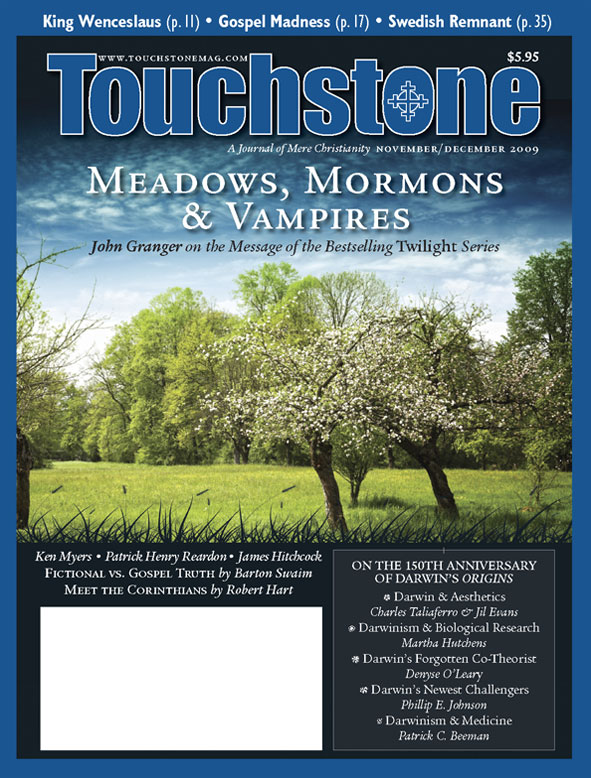
A Better Selection
Alfred Russel Wallace’s Theory Of Intelligent Evolution
by Michael Flannery
Erasmus Press, 2009
(240 pages, $27.95, paperback)
reviewed by Denyse O’Leary
Having followed the intelligent design controversy for a decade, I have noticed a recent key change. This year, being the 150th anniversary of the publication of On the Origin of Species, should have continued Charles Darwin’s century and a half of triumph. Yet his followers’ accolades are greeted with increasing incredulity, among both serious scientists and the general public. For example, serious scientists and thinkers convened last year at Altenberg, Austria, to consider alternatives to Darwin’s theory of evolution, and a recent Zogby poll showed that most people still don’t believe it, after countless years and dollars spent to convince them.
Darwin argued that natural selection acting on random mutations produces the intricate machinery of life. As theoretical physicist Leonard Susskind said recently, his masterstroke was to have “ejected God from the science of life.” If that, rather than following the evidence, is the goal, demonstrating the explanatory value of Darwin’s theory is superfluous. The slender evidence base that Michael Behe outlines in Edge of Evolution is irrelevant, because the theory must be true.
A Calculated Imposture
Michael Flannery’s Alfred Russel Wallace’s Theory of Intelligent Evolution (Erasmus, 2009) focuses on Wallace, Darwin’s co-theorist, whom he sees as a pioneer of design theory. Flannery, a University of Alabama medical historian, has no time for the usual Darwin hagiography. Assessing Darwin candidly in relation to Wallace, he calls the official history a “calculated imposture”:
Historians have slowly begun to catch on as more and more primary materials have surfaced. Admitting that Darwin often played dumb and was hardly the figure that Victorians made of him, [sympathetic biographer Janet] Browne correctly observes that his autobiography led the way in throwing up a smokescreen “almost as effective as if no records had been left behind at all.”
For example, late in life, Darwin informed visiting atheists, “I never gave up Christianity until I was forty years of age.” This was false, and he knew it. He had been drawn to materialist atheism in university, as a member of the Plinian Society freethinkers’ circle. At 29, he was making materialist statements in his notebooks, like “Why is thought, being a secretion of the brain, more wonderful than gravity, a property of matter? It is our arrogance, it is our admiration of ourselves. . . .”
So, Flannery explains, by 1838, Darwin was a thoroughgoing materialist: “That was four years before his rough 30-page sketch on transmutation and six years before the first 230-page draft of his general theory—he had even sketched its main application to man 33 years before [publication of] his Descent [ of Man].” Thus, far from embracing materialism on account of the implications of his theory, Darwin developed a theory to support the materialism he already believed in. Darwin encouraged the legend that he lost his faith when he beheld animal suffering.
A Contrasting View of Man
But now, what of Wallace? He was perhaps the nineteenth century’s greatest naturalist (he had twice Darwin’s field experience), yet he was as neglected and ridiculed as Darwin was lionized. There were two problems, Flannery writes. The first was that Wallace tended to defer to Darwin, and avoided taking credit for his original contributions. And the second was that Darwin’s bulldog, Thomas Huxley, and his X Club managed an exceedingly successful public relations campaign against him.
Well, there was a third problem too: Wallace accepted an “overruling intelligence” that fine-tuned the universe, and he argued for intelligent evolution (IE). That was enough to get him marginalized anyway—though he was hardly a conventional believer.
Wallace came to see a deep and abiding design in the features of nature, which he discussed in his The World of Life, which Flannery reprints with an Introduction and Notes. His subject emerges as a sympathetic figure. For example,
When he observed and lived among natives, whether along the banks of the Amazon or on the islands of Malaysia, he saw human beings with the same innate capacities as himself. In contrast Darwin was horrified by the natives of Tierra del Fuego and thought them closer to animals than men. Wallace had a more intimate and therefore deeper appreciation of indigenous cultures. Among the Dyak headhunters of Borneo Wallace noted that, aside from ritualistic violence, tribal crime was almost unheard of. . . . In the end, the very different reactions between Darwin and Wallace to the “uncivilized” translated into two radically different views of humanity. Darwin saw man a little above the beasts; Wallace saw man a little below the angels.
What if Wallace, not Darwin, had become the icon of evolution? Some probable outcomes: Eugenics would not have blossomed so large if no one assumed that some people are “less evolved” than others; the fine-tuning of the universe would not need explaining away; and the human mind would not need explaining away. Would we not, perhaps, even better appreciate the intricate ecologies of our planet if we saw them as part of the design of life? It is to dream. •
Denyse O'Leary is a columnist for Salvo magazine, and co-author, with Mario Beauregard, of The Spiritual Brain (HarperOne).
A Journal of Mere Christianity—Delivered to Your Door
- Essays on theology, culture, and the Church
- Contributors from across the Christian traditions

Six print issues (one year) of Touchstone, plus full online access and PDF downloads for only $39.95.

Get a one-year full-access subscription to the Touchstone online archives for only $19.95.
bulk subscriptions
Order Touchstone subscriptions in bulk and save $10 per sub! Each subscription includes 6 issues of Touchstone plus full online access to touchstonemag.com—including archives, videos, and pdf downloads of recent issues for only $29.95 each! Great for churches or study groups.
Transactions will be processed on a secure server.
more on evolution from the online archives

22.8—November/December 2009
Looking for Beauty & Justice 150 Years After Darwin’s Classic by Charles Taliaferro
23.6—November/December 2010
Darwin, Design & Thomas Aquinas
The Mythical Conflict Between Thomism & Intelligent Design by Logan Paul Gage

22.6—July/August 2009
on a Noble Defense Doomed by Darwinian Materialism by John G. West
more from the online archives

24.4—July/August 2011
The Cultural Marxists’ Strategic Assault on Religion, Life & Family by Patrick F. Fagan

calling all readers
Please Donate
"There are magazines worth reading but few worth saving . . . Touchstone is just such a magazine."
—Alice von Hildebrand
"Here we do not concede one square millimeter of territory to falsehood, folly, contemporary sentimentality, or fashion. We speak the truth, and let God be our judge. . . . Touchstone is the one committedly Christian conservative journal."
—Anthony Esolen, Touchstone senior editor
