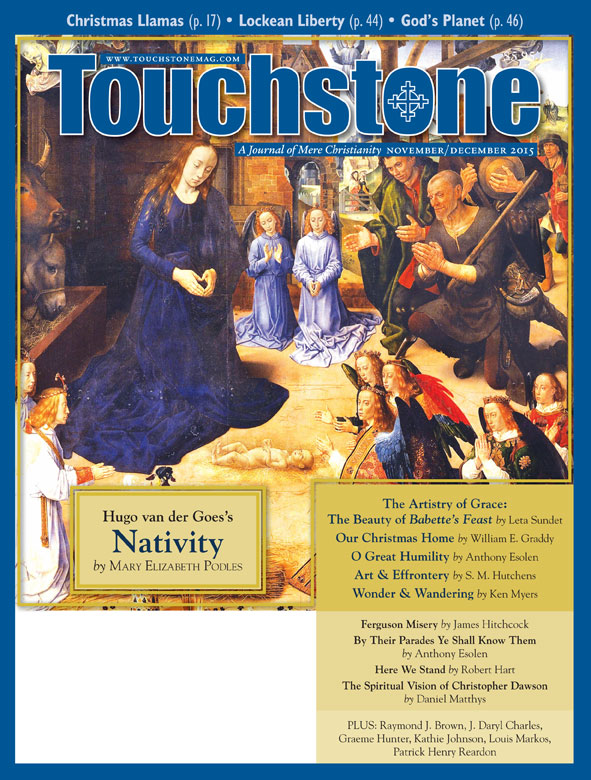
Wonder & Wandering by Ken Myers

From Heavenly Harmony

Wonder & Wandering

by Ken Myers

For centuries, the singing of the Psalms has been at the heart of the Church's worship. The poetic form of the Psalter, with verses typically in two-line parallelisms, lends itself to antiphonal chanting. Typically, two groups of singers alternate lines of each verse, chanting back and forth in what we sometimes call "responsive" singing. The Gregorian chant repertoire includes a collection of eight short melodic patterns called "psalm tones," each with two phrases, to which any psalm could be chanted. Each of the two phrases in each tone includes some introductory notes (the "intonation"), a single reciting note on which a variable number of syllables may be chanted, and a final pattern of notes called a "cadence."

In Latin, the reciting note—the heart of each phrase—is called the tenor, a word meaning an uninterrupted course or a holding on, from a root meaning "to hold" (hence tenacious, maintain, sustain, and so on). The tenor in the first phrase of each standard psalm tone is always on the same pitch as the tenor in the second phrase. The many-syllabled chanting of one choral force is thus on the same pitch as the similarly extended course of notes sung by the other group. This provides a pleasing continuity and a sense of solid musical symmetry.

Tonus Peregrinus & Psalm 114

There is a ninth and rarely used psalm tone in which the tenor in the second phrase is a whole-step lower than the tenor of the first phrase. When the first phrase is repeated in the next verse of the Psalm, the tenor regains its higher position. The undulating motion produced as the chanting of the psalm proceeds gave rise to a name for this psalm tone: the tonus peregrinus, the "wandering tone."

This acoustic motion, coupled with the general downward shape of the melody, gives this chant a sense of restlessness and of longing like that associated with wandering. Very early in the Church's history, the tonus peregrinus was often used when chanting Psalm 114 (Vulgate 113), an eight-verse account of the commencement of Israel's wandering in the wilderness: "When Israel came out of Egypt, and the house of Jacob from among the strange people. . . . The sea saw that, and fled; Jordan was driven back. . . . Tremble, thou earth, at the presence of the Lord: at the presence of the God of Jacob."

The Church's singers were not the first to connect this haunting, sighing melody with the spirit of this psalm. The fittingness of this melody's shape for the text summarizing the Exodus was recognized in the Jewish tradition as well. There survives an ancient Lithuanian Jewish chant of this same psalm, sung during Passover (in Hebrew, of course) with an almost identical melodic pattern of a wandering recitation tone. In the 1950s, Eric Werner, professor of liturgical music at Hebrew Union College, echoed the opinion of a number of other musicologists that the tonus peregrinus is "a direct remnant of ancient Jewish tradition." Conductor and musicologist Joel Cohen has gone so far as to suggest that "we can thus date this recitation formula from (at the latest) the period just preceding the exile of a.d. 70. In all likelihood, this is music the historic Jesus knew."

While Sephardic Jews chanted this Psalm during Passover, Christians chanted it (early on, to the same melody) during Easter. The Resurrection is the New Exodus, the deliverance from slavery that commences the pilgrimage of the Church. As early as the sixth century, Psalm 114 was also sung at funerals and while ministering to the dying. But, thanks to Martin Luther and his German colleagues and successors, the tonus peregrinus had an important liturgical life far beyond this psalm.

Tonus Peregrinus & the Magnificat

Early Lutheran liturgies retained many elements of pre-Reformation worship, including the singing of the Magnificat every Sunday evening at vespers. Known as Der Lobgesang ("The Song of Praise"), Der Lobgesang der Maria ("Mary's Song of Praise"), or Das Magnifikat, the text was translated from Latin into German, but the metrical irregularity of the original was preserved. This meant that it was easier to sing to a chant with a reciting tone than to a chorale, and as early as 1532 tonus peregrinus became the chant of choice for Mary's song. Every week, Lutheran congregations would sing, "Meine Seel erhebt den Herren" ("My soul praises the Lord"), alternating verses with the choir. I don't know how many Lutherans still sing it, but the The Hymnal 1982 of the Episcopal Church follows the Lutheran tradition by presenting a chanted version of the Magnificat (S-242) based on tonus peregrinus.


Ken Myers is the host and producer of the Mars Hill Audio Journal. Formerly an arts editor with National Public Radio, he also serves as music director at All Saints Anglican Church in Ivy, Virginia. He is a contributing editor for Touchstone.

A Journal of Mere Christianity—Delivered to Your Door

  • Essays on theology, culture, and the Church
  • Contributors from across the Christian traditions
Subscribe (Print + Online)

Six print issues (one year) of Touchstone, plus full online access and PDF downloads for only $39.95.

Subscribe (Online Only)

Get a one-year full-access subscription to the Touchstone online archives for only $19.95.


bulk subscriptions

Order Touchstone subscriptions in bulk and save $10 per sub! Each subscription includes 6 issues of Touchstone plus full online access to touchstonemag.com—including archives, videos, and pdf downloads of recent issues for only $29.95 each! Great for churches or study groups.

Transactions will be processed on a secure server.


more from the online archives
31.4—July/August 2018

The Names of the Christian

Labels & the Ecumenism of Discipleship by James M. Kushiner

33.1—January/February 2020

Forbidden Lies

Speaking Truth About the Sexes Is Not Optional by Anthony Esolen

22.6—July/August 2009

Unhappy Fault

on the Integration of Anger into the Virtuous Life by Leon J. Podles

calling all readers

Please Donate

"There are magazines worth reading but few worth saving . . . Touchstone is just such a magazine."
—Alice von Hildebrand

"Here we do not concede one square millimeter of territory to falsehood, folly, contemporary sentimentality, or fashion. We speak the truth, and let God be our judge. . . . Touchstone is the one committedly Christian conservative journal."
—Anthony Esolen, Touchstone senior editor

Support Touchstone

00