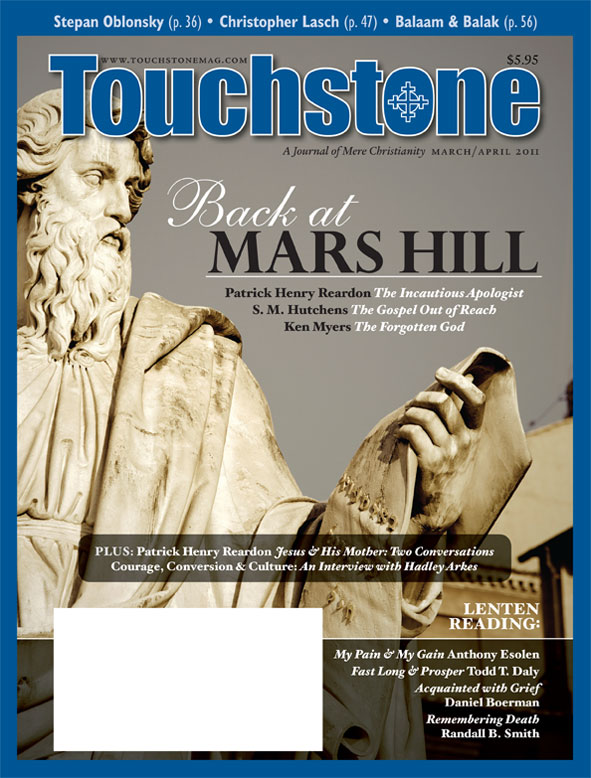
Fast Long & Prosper by Todd T. Daly

Fast Long & Prosper

Todd T. Daly on Christian Asceticism & the Misguided Quest for Longevity

Most of us won’t be as fortunate as Madame Jeanne Calment, who lived to the age of 122. Somewhat of a local celebrity in her hometown of Arles, France, Ms. Calment was still bicycling in her early hundreds, consuming roughly two pounds of chocolate a week, and smoking two cigarettes per day (a habit she finally dropped at age 120). When asked about the secret of her long life, she attributed it to port wine and olive oil.

Ms. Calment’s life is one exceptional instance of a general trend of increasing life expectancies. Indeed, life expectancies in the twentieth century almost doubled, due primarily to the effective treatment of diseases like tuberculosis and smallpox, a reduction in infant mortality, and a general improvement in sanitary conditions.

The prospect of a greatly extended—if not -indefinite—healthy life has always been an alluring idea, conjuring up images of fountain-of-youth legends, alchemic concoctions, and quests for the elusive elixir vitae.

More recently, a growing movement of philosophers, scientists, and technophiles known as “transhumanists” have devoted themselves to the pursuit of eliminating death and all prevalent forms of bodily suffering. Transhumanists believe that human life is unnecessarily held captive to disease, death, and decay, and that emerging technologies, such as genetic engineering, pharmacology, and molecular nano-computing, will enable us to evolve beyond human limitations, becoming, in a manner of speaking, like gods.

While transhumanist visions may be the byproduct of hypertrophic imaginations, it should be noted that researchers have discovered a link between fasting and aging. “Starve” an animal and it lives longer—it ages more slowly. Moreover, biologist Cynthia Kenyon has discovered a way to extend the lifespan of the nematode worm by altering a single gene. The worms she altered lived six times longer.

“I wanted to be those worms,” exclaimed Kenyon, noting that even a moderate increase in lifespan would be analogous to having the body of a 45-year-old at the age of 90. She said, “If our company could make a pill, everyone would want it.” Her goal now is to produce a pharmaceutical that allows us to enjoy the longevity benefits of fasting without altering or curtailing our food intake. Such extensions in life are also to be marked by health and vitality, assuaging fears that we might simply be lengthening old age and its afflictions. This is an enormously attractive prospect in a culture obsessed with youth and morbidly fearful of death.

Adam’s State

Perhaps it seems that Christians, presumably freed from the fear of death, have no vested interest in greatly extended healthy lives, following Paul—“to live is Christ and to die is gain” (Phil. 1:21). However, narratives of longevity are not entirely absent from the Christian faith. Indeed, the Church Father Athanasius (c. 298–373) observed that aging could be considerably attenuated through ascetic practices, through which one’s body and soul regain their proper order, which he describes as recapturing the life of Adam in the Garden of Eden.

In his work On the Incarnation Athanasius describes Adam’s original state in the Garden of Eden as one in which the body and soul were in perfect order: the soul was in submission to God, and the body in perfect submission to the soul. Though Adam’s body was always tending toward decay, his soul expressed some degree of regenerative power in renewing his aging body, so long as it remained in submission to God.

However, when Adam sinned by turning his attention away from God to the material order, his body and soul were effectively thrown into disorder and dissolution—his body began to rebel against the rule of his soul—thereby bringing on God’s pronouncement of death, and hastening the decaying process of his body. It is this condition, says Athanasius, which the Incarnate Word, Jesus Christ, came to rectify.


A Journal of Mere Christianity—Delivered to Your Door

  • Essays on theology, culture, and the Church
  • Contributors from across the Christian traditions
Subscribe (Print + Online)

Six print issues (one year) of Touchstone, plus full online access and PDF downloads for only $39.95.

Subscribe (Online Only)

Get a one-year full-access subscription to the Touchstone online archives for only $19.95.


bulk subscriptions

Order Touchstone subscriptions in bulk and save $10 per sub! Each subscription includes 6 issues of Touchstone plus full online access to touchstonemag.com—including archives, videos, and pdf downloads of recent issues for only $29.95 each! Great for churches or study groups.

Transactions will be processed on a secure server.


more on christianity from the online archives
32.4—July/August 2019

A Case of Win-Win

on Probability, Death & the Existence of God by Graeme Hunter

22.6—July/August 2009

Unhappy Fault

on the Integration of Anger into the Virtuous Life by Leon J. Podles

25.3—May/Jun 2012

Just Sayin'

on What We Used to Know vs. What We Know Now by Thomas Howard


more from the online archives

32.6—November/December 2019

Strategic Christians

The Year of Our Lord 1943: Christian Humanism in an Age of Crisis by Alan Jacobs by Jesse Russell

28.2—March/April 2015

Facing God

on Divine Worship & the Natural Limits of Community by David Mills

28.2—March/April 2015

The Icon of Materialism

Why Scientism's Cherished Progress Narrative Fails by Jonathan Witt

calling all readers

Please Donate

"There are magazines worth reading but few worth saving . . . Touchstone is just such a magazine."
—Alice von Hildebrand

"Here we do not concede one square millimeter of territory to falsehood, folly, contemporary sentimentality, or fashion. We speak the truth, and let God be our judge. . . . Touchstone is the one committedly Christian conservative journal."
—Anthony Esolen, Touchstone senior editor

Support Touchstone

00